More Korean universities provide halal food

Muslim students show off halal foods at Sejong University's cafeteria in Gwangjin-gu, eastern Seoul, Wednesday. / Courtesy of Sejong University
By Kim Jae-heun
For years, halal food has been a realm of indifference and ignorance for Koreans. If they know a little more, they may recognize it as food for Muslims and maybe dishes without pork or pork products.
However, in recent years, several local universities have begun to introduce halal food in their cafeterias, as more Muslim students are coming here to study. This is a result of the schools' efforts to counter the decreasing numbers of domestic students, and the increasing popularity of K-dramas and K-pop in Southeast Asia and the Middle East.
Sejong University introduced a halal menu in 2014 and the school is at the forefront of promoting the food.
“Sejong University, along with Sun Moon University, has the most Muslim students in the country. Nearly 500 Muslim students attend our school and they account for 26.6 percent of the overall foreign student population,” a university official said.
In 2017, the school went further from just selling food in the cafeteria to opening a halal market on campus, organized by Muslim students.
They offered various fruit, vegetables, fish, chicken and beef products, which all have been certified as halal ingredients.
“We wanted to introduce halal foods to Korean friends. We aim to hold this market regularly every year and promote our traditional dishes,” said Uzbek student Jumaboev Temurbek, who planned the event.
The school also operates halal certification centers to make sure Muslim students eat foods and ingredients permitted by Islamic law. The centers offer certification for outside restaurants and ingredient providers.
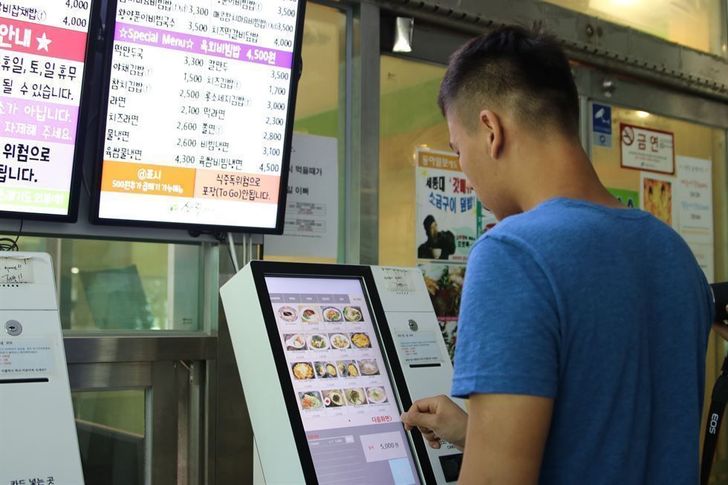
Muslim students purchase halal food through an electronic kiosk at Sejong University in Seoul, Wednesday. / Courtesy of Sejong University
“It is quite hard to tell what is halal and what is not. Taking out the pork, you can't really tell the difference between halal food and non-halal food because it is the procedures that distinguish them,” said Lee Hee-yul, a professor at the Department of Food Services and Franchise Management in Sejong Cyber University.
“First, chicken and beef can only become halal when a butcher kills them while praying to God. Second, halal foods cannot be cooked together or with same cooking utensils used for non-halal foods. These are all hard to verify if you did not witness the whole process of food-preparation.”
Hanyang University was the first school to introduce halal food in the country in 2013. Other schools such as Sun Moon University, Ewha Womans University and Kyung Hee University followed to offer halal options in their cafeterias or provide venues for students to cook halal foods.
Last year, Seoul National University began to provide halal food. On the first day of the service, the school cafeteria prepared halal food for 150 people but was sold out in 30 minutes.
The school expected a majority of the customers would be Muslim students, but nearly half of the students waiting in line were Koreans. Most of them were satisfied with the quality of food and said they had a great experience.
Ewha Womans University does not sell halal food but provides a kitchen for Muslim students to prepare their own meals.
Still, Lee says the number of schools selling halal food in the country is way too low and more universities should engage in introducing traditional halal dishes.
“We have students from Malaysia, Indonesia and India all coming to study in Korea. They account for a large percentage in the international student group here. For them, eating halal food is not a choice, but a life duty they have to follow every day. More universities have to guarantee Muslim students' fundamental dietary rights life if they want to host more foreign students,” Lee said.