Businesses speed up automation amid minmum wage hike
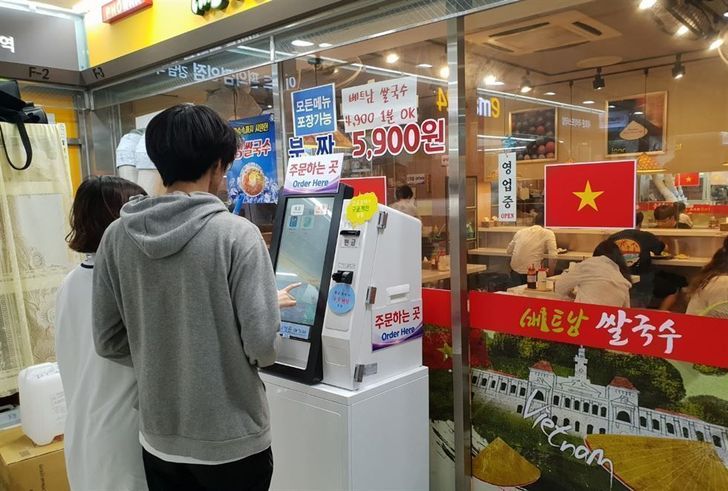
Customers place their order at an electronic kiosk in front of a Vietnamese pho restaurant inside Gangnam Station, Seoul, Thursday. / Korea Times photo by Lee Suh-yoon
By Lee Suh-yoon
More SME owners in the food and drinks service industry are implementing automated cashier systems to save costs amid a recent minimum wage hike.
The government pushed up the hourly minimum wage to 7,530 won ($6.63) from 6,470 won starting on Jan. 1 this year. Next year, the minimum wage will climb again to 8,350 won per hour.
“We run a self-service system,” reads a sign hanging in a small Vietnamese pho restaurant at Gangnam Station, aptly summarizing an accelerating trend among small restaurant businesses here.
Here, customers place and pay for their order at electronic kiosks before they enter. The process is simple and finished in a few taps and swipes. Both cash and card are accepted.
Once inside, customers set up the water, cutlery and side dishes on their own and wait for their order number to flash on the screen at the pick-up counter.
This automated cashier and serving process allows such small restaurants to hire fewer workers amid the recent minimum wage hike.
A few steps from the pho restaurant, two coffee shops also take their orders through electronic kiosks. The machines look more modern than the last one, and accept mobile payments.
Electronic kiosks like these are becoming increasingly common at small businesses and individual-run franchises that usually employ minimum wage part time workers.
Small businesses in Korea struggle to make a profit due to structural problems like high rent, high franchise commission fees and excessive competition.
This slim profit margin makes it difficult for small businesses to bear the rise in labor costs. For them, the switch to automation is more of a survival tactic than a choice.
As a result, electronic kiosk manufacturers have seen brisk sales in recent months.

An electronic self-order kiosk at a takeaway coffee shop inside Gangnam Station, Seoul. / Korea Times photo by Lee Suh-yoon
“We've been getting more orders from all across the country recently,” a worker at Airpos, a firm that manufactures self-order machines, told The Korea Times on Friday. “Some of this new demand came from special cafes that require customers to pay by the hour ― like Kids cafes.”
The installment fee for a self-order kiosk is around 4 million won ($3,522) ― a sum that can be covered by two to three months of saved labor costs of one order-taking staff.
Some of the most aggressive adaptors of automated cashiers are multinational fast-food chains, for one, are expanding the use of self-order kiosks to cut down on labor costs.
Lotteria, a Tokyo-based fast-food chain, has implemented self-order machines in over half of the 1,350 stores it operates in the country.
McDonald's, too, now has self-order kiosks in 200 out of 430 stores and plans to implement them in 50 more stores by the end of the year.
Raising the minimum wage was the key component of President Moon Jae-in's income-led growth policy.
President Moon's original goal was to raise the hourly minimum wage to 10,000 won ($8.81) by 2020. However, he recently pushed the deadline back after facing staunch opposition from firms and SME owners.