Local gov'ts rush to build footbridges for tourism
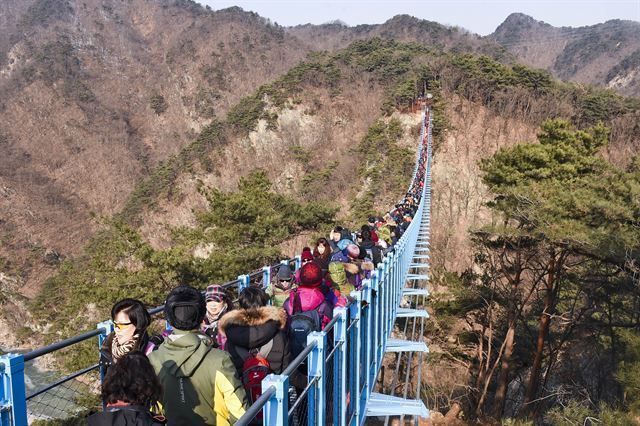
Visitors crowd the footbridge at the Ganhyeon Tourist Site. / Yonhap
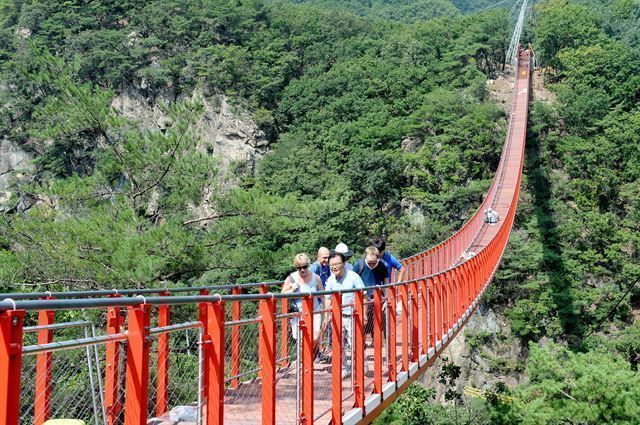
The footbridge on Mt. Gamak in Paju / Courtesy of Paju City Government
By Jung Min-ho
As competition to attract tourists intensifies in Korea, local governments are rushing to build footbridges, which have proved to be a highly cost-effective tourist attraction in some areas.
The Wonju City Government in Gangwon Province plans to build a glass-bottom bridge at the Ganhyeon Tourist Site, which has recently emerged as a popular tourist destination.
About 100,000 people visited the site in 2017, but the number is expected to reach 3 million this year. City officials attribute the success to a new footbridge, which has attracted more than 600,000 tourists since it opened on Jan. 11.
Few officials expected the first bridge project, which cost about 3.8 billion won ($3.6 million), would be so popular.
Buoyed by this success, the city government plans to pour 12 billion won ― a big investment for a small local government ― into building a second bridge and other facilities to develop the site as a major regional tourism hub.
Wonju is not the only city enjoying the “footbridge effect.”
According to the Paju City Government, a footbridge on Mt. Gamak draws more than 2,000 visitors daily. Before the bridge opened in September 2016, only about 100 people visited the mountain each day.
The city government is building two more footbridges; and neighboring Pocheon is also building one.
There are about 50 footbridges nationwide, and more are expected to be built in coming years. Many local governments increasingly regard building a footbridge as a cost-effective way to bring in more tourists while causing minimal environmental damage compared with other construction projects.
But some people are concerned about safety because footbridges are not subject to the same laws as other public structures, which require regular government inspections.
Some residents are also worried that their cities and towns might lose their appeal to tourists because footbridges offer the “same kind of fun” wherever they are.