PHOTOS Seoul health fears as extreme dust blankets city
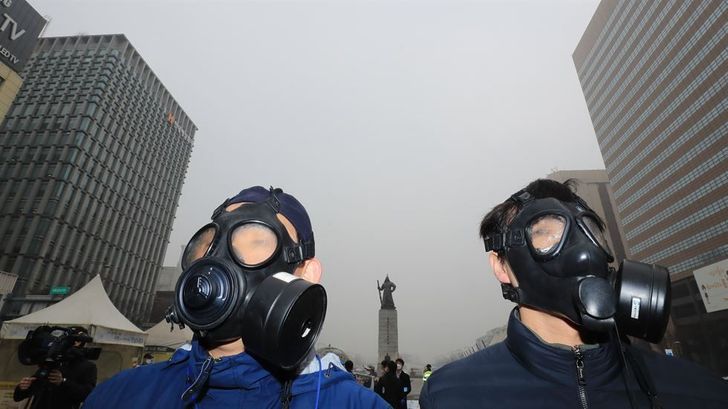
Wearing gas masks, participants in a campaign to reduce fine particulate matter make their point at Gwanghwamun Square in Jongno-gu, Monday. / Yonhap
By Ko Dong-hwan
Seoul residents are fearful about their health, particularly respiratory problems following the city's record-breaking spell of poor air quality.
Visibility across the South Korean capital and the nation's central regions has been poor for several days due to dangerously high particulate matter concentration levels and fog from the West Sea.
On Monday morning many people wore air-filter masks or covered their mouths and noses with clothing.
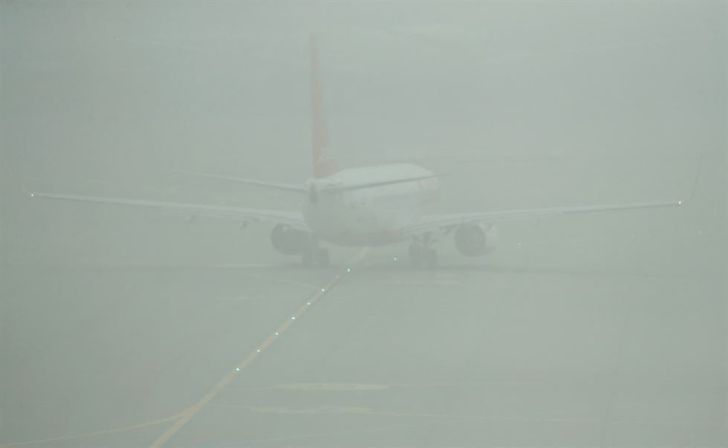
Poor visibility delayed flights at Incheon International Airport. / Yonhap
Some residents have suffered from stinging eyes, sore throats, rashes and coughs. Rush hour crowds and crowded buses and trains aggravated the situation.
One of the common sights when air quality is bad is crowded coffee shops or other indoor spaces. Because residents cannot stroll outside, many people crowd these indoor venues.
On Sunday, the average concentration of particulate matter with a diameter of 2.5 micrometers or less (PM2.5) in Seoul was the worst since South Korean weather watchdogs started monitoring the air pollutants in 2015 ― 99 micrograms per cubic meters.
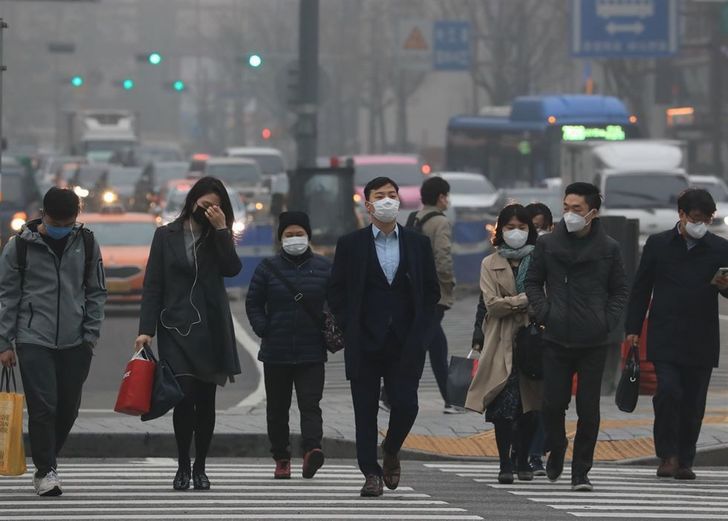
People wearing air-filter masks head to work at Gwanghwamun Square in Jongno-gu, Seoul, Monday. / Yonhap
Gyeonggi Province also had a record level of 102. The figures for Seoul and Gyeonggi Province were worse than 95 on Dec. 30 last year and 100 on Jan. 16, respectively.
The “bad” air quality ― within 51-100 micrograms per cubic meter ― continued the following day. As of Monday at 9 a.m., PM2.5 levels recorded 88 in Seoul, 53 in Busan, 68 in Gwangju, 55 in Daejeon, 66 in Gyeonggi Province, 52 in Gangwon Province, 67 in North Chungcheong Province and 56 on Jeju Island.
PM2.5 is more lethal than PM10 because its smaller size enables it to infiltrate deeper into human organs. Accumulated amounts can cause cancer.
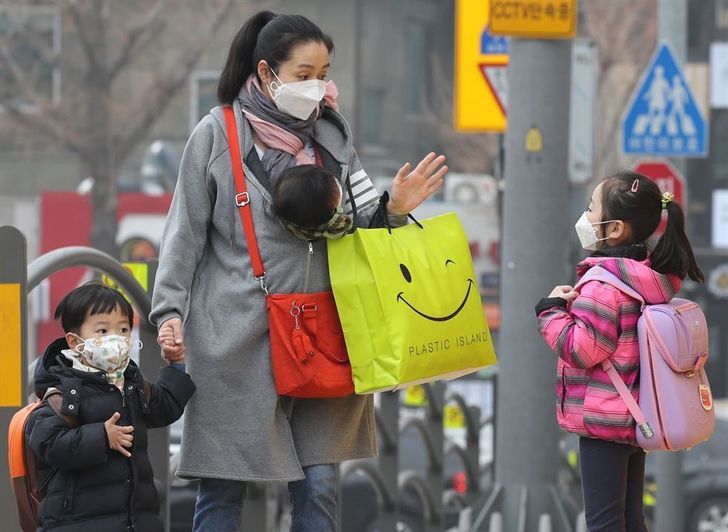
Elementary school students in Seoul were forced to brave Monday's extreme air pollution. / Yonhap
According to the Korea Environment Corporation's air quality monitoring agency Air Korea, Seoul recorded the worst PM2.5 and PM10 in the nation on Monday, with levels of 143 for PM2.5 and 171 for PM10. North Chungcheong Province, Gyeonggi Province and Gwangju all had levels over 100 for PM10 and over 90 for PM2.5.
On Monday morning, Seoul Metropolitan Government issued special anti-air pollution directives, the fourth time since December. These included shutting down more than 450 public parking lots in the city and not using 33,000 government-registered vehicles. The city also encouraged drivers of cars with license plates ending in even numbers not to drive.
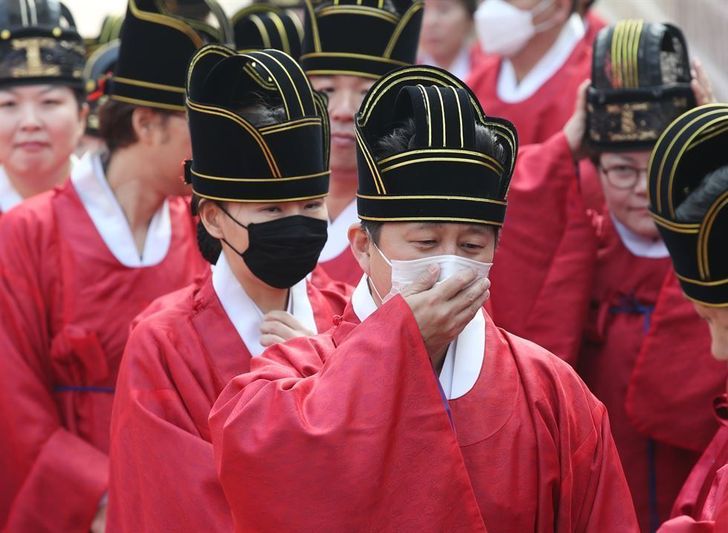
Participants in a traditional Confucius rite at Sungkyunkwan University in Jongno-gu, Seoul, Monday. / Yonhap
In January, the special directives included free public transport for two consecutive days. But critics said this was not effective enough and a waste of taxpayers' money.
Seoul's air quality began to deteriorate on Mar. 21, and was at its worst on Sunday. The bad air is now forecast to dissipate gradually.
The environment ministry said stagnant air was the main cause of the pollution, because it prevented pollutants from drifting away. Instead the situation worsened, with more particulate matter from within and outside the country.
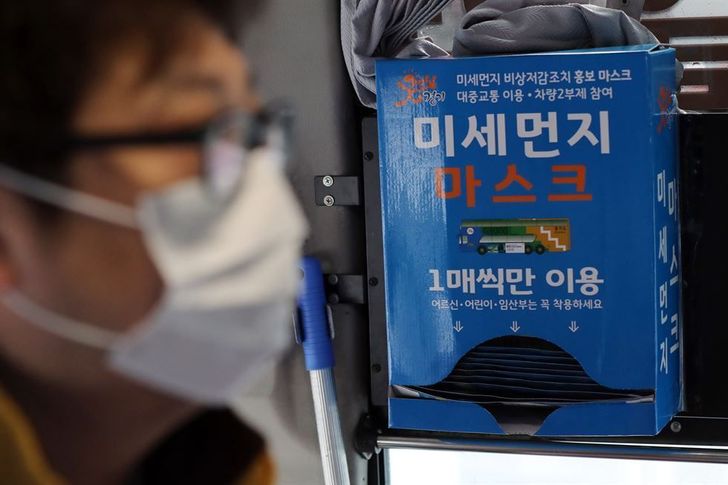
Anti-dust filter masks were available free on bus travelling between Seoul and Suwon on Monday. Gyeonggi Province, one of the areas worst-hit by air pollution, distributed 18,000 masks on 185 buses. / Yonhap
“Throughout the last weekend, particulate matter from China was carried in on the wind,” a ministry official said. “This dust, mixed with domestic pollutants, affected air quality nationwide. If the stagnancy persists, air quality will remain at a similar level for days.”
But the official said the situation in some regions would start to improve on Wednesday.