South Jeolla: top renewable energy producer relies on toxic waste

Solar panels for a photovoltaic energy plant in Goheung, South Jeolla Province. / Korea Times file
By Ko Dong-hwan
South Korea’s province producing the most renewable energy needs to develop more ways to do this because it still largely relies on environmentally toxic methods.
South Jeolla province was selected the nation’s most efficient region in producing energy without using fossil fuels, accounting for 22 percent of the nation’s entire renewable energy output in 2016. The province generated 3,034,387 tons of oil equivalent (TOE), according to Korea Energy Agency’s New and Renewable Energy Facilities on Sunday.
Among the generated renewable energy in the province, waste-turned-energy accounted for 82 percent. This process generates energy in the form of electricity or heat from the primary treatment of waste. But the method is environmentally hazardous, contributing to pollution such as aerial particulates generated during incineration.
The paradoxical result of renewable energy generation has emboldened the South Korean government’s energy policies for the coming years. In its “Implementation Plan for the 3020 Renewable Energy,” the Moon Jae-in administration recently promised to lower biomass and waste and increase photovoltaic and wind as energy sources.
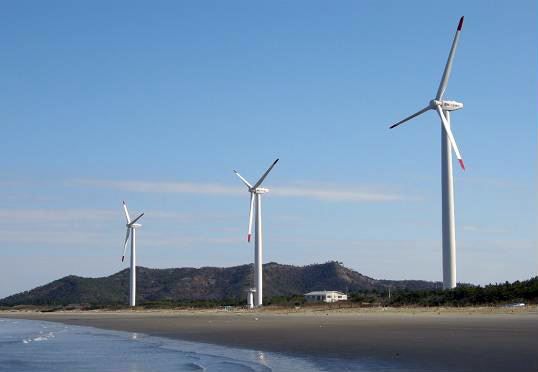
A wind-power plant with 3 megawatts capacity in Sinan, South Jeolla Province, produces 6,477 megawatts per hour, providing for about 2,200 households a year. / Korea Times file
“The International Energy Agency doesn’t recognize waste-turned-energy as renewable energy,” said an industry expert in South Korea. “The government should not focus on numbers to achieve the objectives of the 3020 Plan but instead come up with solid measures to realize more qualitative improvement in the energy industry.”
South Jeolla’s other renewable energy sources were photovoltaic (9 percent), biomass (6 percent) and wind (1.7 percent).
North Gyeongsang province produced 15 percent of national renewable energy with 2,043,000 TOE. South Chungcheong province produced 1,845,000 TOE in 2016. In both regions, waste-turned-energy was also the dominant method and uses of hazardous energy sources were conspicuously high. Forest fuel (biomass) and solid refuse fuel (waste) were among the top sources, each increasing by 4,593 percent and 1,709 percent from the previous year, respectively.
The nation’s overall renewable energy output in 2016 increased year-on-year by 6.7 percent ― 14,178,408 TOE.