Fighting for right to affordable housing
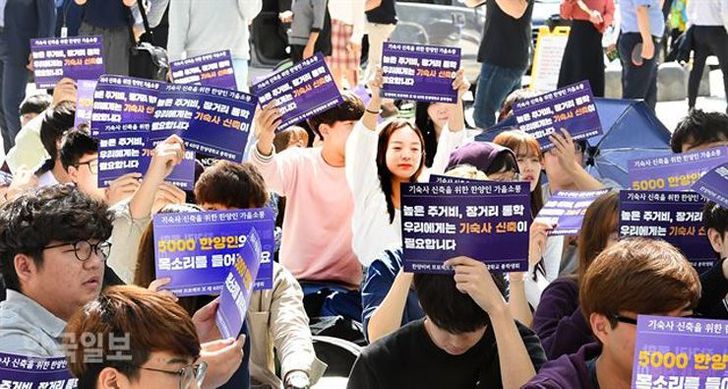
Hanyang University students gathered in front of City Hall in September to demand that the Seoul Metropolitan Government approve more dormitories. The city government approved the project, Thursday. / Korea Times photo by Shin Sang-soon
Seoul City sides with students, not landlords, on dorm construction
By Jung Min-ho
Korea’s college students have always had trouble with landlords. In a country where most of the best-performing students flock to Seoul to go to the top schools, many end up living in miserable and expensive dwellings.
The government recognized the problem long ago. But for many years, it made little progress in solving it because landlords in college towns fiercely protested any construction projects that could disrupt their businesses.
A tiny, smelly room in the Sinchon area, where many universities are situated, costs about 500,000 won ($460) a month with a deposit of 10 million won. Some landlords own multiple illegally renovated “houses,” where there are more rooms than allowed.
The situation near Hanyang University is no different. When the school revealed plans to build new facilities to accommodate 1,990 students in 2015, landlords protested, saying the plan would infringe on their property rights.
Politically pressured, the school didn’t push ahead with its plans. Frustrated, thousands of students signed a petition against the landlords, which its student union sent to the Seoul Metropolitan Government.
On Thursday, after months of debate, the city government approved the construction plan ― a decision that could affect other college students and landlords across Seoul.
Students were happy. “We welcome this reasonable decision,” a student at Hanyang University said. “We will continue to fight for improvements.”
According to Higher Education in Korea, a website that provides information about colleges, the school’s dormitories can accommodate 12.5 percent of its students (the student union claims it is 11.5 percent).
Many students, parents and professors have raised their voices to criticize landlords, calling them “selfish people” who don’t work but live off the poor.
Once Seongdong-gu Office approves the construction, the school is expected to set about the work.
But a group of landlords said they will take the issue to court. Following the decision, 70 of them gathered near City Hall in protest. They said the school is simply trying to win government subsidies using the plan as an excuse. They also claimed, once completed, dormitories will cause environmental damage and traffic jams for people living nearby.
Hanyang University is hardly alone in dealing with the issue. In 2013, Korea University also announced plans to build dormitories to accommodate 1,100 students but has not been able to start the work yet.
Seongbuk-gu Office has refused to approve it, saying the school should protect parkland in the area. But many believe it is nothing more than a flimsy excuse to keep the project on hold.
The city government also approved Chongshin University’s dormitory construction project but it too could not implement its plan because of opposition.
Many others, including Yonsei, Hongik and Ewha Womans universities, also faced the same problem when they tried to build dormitories.
Landlords are at the forefront of the opposition campaign, pressuring council members and local government officials and encouraging other people to join in by evoking fears about the possible decline in rent such projects could bring to their areas.
According to the Ministry of Education, the dormitories of 70 universities in and near the capital can accommodate only 16.1 percent of their students.