INTERVIEW KDI School seeks to become Asia's top
By You Soo-sun
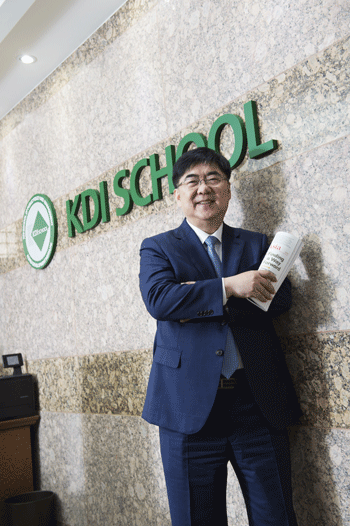
KDI School Dean Chun Hong-tack / Courtesy of KDI School of Public Policy and Management
Twenty years have passed since the KDI School of Public Policy and Management was established to meet the rapidly changing needs of the global economy.
As the world has changed, so has the school ― no longer does it aim to foster leaders in Korea alone, but also in developing countries that may gain from the Korean experience.
With 20 years already behind it, the school is now gearing up for the next 20 with three basic values in mind: innovative education, impactful research, and result-oriented knowledge sharing.
But its primary goal is to establish itself as Asia’s best public policy and management school, KDI School Dean Chun Hong-tack said in an interview with The Korea Times, Nov. 22.
“And this certainly means we can become the best in Asia, if not the world,” he said.
Hidden champion among policy schools
Although the school is relatively small in size, comprised only of graduate programs, Chun believes it has the potential to become the best in the field by focusing on and building upon its expertise.
“Through excellent faculty and a breadth of experience, I believe we can become the hidden champion of public policy schools,” Chun said.
“We may be small in size, but because of this we can be more agile in adapting to the administrative and social changes around us. This allows us to play a leading role in the field by not only quickly accepting evolving trends, but also setting new ones ourselves.”
For example, when the G20 was established with Korea as a member country, one of the moves was to strengthen knowledge sharing as a means of promoting development. Accordingly, the KDI School began enrolling students from less developed countries to better disseminate Korea’s experience, Chun said.
But by far, its greatest achievement has been receiving the Network of Schools of Public Policy, Affairs, and Administration (NASPAA) accreditation for its public policy and development policy master’s programs ― the only school to do so in the country. There are around 180 NASPAA accredited graduate schools, most notably the Harvard Kennedy School.
“Change does not come easily. But our school has an advantage when it comes to this,” Chun said. “And this also laid the groundwork for us to become an international school with a diverse student body, with almost half of our students coming from abroad.”
Development as diversity

Students dance with the school dean for the annual KDI Song & Dance Festival held at the KDI main conference room in Sejong City, July 7. / Courtesy of KDI School of Public Policy and Management
Nowhere in Korea is a school more diverse than the KDI School. This year, half of the students, or 149, are foreigners from 78 countries. Half of them are from Asia, but close to 30 percent are from Africa, 17 percent from America, and about five percent from Europe and Oceania.
It also boasts of a wide-ranging network across the world, including partnerships with 55 institutions in 24 countries.
“A good international education institution should be equipped with not only excellent faculty and curriculum, but also diversity and openness,” Chun said. “Diversity and openness are what Korean society lacks most. Comparatively, I would say we are far ahead.”
No more than five people come from the same country, except for few exceptions given to countries such as Myanmar, Chun explained.
Most of its students are from the public sector who come with the aim of furthering development in their respective countries.
By training them to become adept practitioners, many graduates have gone to fill top posts in Korea and abroad, including Ethiopia’s Minister of Construction Ambachew Mekonnen. Since he assumed office in 2016, interactions between Ethiopia and Korea have also increased.
Especially by sharing the experience of Korea moving from being a developing to a developed country, the school aims to promote sustainable development in other countries.
For example, graduates from Vietnam, Myanmar, Cambodia, Ethiopia, Honduras, Uzbekistan and Mexico have participated in its Knowledge Sharing Program, through which it provides policy consultation drawn from the Korean experience.
But meaningful interactions are not just one-sided.
“Naturally, all our students learn about the various problems that arise in different countries and how vastly different they are perceived and combated,” Chun said.
“We have also added a new course in which students share important policy cases from their countries, whether or not it succeeded. When these cases are accumulated, this could become a great resource for the study of international development.”