PHOTOS Students sit delayed college exam with ground still rumbling
.jpg?w=728)
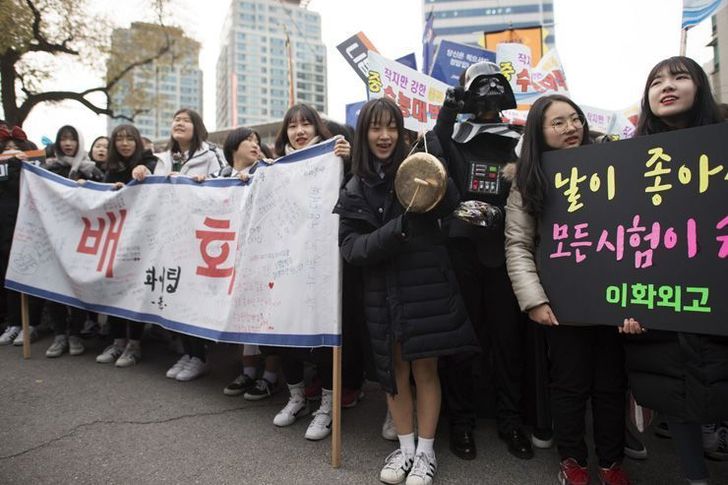
At Ewha Girls' Foreign Language High School in Jung-gu, Seoul, students with placards and posters cheer for their senior peers entering the school to write the College Scholastic Aptitude Test on Nov. 23. / Korea Times photo by Shim Hyun-chul
By Ko Dong-hwan
After the unprecedented postponement of the annual national college exam due to the earthquake that struck Pohang a week ago, students regrouped Thursday morning to face the “life-changing” moment.
Almost 600,000 test-takers, mostly third-grade high school students, took their designated seats in 1,180 sites nationwide. At 12 sites in Pohang, the gloom of the earthquake still lingered, worrying students as to whether another disaster might erupt again while they were sitting the exam.
The National Police Agency focused on minimizing turmoil in the city. They stationed two police officers at each test site to safeguard the students and keep order. The authorities were ready to dispatch more personnel to the sites if another quake occurred.
Police cars and traffic patrols were stationed on selective roads in Pohang to control traffic should the students need to move to different test sites due to a tremor. The local police control tower established an emergency hotline with the rest of the test sites across the nation and mobilized the entire serious crime force and their vehicles reserved for criminal investigation for emergency use.
.jpg?w=728)
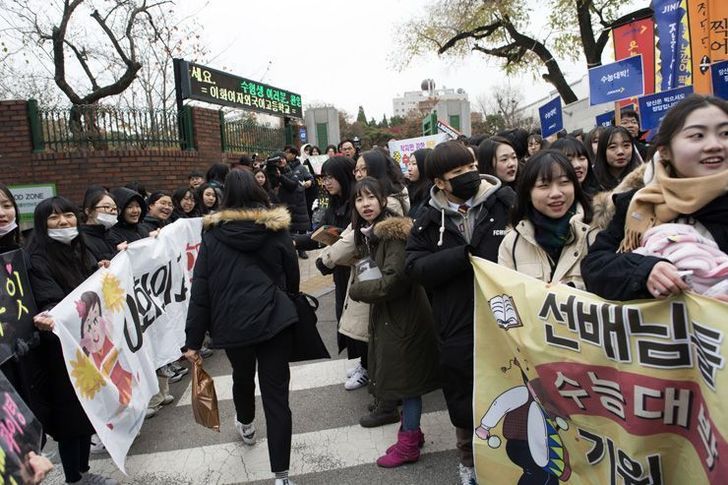
Entering Ewha Girls' Foreign Language High School to take the national exam on Thursday is like walking the red carpet surrounded by groupies. / Korea Times photo by Shim Hyun-chul
While the exam lasted until 5 p.m., the police force kept a close watch on each test site, maintaining their posts in proximity and working in shifts to leave no loophole in monitoring the scene.
On Monday, the education ministry and other government bodies jointly set up a three-stage contingency plan to ensure the test’s completion.
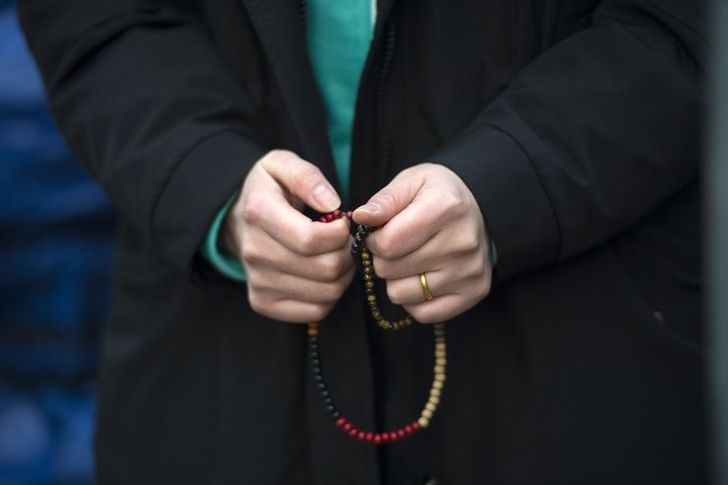
After parting with her child who is taking the exam at Ewha Girls' Foreign Language High School, a parent prays while holding a rosary. / Korea Times photo by Shim Hyun-chul
If the ground shakes during the test, the national weather watchdog Korea Meteorological Administration will instantly send out guidance on how to respond, depending on the intensity of the tremors.
If the quake is at an “endurable level,” students may continue taking the test, while a “medium level” tremor will force students to take cover under their desks and resume taking the test once the tremors are over. The time wasted for the delay will be compensated for by supervisors.
.jpg?w=728)
After passionate cheers for the test-takers, students take a group selfie in front of Ewha Girls' Foreign Language High School. / Korea Times photo by Shim Hyun-chul
If a serious emergency situation occurs, students will be ordered to evacuate.
Education Minister Kim Sang-gon said the government set up plans for the worst-case scenario which they didn’t make public because they could have caused controversy.
A magnitude-5.4 quake at the southeastern port city, accompanied by before and aftershocks, caused the College Scholastic Aptitude Test (CSAT) scheduled for Nov. 16 to be postponed. Test-takers were dumbfounded after the government announced news about the delay. Some rushed to heaps of garbage to retrieve study notes they had thrown away.
There were 62 aftershocks following the main shock that occurred Wednesday, mostly between magnitude 2 and 3.