82-year-old woman takes college entrance exam today
By Kim Rahn
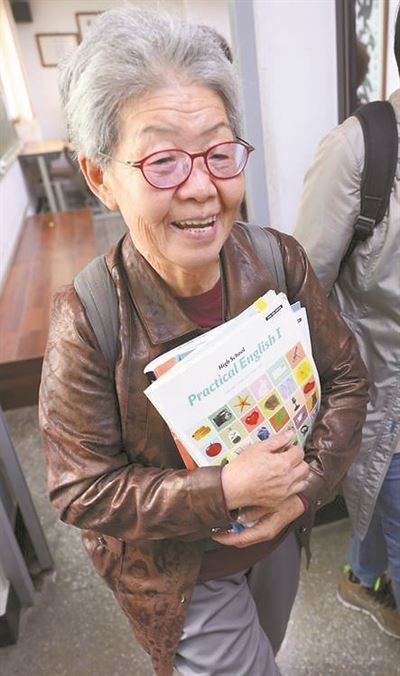
Jang Il-seong, holding her English workbooks, leaves a classroom at Ilsung School in Mapo, Seoul. / Yonhap
For years, Jang Il-seong has been preparing for the college entrance exam to be held today.
She studied hard at school, but also enjoyed chatting with friends during their breaks. She is just like any other high school senior, except that she is 82.
Jang is one of some 200 students at Ilsung School in Mapo, Seoul, an institution for elderly people who did not receive formal education due to poverty, illness, or other reasons.
She missed the chance to go to school while enduring Japanese colonial rule through her teens and following the Korean War. After marrying at 22, she could not study because she had to take care of her four children. “Even not knowing how to read and write was a big stress and shame for me,” she said.
In her 70s after marrying off her children, Jang attended the school to take an elementary school-level course without her family’s knowledge. But her husband and children, who learned about this later, actively supported her new challenge.
She finished the elementary, middle and high school courses over the last eight years and has prepared for the College Scholastic Ability Test (CSAT). For the four-hour class which she took every day, she had to make a four-hour round-trip between Seoul and her home in Namyangju, Gyeonggi Province, transferring subways twice on each journey. But she barely missed a class and even took special Saturday classes. When returning home around 9 p.m., she used the time to review what she had learned.
For the CSAT, Jang took four subjects ― Korean literature, English, Korean history and Chinese character. But she has not missed any classes for the other subjects such as computer science and Chinese language. “Learning itself is important for me, so every subject is important,” she said.
She applied for the food and nutrition major at a college in early admissions, with the CSAT score to be one of the requirements for admission. “I became interested in food while working at restaurants for many years in order to make a living,” she said. “I hope to meet young people, who are about the ages of my grandchildren, on the campus as fellow students,” Jang said.