SNUH accused of exploiting entry-level nurses
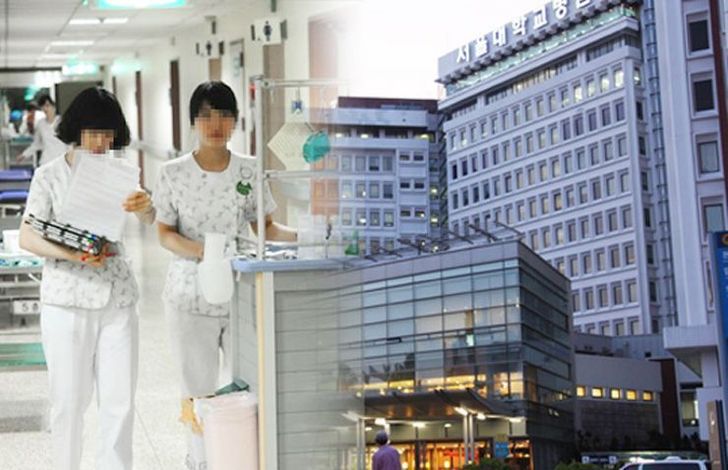
By Chyung Eun-ju, Park Si-soo
Seoul National University Hospital (SNUH) has been accused of exploiting newly hired entry-level nurses.
It was confirmed that the hospital had paid much lower than the legal minimum wage in the nurses’ first month since 2009, a violation of the minimum wage law. The hospital hires nearly 300 entry-level nurses a year, meaning victims could number 2,700.
The first-month salary of those hired this year was 360,000 won ($315), nearly a quarter of the legal minimum monthly wage of 1,352,230 won. This year’s minimum hourly wage is 6,470 won.
The underpayment became an issue early this month after Choi Won-young, a veteran nurse who has worked at SNUH for seven years, revealed the illegal practice on a Facebook page for nursing students and nurses.
“I was paid 312,000 won when I joined SNUH in 2011,” Choi wrote. “Back then, I didn’t know it was a violation of the minimum wage law. I thought it was because I was inexperienced and I thought all hospitals gave this much because SNUH was a big hospital.”
Choi said she made the revelation after the hospital shrugged off her complaint over the underpayment in June.
“I think it (underpayment) was definitely not a mistake,” she wrote. “If it was a mistake, the hospital would have fixed it when I raised the issue in June.”
An SNUH spokesman admitted the underpayment but denied her speculation that the hospital did it intentionally.
“It was a mistake,” Lim Jong-pil, the head of SNUH’s public relations team, told The Korea Times. “We did not know that we were obliged to pay a regular wage to nurses during their training period, which is the first month in the hospital.”
Lim said the hospital signs a formal employment contract with entry-level nurses after the training period.
“During the period, we considered them as trainees, not employees,” he said. “So we only paid them an educational allowance, which was 360,000 won this year.”
Lim said the hospital will pay the unpaid wages to affected nurses.
He said the hospital will treat nurses fairly and transparently in accordance with the labor law.