Human rights issue flares up at Seoul National University
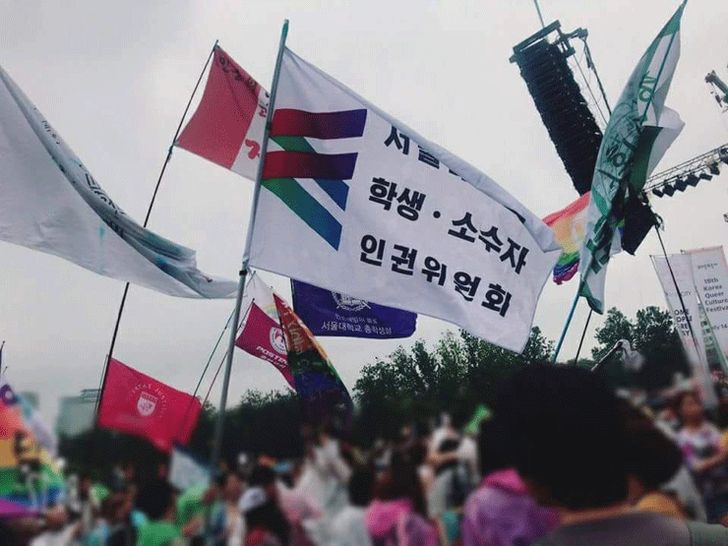
Members of the Human Rights Council wave a flag on Seoul National University campus. / Courtesy of the Human Rights Council
Students boycott event, accuse professors of violating rights
By You Soo-sun
Seoul National University canceled its annual Human Rights Week this year, originally slated for this week from Tuesday to Thursday.
This follows a student boycott of the event, which has been hosted by the university’s Human Rights Center since 2013.
Instead, student groups will hold a separate event on Wednesday and Thursday highlighting the various human rights issues, including one the Human Rights Center rejected and thus led to the boycott.
According to the Human Rights Council, a student-run human rights group, the reason for the rejection is because the plan would display various cases in which professors had abused their power or violated students’ rights.
The Human Rights Center, which is under the umbrella of the chancellor’s office, requested the plan be revised arguing it may defame specific faculty members of the university. Students made numerous revisions in an effort to adhere to the school’s recommendations, and came up with plans that would secure complete anonymity of the faculty members.
After multiple meetings, they were told they could no longer participate in the event.
“The decision caught us by complete surprise, as we thought we were still in the process of negotiation. It happened in a very one-sided way, without the center giving us any reason for the dismissal,” Human Rights Council media representative Choi Woo-hyuk, 22, told The Korea Times, Sunday.
The decision was followed by criticism from the student group as well as other human rights groups at the school, which also refused to participate in the event. This led the Human Rights Center to cancel the event.
The most frustrating part of the situation for Choi and his fellow members was that the Human Rights Center officials, consisting of human rights experts, did not strive to communicate with the group, let alone give a legitimate reason for dismissing the group.
“We thought the process was one of a partnership, built on communication and negotiation,” Choi said.
“We were extremely disappointed because we believed our groups share the same concerns and wishes to promote human rights. The basic principle for a human rights group should be striving to communicate and convince others even in times of conflict.”
Prior to their dismissal, the two parties discussed ways to revise the group’s original plan to display various cases in which professors had violated students’ rights. The center had expressed concerns it may defame one professor in particular, who has been embroiled in a scandal recently.
The final revised plan the student group proposed was an exhibition of different cases reported by students, while ensuring complete anonymity. The various cases would be made into stories, so they would not single out a particular incident. They had done a similar exhibition regarding human rights violations against women last year, with the Human Rights Center raising no issues.
Choi also addressed the problem regarding the organizational structure of the Human Rights Center. Because it is under the chancellor’s office, he said, it is systematically difficult to act in ways that go against the interests of the school faculty.
In regards to the most recent case brought to light, a professor whose name begins with the initial “H” was accused of sexually harassing his students and making misogynistic and other degrading comments.
The comments included, “You are trash,” “You deserve to be beaten,” “They say there are women who cannot live without men ― this exactly applies to her.”
He also forced his students to act in certain ways when dining with his guests and to clean his private residence, drive his car and set up his phone accounts.
The students demanded his permanent removal from the university, and filed a complaint with the Human Rights Center. The professor was given three months of probation, which students believe was too lenient.
Regardless, such a problem is not uncommon in the university setting, which the Human Rights Council hopes to bring to light this week. It also plans to march to the Human Rights Center on Thursday, as a way of protesting the dismissal.
“I think the act of listening to others is the key in addressing human rights issues. It is especially important to be attentive to the needs of those with less say in the given power structure of our society, including women, the disabled and sexual minorities,” Choi said. “The Human Rights Center is also an institution that has more authority. It should listen to student groups like us without status.”