Acid attack survivor offers counseling for victims
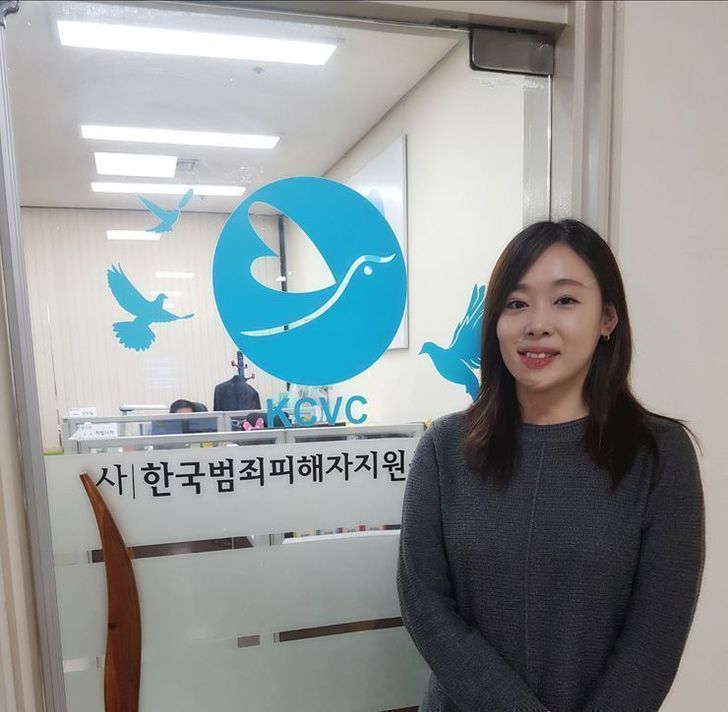
Park Seon-young, a counselor at the Korea Crime Victims Center (KCVC), poses in front of her office in the Seoul Central District Prosecutors’ Office, Wednesday. / Courtesy of Park Seon-young
By Kim Hyo-jin
A 35-year-old counselor for victims of violent crimes, Park Seon-young, says she never tells her clients they should overcome the trauma.
“I know for sure it is impossible. What happened to you is something you can only bury inside so you can live your life ahead,” she told The Korea Times, Tuesday. “Focusing on your future is the only way to survive.”
Her advice must carry weight for victims of violent crimes as she is also one of them.
Park is a victim of a 2009 acid attack. The attack left third-degree burns over half of her face and torso ― 25 percent of her body.
With an eyelid melted off, she could not fall asleep unless she covered her eye with a wet tissue. She also lost her right ear. Dozens of skin grafts and treatments still could not help her avoid skin contraction.
The assailant was the CEO of her previous company, who held a grudge against her for filing a lawsuit over overdue wages. He and an employee who helped throw acid on Park were sentenced to imprisonment for 15 and 12 years, respectively.
“Sometimes people advise me to forgive them so I will feel free,” Park said. “But it did hurt me big time.”
For about two years after the incident, she could not step outside of her home except for regular visits to her doctor. People’s overwhelming attention on the streets was hard to bear, she said.
Meanwhile, post-traumatic stress disorder (PTSD) hit her hard. Daily life was engulfed in nightmares, anxiety and hyper-vigilance.
“One day, a random guy rushed into the elevator at the hospital. The shock choked me, and for a few seconds of being with him, I couldn’t breathe at all,” Park recalled.
Park fought hard to crawl out of the dark times. Watching sad films, she released her sorrow. Watching thrillers and horror movies, she relieved her anger and fears.
The former computer major returned to college and started studying counseling psychology in 2010. It helped her understand her own traumatized mentality and gradually get back on track.
In the hopes of consoling those in pain like her, she pursued a career as a counselor. And after graduation, she got a job at the Korea Crime Victims Center (KCVC) in 2013. It was where she had undergone psychotherapy herself.
“Looking back, I think there was more I gained than I lost. My life seems to have improved after the incident as I learned this society is still warm and worthwhile to live in,” she said, referring to the financial and psychological support she received from former colleagues, doctors and aid groups.
Park has engaged in 1,500 cases of counseling this year through face-to-face meetings and a helpline, three out of four cases her KCVC branch deals with.
Along with the counseling sessions, the KCVC also provides financial support for victims including money for treatment and living.
The center has sought to benefit more people with its service. Currently, it can only help with Koreans involved in cases that took place inside the country, or foreigners who had trouble with Koreans.
But it now hopes to include cases of Koreans that happened in overseas countries and cases between foreigners in Korea, Park said.
The four year-experienced counselor said she hopes to help victims her entire life, regardless of what kind of career she would have.
“I’d like to share what I learned with them that you need to cherish the remainder of your life,” she said.