Students embrace multiculturalism in Korea's farmland

Students pose with Insooni during a monthly talk show in which renowned guests are invited to help students explore different career paths. / Courtesy of Hae Mill School
Hae Mill School offers alternative education
By You Soo-sun
HONGCHEON, Gangwon Province ―
At a middle school in Korea’s countryside, students from various ethnic backgrounds learn how to mix and blend their different cultures. At Hae Mill School, located in Hongcheon, Gangwon Province, students learn to appreciate the simplicity of the rural lifestyle, spending time each week helping with farm work and living in harmony with members of the close-knit rural community.
Of the 21 students attending the school, half of them have mixed ethnic backgrounds, mostly children of a Korean father and a mother from other parts of Asia. Some came after struggling to blend in at regular schools, often getting into trouble or being taunted at school; others came straight from China, Japan, Vietnam, Thailand, Russia or America.
And while the students go through typical teenage troubles, cultural difference is no longer what separates them ― it's what brings them together, no matter what kind of family they were born into.
“The language barrier does exist, especially for the students who just came to Korea. But we use this as an opportunity to learn different languages,” said Jeong Ha-na, 14. Born in Daejeon to a Korean father and a Vietnamese mother, Jeong is fluent in both Korean and Vietnamese. Before transferring to Hae Mill in June, Jeong spent a semester in a regular middle school where she often found herself in fights. Living with 20 other students who speak different languages and from different cultures, she has learned to acknowledge and work with their differences.
While complaining about the restrictions imposed by the school, including the usage of smartphones and eating snacks, Jeong heartily talked about the different activities she’s been involved in.
Farming, required by the school on a weekly basis, was her favorite: “It’s really something to harvest a potato I had planted,” she said. “We’re also preparing for a school festival in September; part of it will be playing a movie for the elderly in the village.”
She also talked about the difficulties she has in connecting with her mom; instead, she found comfort in her teachers whom she considers as family. “They are like uncles and aunts to me ― I consult them and go to them whenever I feel the need.”
And like Jeong, the teachers maintain close contact with even the graduates of the school, whom they continue to guide in their careers and lives.
Many students also come to Hae Mill to get away from the hyper-competitive atmosphere of regular schools here.
“I didn’t speak at all in my previous school,” said Jung Soo-hyun, 14. Although still reserved, she now opens up to her teachers and peers who are with her every waking hour of the week.
“It is difficult to have them around me, constantly talking to me. But I realized I needed to change, so I’m trying,” she said. Her dream is to become a teacher.
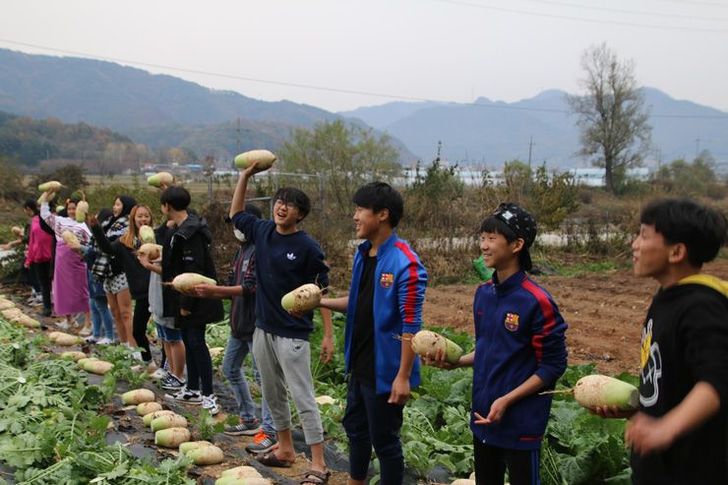
Students hold radishes at their school garden in Hongcheon, Gangwon Province. / Courtesy of Hae Mill School
Students prepare for a more diverse world
The school was established four years ago in 2013 as a way to provide a better learning experience for children of mixed ethnic backgrounds, a sector of the population that has spiked since the turn of this decade.
As of 2015, there were over 82,476 children aged between nine and 24 of what are called multicultural families here. The number of newborns who have mixed heritage is also growing, reaching 4.5 percent (19,729 babies) in 2015 from 2.9 percent (13,443) in 2008.
Children from multicultural families are one of the most vulnerable groups in Korea, a largely homogeneous country that has recently realized and is trying to cope with a growing influx of foreigners.
But with its rapidly declining birthrate, Korea is expected to become more ethnically diverse and needs to confront these new challenges.
Renowned singer Kim In-soon (Insooni), born of a Korean mother and an African-American father, is often referred to as “the first generation of multicultural families.” Acknowledging the disadvantages and struggles many of these youths are prone to, she founded Hae Mill, which translated directly from Korean is: “clear sky after pouring rain."
“I gave the school its name because I didn’t want it to be just about the multicultural children,” Kim told the Korea Times. “I wanted to tell all the children that everyone has his or her own ordeal, like how rain pours down on everyone ― but that’s not eternal. The sky will clear.”
Right now, students here receive free education solely facilitated by donation and from Kim’s own concert revenues. “These kids are already prepared for what will be a more diverse country, moreover the world. My hope is they will take on the role as global citizens.”