Fair showcases businesses pursuing social goals
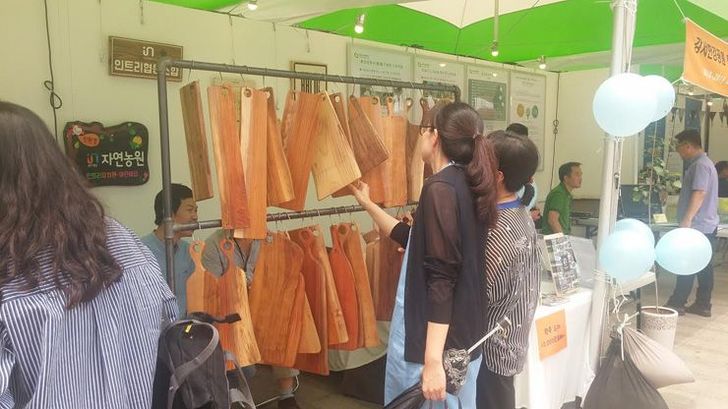
People look at wooden cutting boards at the Social Economy Fair held at Seoul Plaza, Friday./Korea Times photo by Kim Se-jeong
By Kim Se-jeong
A wig company, a travel agency, an arts and crafts firm, an interior design company, a rice cake producer and a cleaning and sanitizing company ― these are some of the companies people will encounter at the Social Economy Fair which is ongoing at Seoul City Hall and Seoul Plaza.
What distinguishes these firms from others is that their ultimate goal isn’t to make money, instead they want to do something good for society.
For example, WooZoo rents an empty residential building, renovates it and then rents rooms out to young jobseekers. Good Travel connects travelers looking for authentic local experiences with villages and communities that offer these.
Tteok Prince is providing rice cake catering service employing people with disabilities.
Joo Gaon provides cleaning and sanitation services for buildings. Most employees are mothers who wish to stay employed while raising their children, and healthy retired men. Joo Gaon has big companies as clients, but they also clean local libraries and nursing homes in the Songpa district of Seoul.
“This is an opportunity to let people know who we are and what we do,” said a representative from Joo Gaon. “And hopefully, we’ll find more clients during the fair.”
While awareness about it is improving, the social economy is still a foreign concept to many people in Korea.
The three-day fair opened Friday to celebrate the 10th anniversary of the Korean government’s policy to support the social economy. The Seoul Metropolitan Government, which is one of the fair’s strongest supporters among local governments, organized the large-scale event ― on the sidelines it also invited 150 social economy activists from around the world for training.
Two hundred social enterprises, cooperative associations and community businesses are participating in the fair.
Many visitors wandered about, sampling food, trying on clothing or gathering information. One section was set up for education on the social economy in general, displaying the social development of Seoul and Korea.
The Seoul city government’s support for the social economy really took off with Mayor Park Won-soon when he was elected in 2011. Mayor Park was a social enterprises CEO himself of Beautiful Store, a secondhand shop, which has now 143 stores around the country.
The city has a 10 billion won fund which social business owners can borrow from at a good rate. It also rewards good performing companies with cash prizes. The number of registered social enterprises in Seoul is 3,501.
In a recent interview with The Korea Times, Mayor Park said the social economy is an alternative to the market economy.
“Unlike the market economy that aims at maximum profit and competition, the social economy’s priorities are on people and building communities. The social economy helps minorities, the elderly and women to find work and offers care and welfare for them. It’s a new solution to problems that have resulted from the market economy.”