Sungkyunkwan focuses on biomedical engineering
University president sees convergence as key to maximize inter-disciplinary synergy
By Chung Hyun-chae
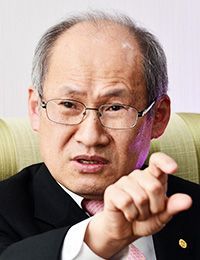
Chung Kyu-sang, president of Sungkyunkwan University
Sungkyunkwan University (SKKU) President Chung Kyu-sang has vowed to cultivate experts in biomedical engineering, which offers great potential for healthcare services and economic growth.
The school launched its Biomedical Engineering Department (BME) early this year as part of its efforts to allow students to research not only medical equipment but also biomaterials and u-healthcare.
“We set up the BME as biomedical technology has emerged as one of leading growth engines both at home and abroad. Therefore it is important to foster engineers and researchers specializing in this field,” Chung said in a recent interview with The Korea Times.
“Our new goal is not just to nurture professionals for the medical equipment industry, but also to promote research in such advanced fields as a u-healthcare system using medical imaging technology, robotics, telecommunication networks and nanotechnology,”he said.
Chung stressed the importance of convergence education, saying that biomedical engineering can maximize synergy when combined with basic sciences such as neuroscience as well as medicine, pharmacology, biotechnology and nanotechnology.
He said the BME department will combine three fields — high-tech medical devices, biomaterials and neuro-technology — for the convergence of medical science and engineering.
“As there is growing demand for better healthcare services amid a rise in living standards and the rapidly aging population, we have felt the need to cultivate biomedical scientists and engineers,” Chung said.
American universities, including MIT, Standford and UC Berkely, already run various BME programs at the undergraduate level, while 14 British universities, including Oxford, Bath and Birmingham, have been teaching BME to their students.
For Sungkyunkwan’s BME department with a 30 freshman quota this year, 1,338 students applied in early admissions and 66 students for regular admissions.
All major classes at the department are given in English and every student receives a full scholarship plus 500,000 won in incentive pay per month if they maintain a GPA of 3.0.
Chung said the university plans to invest an annual 10 billion won ($9.16 million) over the next 10 years for the development of the department.
Sungkyunkwan has also focused on interdisciplinary research, especially for BME, IT convergence and embedded software.
“More outstanding students are coming to our school, which is largely attributed to our efforts to establish specialized departments that will improve competitiveness,” Chung said.
Sungkyunkwan recently created “C-School,” an interdisciplinary study course in which students can receive convergence education in BME and other specialized departments including global economics and global business administration.
“We want our students to develop a creative and integrated thinking ability and acquire a cosmopolitan outlook in an era of globalization,” Chung said.
The university has been active in attracting research centers of local and foreign companies to boost academic-industry cooperation.
It now hosts the Asia-Pacific R&D center of BASF, the largest chemical firm in the world; and the electronics, electrical and lighting technology center of SABIC, or Saudi Basic Industries Corp.
It established the SKKU Advance Institute of Nanotechnology (SAINT) in the school’s natural sciences campus in Suwon, Gyeonggi Province, in 2005, to conduct various research including a project on graphene with Samsung Electronics.
The university has also created contract departments including IT convergence, software and semiconductor systems engineering, in cooperation with companies including Samsung Group which took over the school’s foundation in 1996.
In 2012, Sungkyunkwan was selected as the best university for promoting cooperation with businesses. The selection won the university 25 billion won ($22.9 million) in government aid.
The money will be spent on industry-university cooperation projects aimed at enhancing global competency of mid- and small-sized business and to support young entrepreneurs, for five years until 2017.