New seeds of ideological division?
By Jung Min-ho
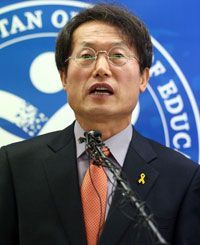
Cho Hee-yeon, the superintendent of education in Seoul, speaks about his proposal to push back the start time at schools, during a news conference at the Seoul Metropolitan Office of Education on Nov. 3. / Yonhap
Seoul education chief Cho Hee-yeon’s recent proposal to implement a later start to the school day is drawing mixed responses from students, teachers, schools and even politicians.
While conservative groups say the liberal superintendent’s “reckless” experiment is sowing new seeds of ideological conflict in the educational sector, liberal groups generally welcome the idea.
Cho said he wants to delay the start time at elementary, middle and high schools by up to 90 minutes, to 9 a.m., in Seoul from next year. He said he will give up on the idea if a majority of people disagree with him.
Cho intends to give students more time to sleep and have breakfast with their families, but some busy parents who send their children off to school before they leave for work early in the morning don’t like the idea.
“I’m absolutely supporting him,” Kim Ji-eun, 14, a student at Seoul Girl’s Middle School, said. “The early morning classes are useless anyway. No one pays attention to them. Students either sleep or chat.”
“It’ll be great,” Kwon Yoon-ha, 18, a senior at St. Paul Preparatory School in Seoul, said. “It’s too bad that I won't have that privilege next year because I'll be a senior.”
Other students are against the proposal.
“A later start means a later end,” Kim Seon-kyung, a freshman at Youngshin Nursing Business High School in Seoul, said. “With the change, we have to return from school one hour later, and the entire daily schedule will be delayed accordingly.”
A mother of a first-grader at an elementary school in Seoul said a later start will cause great inconvenience for her and many others.
“My child will have to go to school by himself after I’m gone,” she said. “I need a place to take care of my child from early morning because my work starts at 8:30 a.m. I’m sure many working parents feel the same way.”
The later school start program was first adopted by Gyeonggi Province on Sept. 1, and most schools in the province now start at 9. Lee Jae-jeong, education chief of the region, pushed for the “necessary change that will give students health benefits and reduce their study burden.”
Cho’s late school start proposal is expected to trigger other liberal education superintendents in 13 of 17 cities and provinces nationwide to follow suit.
After collecting opinions from students, parents and teachers, Cho said he plans to map out the details of the policy by February before putting it into effect in March.
Politicians are also divided over the idea.
While Saenuri Party spokesman Park Dae-chul criticized Cho for “being too pushy and quick” in adopting the policy, New Politics Alliance for Democracy spokesman Yoo Ki-hong said he is supports it.
So, is it really good for students? According to scientists, it is.
A study released earlier this year by University of Minnesota researchers showed that later school start times and more sleep can increase academic performance, reduce depression and substance abuse and lower the rate of automobile accidents.
Cho has also suggested preventing students from taking private classes before 9 a.m. Instead, he proposed giving them two to three hours of "play time" to help them develop creativity.
“When I see young children dozing off early in the morning, I feel pity for them,” Kim Yeon-joo, an elementary school teacher in Dongnimmun, Seoul, said.
“What many people might be missing in taking their position on the issue is the students. If it is good for the students, I think, the policy should change, no matter how difficult it will be and how long it has been the wrong.”