Korea Univ. stepping up globalization
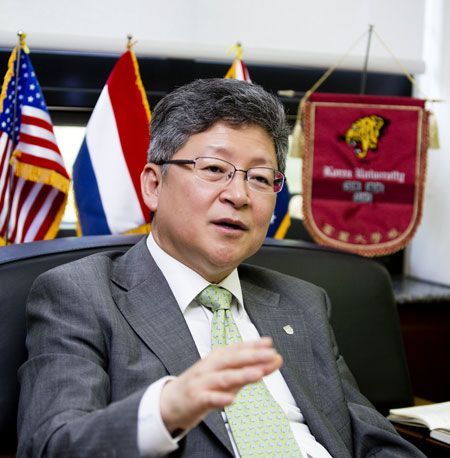
Kang Sung-jin, a vice president for international affairs and professor at Korea University, talks about the university’s vision and goal of globalization programs at his office in Seoul. / Courtesy of Korea University
The university in partnership with 853 schools in 90 countries
By Bahk Eun-ji
Globalization has been the buzzword for different sectors of Korean society for the past three decades. The education sector is no exception.
Especially, local universities have made strenuous efforts to promote exchange programs with schools around the world.
One of them is Korea University that has been taking the initiative in this effort as one of the most prestigious schools in the country.
“The notion of globalization for Korea University is now in transition, as it has reached a peak when it comes to short-term exchange programs with many other overseas universities,” said Kang Sung-jin, a vice president for international affairs and professor at the school.
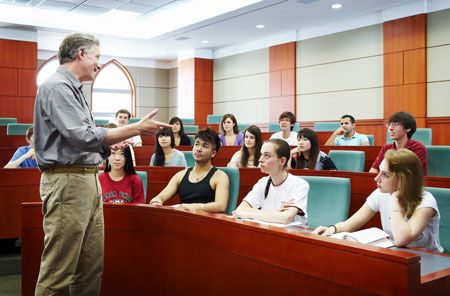
Foreign students listen to a lecture during the International Summer College (ISC) program at Korea University. The program offers a six-week intensive academic course for exchange students from around the world. / Courtesy of Korea University
It has been already 12 years since the university started its globalization program, Kang said. More than 1,200 students from other countries studied there in 2012, while 853 schools in 90 countries work in partnership with it.
“The number means a lot to us, as there were only 273 foreign students in Korea University in 2002. It is definitely significant progress but we need to make a bigger step, and that’s why I talked about transition earlier,” Kang said. So far, the university has focused on short-term programs providing classes in English for exchange students. The school offers 40 percent of its lectures in English to attract foreign students.
“Otherwise, those students wouldn’t have any motivation to come to Korea, because no one could take classes in Korean. The short-term programs have worked well. But we don’t think it is how globalization has to be in the future. In other words, we need to change,” Kang said.
Kang noted the university plans to offer longer programs to exchange students so that they can get a degree from Korea University through classes in Korean.
“Japan is kind of our role model in that sense,” Kang said, pointing out that almost all universities in Japan provide Japanese courses for a year before international students join regular courses through scholarships.
“Those students who get a degree or go through the exchange programs provided by Japanese schools are able to get fluency as well as the qualification,” he added.
“It’s not just about learning language. The example of Japan tells us what the true globalization means and also gives us the direction that we have to take in the years to come,” Kang said.
He said Korea University’s ultimate goal is to develop its own new model for promoting international exchanges.
The vice president described what the school has done for globalization as a valuable achievement that has helped the school stand out among many other universities in Korea.
Korea University has been working as a member school of Universitas 21 and the Association of Pacific Rim Universities (APRU).
Universitas 21 is an international network of schools around the world. It was established in 1997 under the slogan “International reference point and resource for strategic thinking on issues of global significance.”
Currently 23 universities in 14 different countries are part of the network and Korea University is the only Korean member.
APRU is a consortium of leading research universities on the Pacific Rim. It aims to contribute to economic, scientific and cultural advancement by fostering education, research and enterprises.
Forty-two universities in 16 different countries organized the consortium and Korea University has used the network with many other global universities to give opportunities for students to benefit from exchange programs, Kang said.
“Now we are about to change our direction so as to take a bolder step. I admit we have so far been more interested in the number of exchange students in our school, because it represents the tangible outcome instantly that can be measurable,” he said.
“We are going to focus more on the content of education, the level of schools that we are going to set up a relationship, not to mention our efforts to improve the quality of exchange programs between schools,” he said.
Kang said he wants to forge a partnership with the world’s most prestigious universities such as Harvard and Oxford.