Learning English through newspapers

Jang Eun-kyong, an English teacher at Chungryang High School in Seoul, lectures using an English-language newspaper website. Jang uses pictures, captions and stories during her class. / Courtesy of Jang Eun-kyong
By Bahk Eun-ji
How to learn English quickly and effectively is definitely of interest for Koreans, especially for high school students. For them, how to attain and maintain a good record is most important, as the College Scholastic Ability Test (CSAT) awaits them.
Guidance matter and materials for English study flood the market and ”self-claimed experts” are everywhere. The English-teaching business has thrived for more than decades, particularly as private education.
Many parents think the English-language education in schools is not enough to keep their children competitive, and the costs for private tutoring have been getting increasingly expensive.
Income disparity among parents eventually decides their children’s achievements, which has triggered a huge gap between rich and poor in terms of education opportunities.
In other words, children of rich parents can make up for what they lack at school through private tutoring, which enables them more opportunities to become so-called leaders of society, while children of penniless parents cannot.
“Most of students at this school haven’t benefited from a decent quality of education, especially in terms of English,” said Jang Eun-kyong, a teacher Chungryang High School.
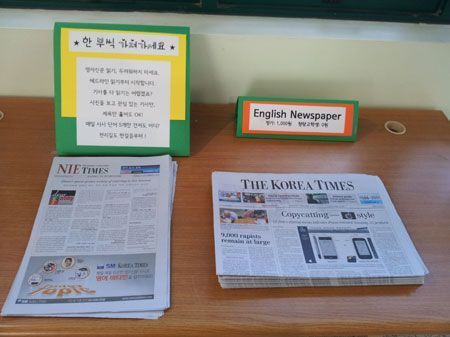
Copies of The Korea Times are put on the table for students at Chungryang High School to read. / Courtesy of Chungryang High School
“The ability of English depends most significantly on how much you invest money and time.
“In that sense, many of these children have been, I would say, underprivileged.”
Jang, who has taught English at different high schools for 22 years, said she is always thinking of how she can make students interested in studying English.
She discovered that local English-language newspapers could be decent study material for her students, as they are filled with stories about what is happening in the nation, so the students can follow current issues.
“Some teachers are skeptical of its effectiveness as a study material because it is too difficult for students, so I mainly used pictures and captions so they can memorize vocabulary items easily,” Jang said.
She believes reading newspapers is definitely helpful for students, even those who used to think reading an English-language newspaper was beyond their capability.
“I told the principal I would say it’s worth doing so if there are at least three students who discover the joy of reading,” she said.
Jang uses newspapers in her class and taught her students how to read them from first reading headlines. She gradually saw a change in her students, as more and more said they now enjoy reading newspapers and have less difficulty doing so than before.
“I used to think English newspapers were something I couldn’t even try to read,” said Song Se-ik, a third-year student at Chungryang High School.
Song said at first the teacher had him pick three to five words he didn’t know, and memorize them. The more new words he learns, the better he is able to read the text easily.
“Now I’m a big fan of English newspapers,” Song said.
“Many students still say it is difficult to read a newspaper, but they also said it is fun,” Jang said.
“I know reading newspapers is not a magic bullet. It doesn’t work instantly but I think it is certainly worth doing, because my students do not think English newspapers are something that far away from them anymore.”