'Innovation schools' hang in the balance
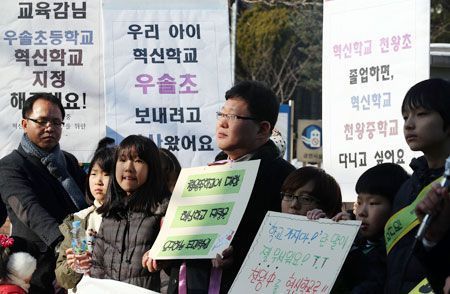
Parents and their children hold a rally in front of the Seoul Metropolitan Office of Education Tuesday, urging it to designate Usol Elementary School and Cheonwang Middle School as “innovation schools.” They denounced the office for refusing to approve them as innovation schools while granting the designation to six others. / Yonhap
By Kim Bo-eun
Seoul City’s “innovation school” project, one of the key policies of the capital’s previous liberal education chief, is causing conflict between parents, and councilors.
Kwak No-hyun, stripped of his post as superintendent of the Seoul Metropolitan Office of Education in September after being convicted on bribery charges, initiated the project as a measure to revive school education.
New conservative Education Superintendent Moon Yong-lin has taken a cool stance toward the project but said right after his inauguration last month that he would not totally scrap the idea.
The new schools focus on six innovative aspects ― management, curriculum, classes, student evaluation methods, counseling and education welfare.
They were designed to enjoy autonomy in running their curricula and are allowed to select their principal through public recruitment, while receiving 100 million to 200 million won in local government subsidies.
Existing schools can become innovation schools on a voluntary basis. And the education superintendent also has the power to designate some schools as innovation schools.
However, conservatives have criticized that innovation schools are being influenced too much by left-leaning ideologies as many of their teachers are members of the liberal Korean Teachers and Education Workers’ Union.
Innovation schools gaining ground
The number of innovation schools in the capital has grown to 61 over the past two years. Although the concept is new and still unfamiliar to many, the schools have started to gain recognition, as parents are now deliberately moving to districts in which such schools are located.
Parents say these schools offer programs that allow students to learn outside of the classroom and that they try to promote cooperation instead of competition.
“My child tells me that he enjoys going to school, ever since it became an innovation school,” said Oh In-hwan, whose son attends Cheonwang Elementary School in southwestern Seoul, which became an innovation school in September 2011.
The learning is based on experience, rather than textbooks, said the 40-year-old Oh.
“For example, if the students are learning about Cheonwang-dong, the area they live in, they would go to a nearby field and take a look at animals and plants that inhabit the area. They would also be taken to meet people doing diverse jobs in the area, to learn how they are contributing to society.”
He added that the school tries to keep from inciting excessive competition among students. It does not rank them first to last in class and does not hand out report cards directly to the students.
Oh is among the parents urging the education office to allow Cheonwang Middle School, set to open in March, to become an innovation school.
“Most of these parents have children attending Cheonwang Elementary School, and want for them to be able to continue studying at an innovation school when they advance to middle school,” he said.
Teachers have also expressed satisfaction with the new model. For them, one of the most important factors is that they have less administrative work.
Lee Min-shik, the head teacher at Hannam Elementary School in central Seoul, says that the new schools allow teachers to focus on developing higher quality class content for the students.
“Students say that classes are fun and that teachers are paying more attention to each of them,” said Lee.
Another positive aspect is that each teacher is responsible for developing their own class content, which gives them greater responsibility.
“This also contributes to enhancing the quality of class content,” he said.
Brakes put on innovation school project
The Seoul Metropolitan Council and the city’s education office agreed to allocate a budget for eight schools to be designated as innovation schools this year.
However, the council and parents are protesting as two of the eight schools have been excluded from being designated as such.
According to the education office, five elementary schools and one middle school are to be newly designated as innovation schools.
Several city councilors and parents visited the education office Friday to meet new Education Superintendent Moon to discuss the issue and hosted a press conference urging the office to designate the two rejected schools as innovation schools.
“The budget for eight innovation schools was confirmed after being passed by the education committee, the special committee on budget and accounts and the plenary session of the municipal council,” said Kim Hyoung-tae, a member of the council’s education committee.
“It does not make sense for the office to say that it will exclude two schools after the budget has been secured, under its approval.”
“It is dogmatic of the education office to refuse the designation of new schools as innovation schools because they had not followed the public recruiting procedure, as new schools cannot apply for the public recruiting process," said Yoon Myung-hwa, a councilor of the Democratic United Party.
A mother whose child is to attend Cheonwang Middle School said, "It is unacceptable to say that the school was excluded because it did not follow the necessary procedure."
According to an official at the education office, the superintendent had agreed to secure a budget for innovation schools but that there had not been a specific agreement on exactly how many schools would become innovation schools.
The city council education committee said it will consider convening a special meeting if the superintendent remains silent on the matter.
The parents of students set to attend the two schools ― Usol Elementary School and Cheonwang Middle School ― hosted another press conference in front of the education office Tuesday, again urging Moon to designate the two as innovation schools.
The parents submitted official requests to the office in November, stating that they wished for the schools to be designated innovation schools.
At the time, 170 households living in apartments nearby Usol Elementary School and 1,033 parents of Cheonwang Middle School students participated in the signing of a petition.
Moon announced following his inauguration that that education office would decide whether to designate innovation schools after a year’s evaluation and monitoring by teachers and experts. He has refrained from speaking about the issue ever since.