School of disappointment
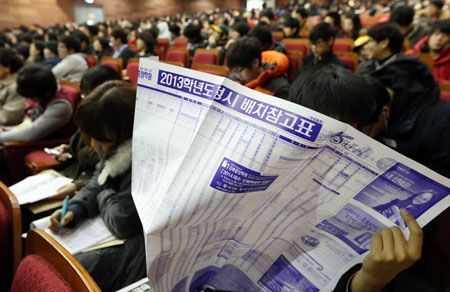
A student examines a printout of the entrance requirements of the nation’s two-year and four-year colleges during a presentation on admission strategies at Dongsung High School in Seoul earlier this month. / Yonhap
Lack of vision, dearth of ideas have candidates struggling to differentiate on education
By Kim Tong-hyung
What would a Park Geun-hye or Moon Jae-in presidency mean for schools, universities and the lives of children?
The pictures presented by the candidate’s campaign strategists are similar to the point of confusion: Cheaper college education, free high-school education, better childcare services for double-income families and no more children stuck late at night in ‘’hagwon’’ or after-hours tutoring academies.
But critics are skeptical about the proposals, questioning whether either candidate is capable of putting their money where their mouth is because both have so far failed to provide specific plans on how to finance their lavish promises.
Equally disturbing is that neither Park, the conservative ruling party favorite, nor Moon, the opposition challenger, has been able to draw up educational systems designed to tackle the challenges of the future.
Of course, combating the side-effects of the country’s education obsession, which locks children into a decade-long marathon of high-stress exams, and prices middle-income families out of the private education market are critical.
What Park and Moon have failed to do is present new philosophies and visions to restore faith in public education as the driving force to help people live better lives and maintain Korea’s competitiveness in the world.
Many westerners, most notably U.S. President Barack Obama, speak glowingly of the enthusiasm Korean parents have for educating their children and credit this for the country’s rapid ascension to becoming an economic powerhouse.
It’s much harder to find a Korean who is happy about a severely hierarchical system accused of throwing students into a rat race and beating the spirit of innovation out of them. A dismal economy, a decaying job market and increasing corporate skepticism about the value of academic qualifications is also making it harder to justify the years and money spent on university degrees.
``Neither Park nor Moon is attempting to attack the essence of the problem, although that indeed will be a monumental challenge,’’ said Huh Eun-yeong, a 35-year-old teacher at a high school in Daejeon.
``The flaw in our education system is that it doesn’t inspire creativity and diversity in values and exists solely for the purpose of rewarding those who finish first. This connects awkwardly with the complex and fast-changing society of the 21st century where they can be no one-size-fits-all standard for determining values.”
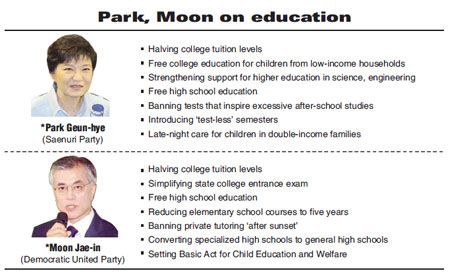
Park, daughter of late military strongman Park Chung-hee and representing the Saenuri Party’s hopes for retaining the country’s most powerful office, promises to lower college tuition for students depending on their income levels and lower borrowing costs on student loans.
She also plans to extend free public education through high school and introduce ``test-less’’ semesters in middle schools. All tests that require students to study their curriculums in advance at hagwon will be banned.
More teachers will be hired at elementary schools to keep the number of students per class at 20 by 2017 and night-care centers will be available for children in double-income households. More daycare centers and kindergartens will be receiving state finance to support the plans to provide free childcare for children under the age of five. Underachieving universities and two-year colleges are to be phased out of the market.
``It’s hard to expect a teacher to provide quality education when he or she has to teach too many students at once. That will prevent them from fostering the individual talents and dreams of the children,’’ Park told reporters recently.
``It will also be important to let teachers concentrate on just teaching and lessen their burden on other things such as administrative work.’’
Moon, the Democratic United Party (DUP) nominee, agrees with Park on reducing college tuition levels, free high school education, free daycare for children under five and more teachers at elementary schools. However, he tries harder to link the educational issues with social mobility.
Social mobility is key
The chances of Korean children doing well are more closely linked to their parents’ education and wealth levels than in most other developed countries, government data suggests, pointing to the soaring costs of education and the massive gulf between the rich and poor.
Moon speechifies about combating this problem and thus is more aggressive than Park in his plans to lessen the financial burden on college students.
Unlike Park, who expresses more concern about the finances of the schools and resists a universal cut, Moon says that the level should be ``halved’’ straightforwardly. He also plans to introduce policies to pressure universities to simplify their admission requirements.
Another controversial plan by Moon is to convert specialized high schools ― originally intended to provide advanced education on science and foreign languages, which are now accused of being glorified farm schools for the nation’s prestigious universities ― into regular high schools.
He suggests that the six-year courses at elementary schools should be reduced to five-year courses with kindergartens entering the realm of compulsory public education. Hagwons will have to send their students home before sunset. Apart from providing free childcare for children under five, Moon also plans to provide free school meals for all students, from those at elementary through to high schools.
Detractors of Park question her commitment to lowering household spending on education and private tutoring. Moon’s detractors comb through his mumbo jumbo of plans and end up questioning whether he really has a plan.
The candidates, who are reluctant to talk about raising taxes with the Dec. 19 vote approaching, have been vague on where they will find the resources to finance their plans. Convincing taxpayers will be just as hard as persuading universities that they should be accepting students for significantly less money.
``I don’t think Park and Moon are providing much material to trigger meaningful social debate on education. They are counting their votes in advance for sure, but refusing to do more than that. Their proposals are safe and familiar, but hardly imaginative,’’ said Yang Jeong-ho, a Sungkyunkwan University professor.
``Park seems to be providing the more realistic plans, but she shows little interest in fixing the fundamental problems. Moon shows more determination to attack the disease instead of the symptoms, but you have to question whether he would be able to get anything done within his presidency.’’
Neither Park nor Moon seems to be generating excitement from teachers. The biggest problem about Korea’s education is that it remains a relic of the times when people were forced to accept a ``one right way’’ of doing things. Chung Gyeong-ae, a middle-school teacher in Seoul, claims that the system should be reset to foster creativity and individuality.
``If a school in the U.S. gives in to pressure from religious groups and decide to use textbooks written by creationists, you could be assured that parents will protest strongly. If the same thing happens in Korea, parents will instead scramble to list their children in cram schools that teach creationist theory. They don’t care about what their children are learning in school. They just care about how well they are scoring in tests,’’ said Chung Gyeong-ae, a middle-school teacher in Seoul.
``Still, it would be great if the new president could conjure up the courage to rethink our educational system from the fundamentals. Under the current system, people here will be permanently unhappy with the `quality’ of public education because quality will be determined by whether their children finish first in class or not. And there will never be enough first places to go around for everyone.’’