Education gets smarter with IT gadgets

Students in a first-year English class use their smartpads to upload their interpretations of an excerpt at Hansol Middle School in Sejong City, South Chungcheong Province, Oct. 24, the day classes were open for observation. The school is one of the first three “smart schools” in the nation that were built in the new administrative town. / Korea Times photo by Kim Bo-eun
By Kim Bo-eun
A second grade math class at Hansol Middle School started as students logged into a system connecting them and their teacher through smartpads on Oct. 24, the day classes were open for observation at the school based in Sejong City, South Chungcheong Province.
Students learnt about the properties of parallelograms through collective problem-solving. They worked with their classmates on the problems the teacher sent to their pads, writing equations on the screen using their fingers.
Once they were done, they sent the pages which had their equations and answers back to the teacher who was then able to check on her monitor how many students got the question right and provide immediate feedback.
This is one of the most basic ways through which the school utilizes technology in classes. Hansol Middle School is one of the nation’s first smart schools, which opened together with Charmsaem Elementary School and Hansol High School in the newly-built administrative town in March.
Each classroom is equipped with a smart board and smart lecture desk and one smartpad for each student. Cloud computing technologies enable each of the devices to be connected to one another.
“Although we are trying to be careful not to overstate the developments since we are only in the initial stage of smart education, we believe that it has great potential,” said Park Ji-hyun, director of smart education at the school.
“We are envisioning greater interaction through utilizing social networking services as well as lectures by renowned instructors, to enrich the learning experience for students,” Park said.
Government initiatives
Suh Heyi-sook, director of smart education at the Ministry of Education, Science and Technology, says that the ministry’s current focus is on preparation, mainly in terms of training teachers and getting the learning content ready.
“From 2015, we will gradually start furnishing schools with the necessary equipment and devices,” said Suh. “But until 2015, we are going to be in the preparation stage of smart education.”
The first major task in order to set the transition process in motion is to have teachers become familiar with the new method of learning, she said.
“It’s not only about learning how to use smart devices, but to utilize them to create an entirely different learning environment,” said Suh.
The ministry has selected several words that define smart education, having each one stand for a letter in the word “smart.”
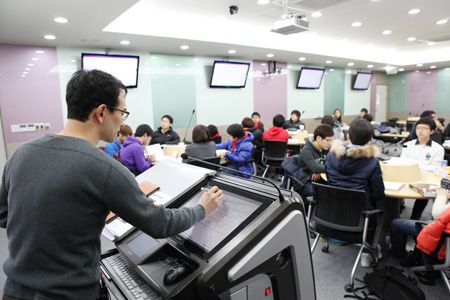
A professor teaches with the help of touch-screen monitors at a KAIST lecture hall in Daejeon where the computer uses “Education 3.0” software in this file photo. The university implemented the next-generation educational program earlier this year to aid both teaching and learning. / Courtesy of KAIST
“S” stands for self-directed, “m” for motivated, “a” for adapted, “r” for resource-enriched and “t” for technology-embedded.
The new mode of learning therefore shifts away from the instructor-centered teaching method to one where students become the main agents of learning. They can utilize vast amounts of information through technology to pursue studies that are adjusted to their own levels.
According to the director, teachers are currently taking training courses both at their schools and at education offices in their respective cities and provinces.
The other task is to have learning contents such as digital textbooks ready. The ministry is obtaining content through MOUs with various institutions that are offering their educational material.
The Seoul Metropolitan Office of Education is also taking measures to facilitate the smooth transition to this technology-savvy education system.
Along with training courses for teachers and workshops sharing successful cases of how smart education has been applied, it has designated several schools in the city as smart education research schools.
According to Kim Se-yeob, supervisor of the ubiquitous-learning (u-learning) support department, Seoul City was the first in the nation to have these trial schools.
“There is one school in each level _ elementary, middle and high school,” said Kim. “These three schools are researching how technology can be utilized effectively in schools, and are also trying various new methods of learning in classrooms.”
Among them is Itaewon Elementary School, which has “smart classrooms” built for research by the Korea Education and Research Information Service and facility investment by mobile communication company LG U+, which signed a memorandum of understanding with the education office. It has 50 smartpads and access points across the school building which enables users of a wireless device to connect to a wired LAN.
The school is providing training sessions to teachers and heads of schools in the city on utilizing QR codes, social networking services and applications for smart education.
“Rather than hastening to increase the number of trial schools, we are going to focus on polishing up the ‘software,’” said Kim. “This is also because of the current budget shortfall. We will take time to devise the most cost-efficient system, ahead of setting up the ‘hardware.’”
Smart education at universities
The transition is not only taking place at primary and secondary schools. The Korea Advanced Institute of Science and Technology (KAIST) is among the universities in the nation taking the initiative to enhance students’ learning experience through utilizing technology and innovating teaching methods.
The school initiated its “I-4” program which is part of the comprehensive “Education 3.0” program, early this year. Based on the core values of being internationalized, IT-based, individualized and integrated, it is a learning method which emphasizes student autonomy and participation backed by technology.
Learning takes place through auditing online lectures, having discussions and solving problems together, instead of the conventional method of a professor lecturing to students in a classroom.
Boosted by positive feedback, the program has been expanded to include the participation of international students. Students from around the world will be in their home countries, interacting with Korean students at KAIST through mediums such as Skype.
KAIST is considering the application of IT technology that will enable students in a group to see one another while solving assigned problems, as if they were in the same room. It also has teleconference classrooms in mind.
As KAIST and schools across the nation continue to adapt new technology to innovate learning methods, students are expected to immensely gain from the benefits of interesting, interactive and efficient education.