Foreign workers needed, but at what cost? Korea debates 'metropolitan visa' plan
Controversy grows in Ulsan as president questions reliance on minimum‑wage foreign workers in shipbuilding
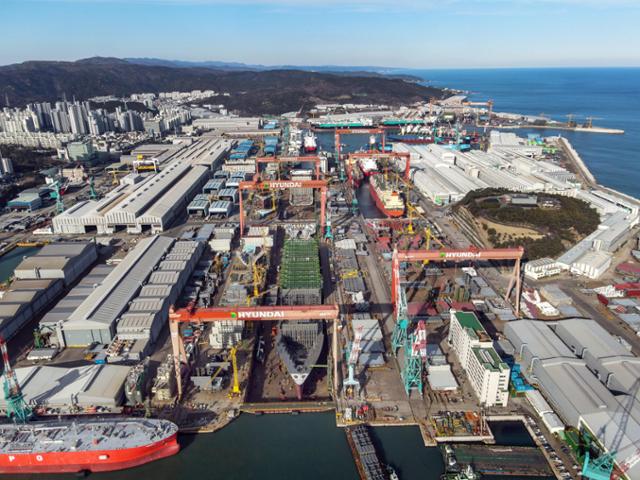
A view of the HD Hyundai Heavy Industries shipyard in Ulsan / Courtesy of HD Hyundai
President Lee Jae Myung has sparked intense debate with his comments on the “metropolitan visa” policy, aimed at supplying foreign labor to Korea’s industrial regions.
The controversy escalated after President Lee openly criticized the shipbuilding industry’s reliance on low-wage foreign workers during a visit to Ulsan, a hub for the nation’s maritime sector.
His remarks have divided stakeholders. Local governments and businesses view the visa as a desperate measure to solve chronic labor shortages, while labor groups and critics argue it merely entrenches harsh working conditions and low wages.
What is the 'Metropolitan Visa?'
The metropolitan visa program, also known as the metropolitan-recommended visa, is a system that allows local governments to tailor visa requirements to their specific industrial needs and regional conditions. Once approved by the central government, the visas are issued to foreign nationals.
Ulsan has aggressively adopted this system to support its struggling shipyards. The city plans to bring in 440 foreign workers by the end of this year, following the recruitment of 88 workers last year for jobs specific to shipbuilding such as welding, electrical work and painting.
The annual salary requirement for the visa for these workers is set at the legal minimum wage level.
Presidential challenge: 'Not a labor shortage, but a wage shortage'
Debate over the visas resurfaced during a town hall meeting President Lee held in Ulsan last Friday.
“Doesn’t it seem strange that an industry claiming the world’s strongest competitiveness — generating trillions of won in profit — is hiring workers at 2.2 million won ($1,543) a month?” Lee asked.
He challenged the argument that the industry is suffering from a labor shortage, suggesting it is instead a "wage shortage."
“Since the work is physically demanding but pays only minimum wage, domestic workers cannot be found,” he said. “We must consider whether filling these jobs with foreign workers is the right way to support Korea’s shipbuilding industry.”

President Lee Jae Myung speaks at the town hall meeting at the Ulsan Exhibition and Convention Center on Jan. 23. Yonhap
Ulsan Mayor Kim Doo‑gyeom strongly defended the program, calling it essential for survival.
“When shipbuilding subcontractors try to hire, they can fill only 56 percent of their workforce needs. They simply cannot find the remaining 44 percent,” Kim explained during the meeting.
After the president’s criticism, Kim reiterated Monday that the issue should be viewed strictly from an economic standpoint, not through a political lens.
"China currently dominates with 70.3 percent of the global shipbuilding market and labor costs that are half of Korea's," Kim said, adding that the domestic shipbuilding industry, by contrast, has become a job sector many Koreans avoid.
"If we fail to secure even foreign workers, maintaining competitiveness in the shipbuilding industry will be impossible, and this could ultimately cause a job crisis for Koreans as well,” he added.

Ulsan Mayor Kim Doo-gyeom answers a question from President Lee Jae Myung during the town hall meeting held at the Ulsan Exhibition and Convention Center on Jan. 23. Yonhap
Labor and political blowback: 'A poisoned chalice'
Civic groups and political parties have echoed the president’s criticism, calling Ulsan’s expansion of the visa program a “poisoned chalice” that undermines the industry’s long‑term sustainability.
The Ulsan chapter of the Progressive Party said Tuesday that the shortage reflects "not a lack of people, but a lack of decent jobs."
“The government must stop expanding the metropolitan visa immediately,” the party said. “It should provide direct budget support to resolve the wage gap between primary contractors and subcontractors, expand regular employment and build a social safety net to encourage skilled workers to return."
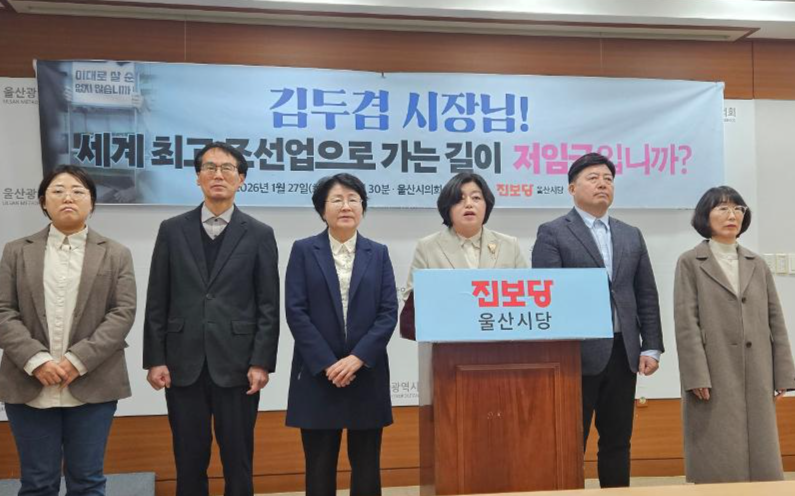
Members of the Progressive Party's Ulsan chapter hold a press conference at the Ulsan City Council on Tuesday, calling for the suspension of the metropolitan visa program. Korea Times photo by Park Eun-kyung
The Democratic Party’s Ulsan chapter also condemned the policy, asking, “Are we turning our children’s future jobs into a permanent low‑wage subcontracting base just to protect corporate profits?”
A local civic group added that domestic workers avoid shipyards because of intense labor demands, hazardous conditions and low pay. “We need a policy shift that balances industrial competitiveness with labor stability and regional sustainability, rather than simply expanding visas,” the group said.
Industry dilemma
Industry insiders argue that immediate structural changes are difficult due to the cyclical nature of shipbuilding.
“The industry goes through repeated boom‑and‑bust cycles tied to ship replacement timelines. It is difficult to immediately overhaul the wage system just because we are currently in a boom,” an industry official said.
The official added that the halt in the program would cause disruption. “Foreign workers entering through the metropolitan visa complete job training and Korean language programs in their home countries. They can be deployed after a brief orientation, so suspending the program would inevitably lead to chaos.”
This article from the Hankook Ilbo, the sister publication of The Korea Times, is translated by a generative AI system and edited by The Korea Times.