Ruling party, gov't urge seafood consumption amid Fukushima fears

Fish mongers are seen at a market in Daedeok District, Daejeon, Wednesday. Yonhap
Gov't considers calling wastewater 'treated water'
By Nam Hyun-woo
The ruling People Power Party (PPP) and the government are calling for industries to join their campaign to promote seafood consumption, despite lingering public fear over the impact of Japan's release of wastewater from the Fukushima Daiichi Nuclear Power Plant into the ocean.
The PPP held an agreement signing ceremony between domestic catering firms and the National Federation of Fisheries Cooperatives to promote domestic seafood consumption, Wednesday.
“The domestic fisheries industry is now facing a serious crisis of groundless concerns and worries that may result in weakening seafood consumption, due to the myth and rumors created by a certain group,” PPP floor leader Yun Jae-ok said during the ceremony, referring to the main opposition Democratic Party of Korea's (DPK) campaign against Japan's wastewater release.
“Luckily enough, the seafood consumption in the first weekend after the release grew year-on-year, and the atmosphere at major fisheries markets is not bad. It has been revealed that the political trick of spreading false information and instigating a nationwide boycott was nothing more than empty threats.”
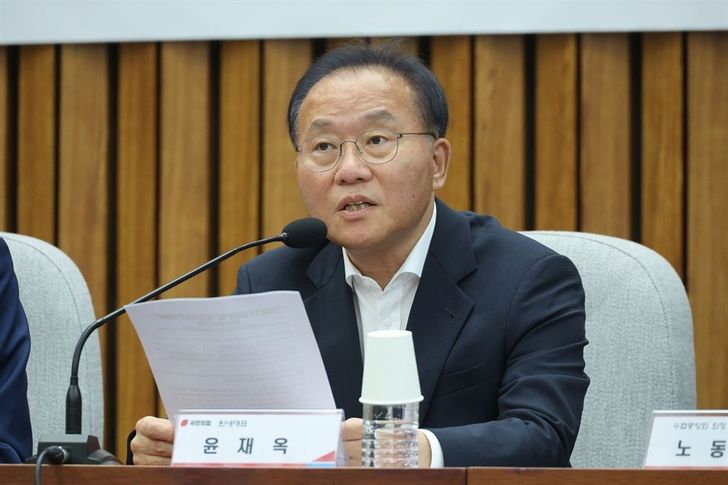
Ruling People Power Party floor leader Yun Jae-ok speaks during an agreement signing ceremony between domestic catering firms and the National Federation of Fisheries Cooperatives to promote domestic seafood consumption at the National Assembly on Yeouido, Seoul, Wednesday. Yonhap
Following the agreement, catering companies including Ourhome, Shinsegae Food, CJ Freshway, Samsung Welstory and Pulmuone Food & Culture promised to promote the use of Korean seafood in the menu of affiliated companies' cafeterias. Schools were excluded from the campaign because of the difficulty of convincing concerned parents.
Despite the agreement, however, industry officials are expressing difficulties stemming from the government and the ruling party's push.
“It could be possible to feature more seafood dishes at the cafeterias of our affiliates,” an official at a conglomerate said. “But providing seafood dishes to customer cafeterias is a different matter because we cannot provide meals that customers refuse to eat.”
In terms of an outsourced company running a company cafeteria, nutritionists plan menus based on the customer company's demand. For example, HD Hyundai, a shipbuilding conglomerate, announced on Aug. 22 that it will feature more seafood in its affiliates' cafeterias, but industry officials said this was possible because the customer company demanded this.
Against the backdrop, the PPP said it decided to call the wastewater “treated water” instead of using the Korean government's current expression of “contaminated water,” because the International Atomic Energy Agency (IAEA) is calling it treated water and the party wants to dispel public fears.
The government said that it will be using the term “contaminated water” during a press briefing on Wednesday morning. But Prime Minister Han Duck-soo said in a National Assembly inquiry session hours later that the government will “consider using the term 'treated water' in the future.”
“I believe the IAEA's term of Advanced Liquid Processing System (ALPS)-treated contaminated water is the scientifically correct term,” Han said. “What is clear is that Japan is not discharging untreated contaminated water.”
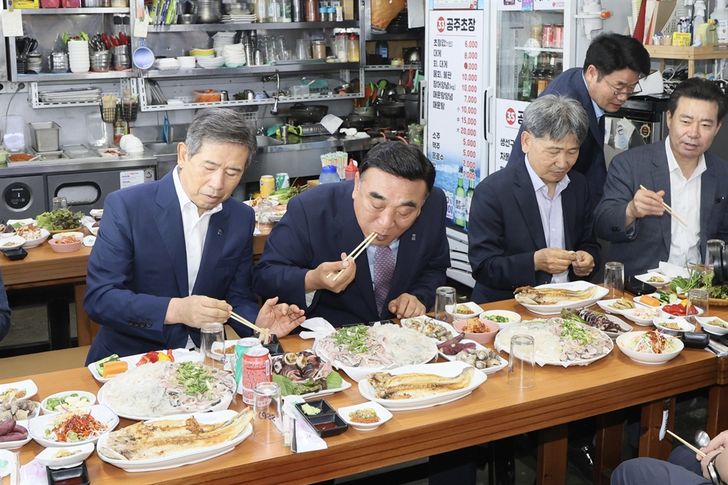
Ulsan Mayor Kim Doo-kyum, second from left, eats raw fish during a seafood consumption campaign at a traditional market in Nam District, Ulsan, Wednesday. Courtesy of Ulsan Metropolitan Government
At the local level, municipal governments, particularly those led by members of the ruling party, are also actively advocating for increased seafood consumption.
Ulsan Mayor Kim Doo-kyum and his aides on Wednesday visited a local fishery market and ate lunch at a raw fish restaurant there in order to promote seafood consumption.
On Monday, Seoul Mayor Oh Se-hoon had dinner with medical experts at a raw fish restaurant in Jongno District and said that “the public's groundless fear is due to wrong information on seafood.”
During the dinner, Kang Keon-wook, a professor at Seoul National University's Department of Nuclear Medicine, said that “the groundless fear of the wastewater is exploited for political purposes” and “the tritium level of seafood remains at one-tenth of fruits and vegetables, and seafood naturally emits tritium.”
Other municipal governments are strengthening monitoring of imported seafood to prevent cases of Japanese seafood being labeled as domestic.
Despite the government's efforts, public concern remains as questions are still poised over the IAEA's verification based upon ALPS, the assessments on long-term maritime impact and the presumed existence of contaminated water that is not treated by ALPS.
“Japan's release plan does not contain a comprehensive long-term assessment of the ecological impact on marine ecosystems based on the total radioactivity emissions after the Fukushima accident, and the seafood safety sampling is limited to coastal fish species,” Lee Jeong-yoon, a former nuclear engineer and head of the civic group Nuclear Safety and Future, wrote in a contribution piece to Kyunghyang Shinmun.