INTERVIEW 'Labor reforms aim to foster conditions favorable for both business, labor'

Employment and Labor Minister Lee Jung-sik holds an interview with The Korea Times at the Seoul Regional Employment and Labor Office, Aug. 23. Korea Times photo by Shim Hyun-chul
Minister tackles aging population, low birthrate challenges facing labor sector
By Jun Ji-hye
Reforming the labor sector means not only pursuing pro-business policies, but also promoting a worker-friendly environment, the labor minister said, refuting criticism from unions that the Yoon Suk Yeol administration has been leaning too heavily in favor of big businesses.
During a recent interview with The Korea Times, Employment and Labor Minister Lee Jung-sik said the government's labor reform agenda has emphasized laws and principles with the aim of improving outdated norms and practices and creating a sustainable labor market that can be a substantial help to both workers and managers.
“So, the government's labor reform policies are not pro-business and anti-labor, but pro-business and pro-labor,” Lee said.
“The two umbrella labor organizations have resisted the government's emphasis on laws and principles, but those calls are aimed at establishing fair labor-management relations and protecting the vulnerable,” he added.
Labor reforms are one of three areas of change President Yoon Suk Yeol is pursuing. The other two are education and pension reforms.
Since his inauguration in May 2022, the Yoon administration has attempted to restore market-oriented growth and root out what the president describes as the “deviant behaviors” of some labor unions.
Primarily concerned about the Yoon government's move to reverse pro-labor policies set by the former Moon Jae-in administration, the Federation of Korean Trade Unions and the Korean Confederation of Trade Unions have slammed Yoon for siding with businesses and demanded the president's resignation by holding general strikes and other rallies.
Citing English philosopher John Locke's famous quote, “Where there is no law there is no freedom,” the minister claimed that the public would not support the unions' criticism of the government's labor reforms.
“The government will continue to sternly respond to any illegal and unfair activities, regardless of labor and management, in accordance with laws and principles,” Lee said.
“The government will also focus on reforming bad practices and modernizing the labor sector to resolve uncertainties and irrationality and better protect the vulnerable,” he added.
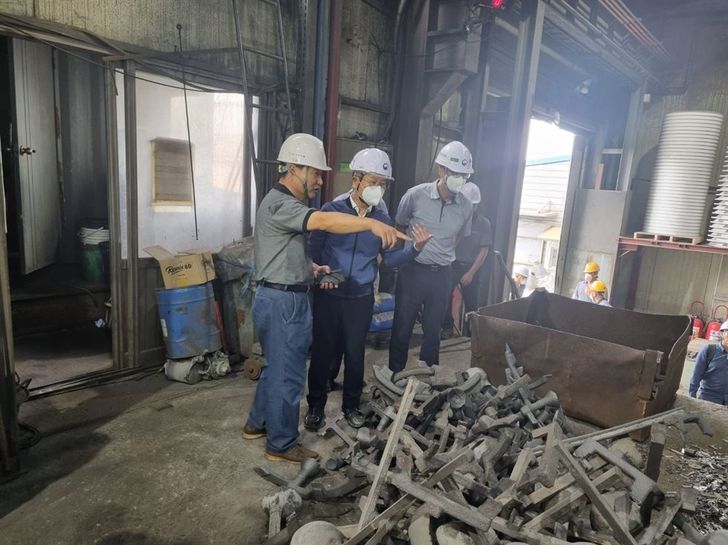
Employment and Labor Minister Lee Jung-sik, center, visits a manhole cover manufacturing factory in Gimpo, Gyeonggi Province, Aug. 22, to listen to difficulties faced by laborers subject to high temperatures in their workplaces. Courtesy of Ministry of Employment and Labor
In that respect, Lee made it clear that the government opposes a move by opposition parties to pass the so-called “yellow envelope bill” at the National Assembly, saying the concept of the proposed legislation is far from something that the government intends to pursue.
The bill, aimed at revising the Trade Union and Labor Relations Adjustment Act, is designed to restrict claims on damage caused by labor strikes and other collective actions. It also calls for guaranteeing the collective bargaining rights of subcontracted workers.
The proposed legislation got its name after supporters of unionized SsangYong Motor workers at the time delivered yellow envelopes with cash following a 2013 court ruling ordering them to pay a combined 4.7 billion won ($3.6 million) to the automaker for causing losses due to their strike in 2009.
“The bill runs counter to the direction of the government's labor reforms that call for all parties ― labor, management and the government ― to obey the law,” Lee said.
“The bill will further incite the practice of attempting to resolve all problems through strikes. This will intensify confusion and disrupt the stabilization of labor-management relations,” the minister added.
Concerning the government's plan to reform the current 52-hour cap on the workweek, the minister maintained his ministry's position that there should be more options for working hours for both labor and management.
When announcing its plan to reform the workweek system on March 6, the ministry claimed it is seeking flexibility beyond the mandatory cap on the workweek introduced by the previous administration.
Under the plan, the maximum weekly work hours will be extended to 69 during busy periods, and subsequently, workers would be granted longer vacations instead.
However, the plan was criticized for benefiting employers, while forcing employees to work longer hours. That prompted the president to order the labor ministry to review the proposal.
Lee said the plan intended to make working hours more flexible, since the current cap, which applies to all industries, is based on a factory system that was prevalent 70 years ago.
“Such a cap is not in accordance with today's industrial environment,” Lee said, stressing that the plan is not intended to indiscriminately allow longer working hours.
“We have surveyed 6,000 people to listen to more opinions from labor and management as well as the general public,” he said. “We will draw up measures to improve the plan based on the survey results.”
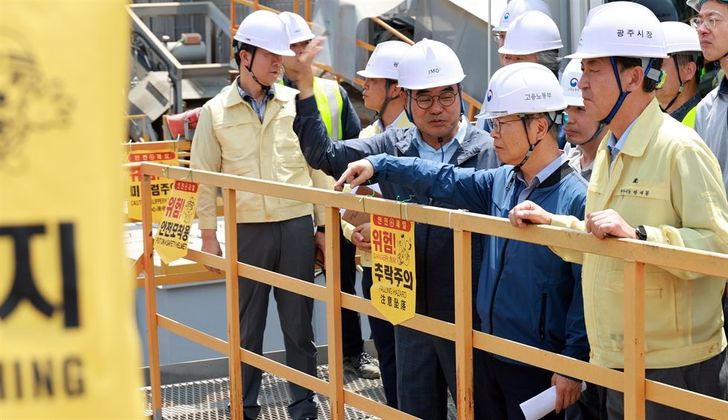
Employment and Labor Minister Lee Jung-sik, second from right, visits a stone mill in Gwangju, Gyeonggi Province, Aug. 3, to check measures to protect workers from the heat. Courtesy of Ministry of Employment and Labor
Utilizing foreign workers
Another urgent task for the minister is dealing with a labor shortage caused by the country's aging population and low birthrate.
As part of efforts to ease the shortage, Lee recently announced a decision to fundamentally reform the Employment Permit System (EPS) system, in accordance with many economic and social changes that have taken place since the system was introduced 20 years ago.
The EPS is a migration labor program, under which workers from 16 Asian countries, including the Philippines, Vietnam, Thailand and Indonesia, are allowed to work here under special visas.
“This reform will be carried out aiming to improve the rights of workers and address challenges faced by employers,” Lee said.
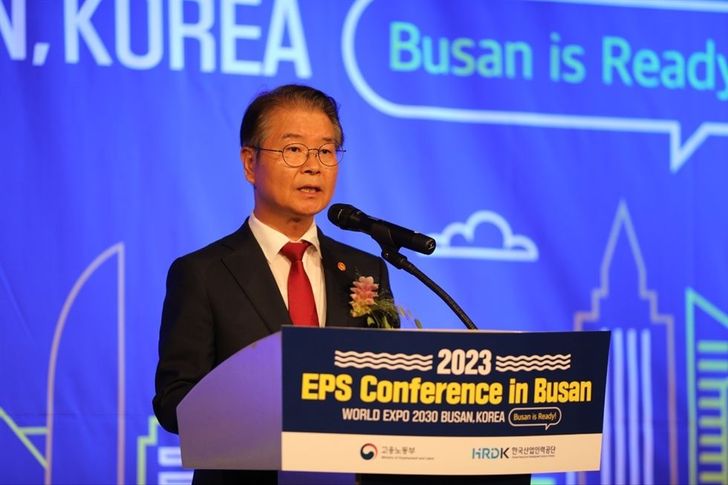
Employment and Labor Minister Lee Jung-sik delivers a congratulatory speech during the 2023 EPS Conference in Busan, Aug. 9. Courtesy of Ministry of Employment and Labor
The first step will be swift deregulation to enable a more flexible labor supply, including a decision, announced on Aug. 24, to increase the cap on foreign workers to around double the current limit in certain industries, such as manufacturing and agriculture.
The number of foreign workers will also be increased from 110,000 to 120,000 by the end of the year and to over 120,000 in 2024, which will be the highest ever.
The ministry also unveiled a pilot program on July 31 to hire 100 people from mostly Southeast Asian countries within this year to work as housekeepers and babysitters. Through that project, the government hopes to address a shortage of nannies and ease the burden of childcare faced by working parents.
The minister said the pilot program would be meaningful by giving more options to working parents and could be a new method to tackle the nation's low birthrate problem.
“Along with the pilot program, we will analyze demand and supply and the satisfaction level of the service. We will also study cases of foreign countries,” he said.
“We will then draw up a rational measure that suits the circumstances of this country.”