Calls grow for steps to limit number of political banners

Banners installed by political parties hang near a crosswalk in Seoul's Mapo district, June 21. Korea Times photo by Ha Sang-yun
By Lee Hae-rin
Amid a surge in complaints by the public as well as safety concerns over political banners mounted outdoors, calls are growing here to put a legislative restriction back in place to regulate political parties from putting them up.
According to the Ministry of Interior and Safety, Monday, the number of civil complaints concerning political banners went down by 12 percent from April to 3,680 in May.
The decrease is believed to be the result of the ministry's new regulatory guidelines on installing political banners, issued in May. But the figure still remains much higher than last year's 2,000 ― before the amendment to the Outdoor Advertisements Act took effect in December 2022 ― which gave political parties the freedom to install banners without local government permission.
Previously in Korea, banners could be installed outdoors without local government permission only if they involved school or religious events, safety and traffic instructions or announcements related to missing children or accident witnesses.
However, in December 2022, political parties were also allowed to install banners without limitation, anywhere, without local government permission, as the revised bill took effect.
The bill, originally proposed to let political parties exercise their constitutional rights to activities by Rep. Kim Min-chul of the Democratic Party of Korea (DPK) in 2020, initially saw some opposition but was passed unanimously in May 2022.
The legislation's impact was almost immediate as political parties took advantage of the relaxed rules and filled streets with banners in an attempt to gain voter attention, leading to a surge in civil complaints and safety concerns of late.
Several people who spoke to The Korea Times on condition of anonymity criticized the surge in the number of political banners, saying that they are often not informative, but focus primarily on slandering members of rival parties instead of offering policy information.
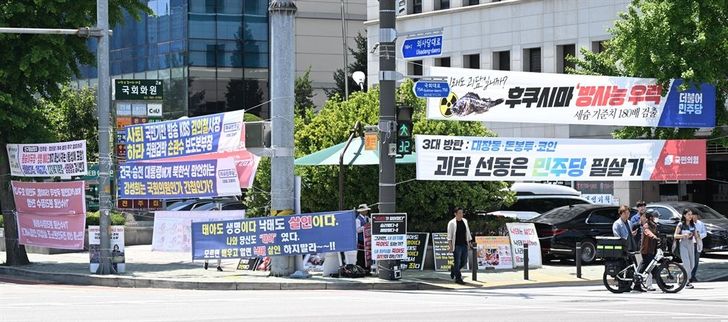
A crosswalk in front of the National Assembly in Seoul is filled with banners installed by political parties and protesters, June 16. Korea Times photo by Koh Young-kwon
In addition, many people believe that the surge in the number of political banners spoils the city's urban landscape. They argue that political parties often choose to use primary colors, such as red and blue, which can lead passersby to associate the banners' negative messages with rival parties.
Some banners have been found to block traffic lights and signboards, raising safety concerns. The safety ministry reported that at least six accidents had been reported by May, in which pedestrians tripped over banners and were injured.
A series of problems posed by the explosive growth of banners have ignited public outrage, as the number of civil complaints reported nationwide more than doubled, from 6,415 to 14,197 during the three months before and after the amendment took effect, according to the National Assembly Research Service.
The banners are also being criticized due to environmental issues, as over 236 tons of waste from discarded banners were generated last year in Seoul alone, most of which are non-recyclable.
In response, the safety ministry issued guidelines to regulate banners in May. The guidelines specify how to install banners outdoors so as to enhance safety and slightly decrease civil complaints, but are not legally binding.
Local governments have also been struggling to deal with the problem.
The Seoul Metropolitan Council proposed an ordinance earlier this month to regulate political banners. However, the safety ministry said discarding installed banners based on the local council's ordinance is against the current law and called on lawmakers to enact new legislation.
A total of eight relevant amendment proposals are pending at the National Assembly as of Monday.
Among them, the ministry views the proposal by ruling People Power Party Rep. Lee Man-hee, which adds restrictions on the number, size and location of political banners, as the most viable alternative to find a solution to the problem.