Yoon urges gov't effort to ensure public benefits from Camp David summit

President Yoon Suk Yeol speaks during a Cabinet meeting at his office in Yongsan District, Seoul, Monday. Yonhap
By Nam Hyun-woo
President Yoon Suk Yeol said, Monday, the government should step up efforts to help the public experience the outcomes of his summit with U.S. President Joe Biden and Japanese Prime Minister Fumio Kishida last week in a bid to dispel the opposition's doubts over the feasibility of agreements from the gathering at Camp David.
“The three countries' partnership and their pursuit of common interests are not exclusive, but rather universal and just,” Yoon said during a Cabinet meeting. “Ministries should put effort into making the achievements of the South Korea-United States-Japan cooperation system tangible and ensure their benefits could be felt by the citizens.”
On Friday (local time), Yoon, Biden and Kishida gathered at the U.S. presidential retreat of Camp David in Maryland and adopted a series of documents that heightens the three countries' security cooperation and economic partnerships into a quasi-alliance level.
During the summit, the leaders agreed to institutionalize their three-way cooperation by agreeing to hold the trilateral summit at least once a year, and set up a number of annual Cabinet members' meetings, in order to improve the sustainability of their cooperation regime and expand the areas of partnerships.
The leaders also agreed to set up a data-sharing warning system for North Korea's missile launches and regularly hold joint military exercises between the three countries.
“The bigger the threat from the North grows, the stronger the security cooperation between the three countries becomes,” Yoon said. “This will lower the risks of North Korean provocations and strengthen our national security.”
On the economic front, the leaders agreed to link each country's supply chain early warning systems, in order to better respond to possible disruptions in securing key industrial materials.
Yoon cited a 2021 nationwide shortage of diesel exhaust fluid (DEF), which stemmed from China's export control due to its domestic shortage and caused public inconvenience, especially among diesel vehicle drivers.
He further noted that the trilateral partnership allows prompt responses from such external disruptions, as well as addressing uncertainties of industries with high dependency on critical minerals, such as semiconductors, electric vehicles and rechargeable batterys.
“The trilateral cooperation regime at Camp David is about transforming global complex crises and challenges into opportunities through collective leadership and responsibility,” Yoon said. “The risks to our citizens will undoubtedly decrease, while the prospects for opportunities will substantially increase.”
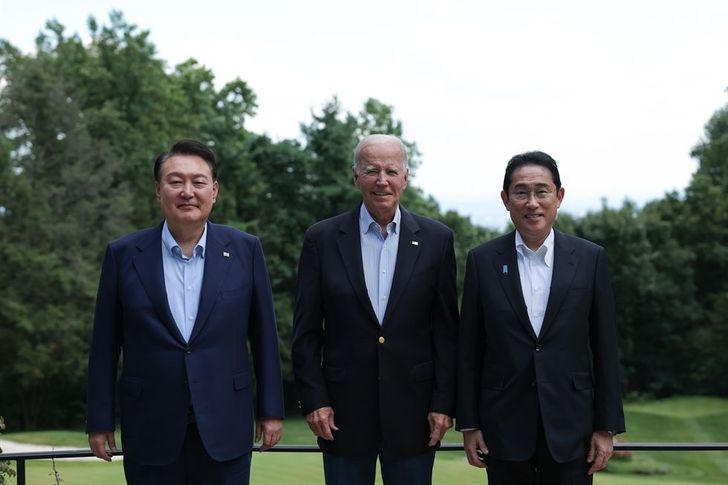
From left, President Yoon Suk Yeol, U.S. President Joe Biden and Japanese Prime Minister Fumio Kishida pose before their luncheon at Camp David in Maryland, Friday (local time). Joint Press Corps
Yoon's comments are an apparent rebuttal to the opposition's criticism that the outcome of the summit remains “intangible and unpractical.”
“The majority of the public opinion is that the national interests of the U.S. and Japan were visible at the summit, but not that of South Korea,” main opposition Democratic Party of Korea (DPK) floor leader Rep. Park Kwang-on said during a party meeting, Monday.
Park continued, “The enhanced military cooperation between South Korea, the U.S. and Japan should not be the opportunity to strengthen the confrontation on the Korean Peninsula or heighten the regional tensions … The public are concerned that South Korea could fall to a subordinate partner of the U.S.-Japan relations.”
DPK Chairman Rep. Lee Jae-myung slammed Yoon for not correcting the U.S. reference to the East Sea as the Sea of Japan, and not having discussions with Kishida on stopping Japan's plan to release wastewater from the Fukushima Daiichi Nuclear Power Plant into the ocean.
Against this backdrop, Lee Seong-hyon, a senior fellow at George H. W. Bush Foundation for U.S.-China Relations said it is imperative for Yoon to visibly demonstrate to the South Korean public that he knows what he is doing.
“A prominent way to achieve this is by revitalizing the nation's struggling economy. With the legislative election set for April of next year, Yoon needs to deliver concrete economic results. Failure to do so might undermine his bold new foreign policy initiative, rendering it reckless,” he added.
According to a Realmeter poll released Monday, a three-week streak of improvement in his approval rating was snapped, due largely to the country's failure in hosting the World Scout Jamboree earlier this month. The outcome of the Camp David summit was not reflected in the poll.
Yoon's job approval rating stood at 35.6 percent in the Aug. 14 to 18 poll, down 2.7 percentage points from a week earlier. A Realmeter analyst attributed this to “the country's unsuccessful hosting of the World Scout Jamboree earlier this month,” adding that, “there seemed to be limitations in shifting the focus to the Camp David summit, as Yoon, who should be the most influential speaker, could not promote the summit due to the death of his father.”
The Realmeter poll surveyed 2,016 adults at the request of Media Tribune, and further details are available on the National Election Survey Deliberation Commission's website.