INTERVIEW China expert expects Xi to emulate Putin on Taiwan

A People's Republic of China (PRC) warship, identified by the U.S. Indo-Pacific Command as PRC LY 132, crosses the path of U.S. Navy destroyer USS Chung-Hoon as it passes by the Taiwan Strait with the Royal Canadian Navy frigate HMCS Montreal on June 3 in an image captured from video. Reuters-Yonhap
Retired US Air Force general unravels China's political warfare, urges political leaders of free democracies to look into Beijing's true intentions
By Kang Hyun-kyung
There are two schools of thought in the United States about how to interpret China's motives behind its massive military buildup.
Some senior military officials, such as Adm. Michael Gilday and Air Force Gen. Mike Minihan, claim that China's invasion of Taiwan is imminent and it could occur as early as 2023.
Senior officials at the Department of Defense, however, remain doubtful about the claims. In February, Colin Kahl, then undersecretary of defense for policy, said on a podcast interview with Defense News that he did not see anything suggesting that a Chinese invasion of Taiwan is imminent in the next couple of years.
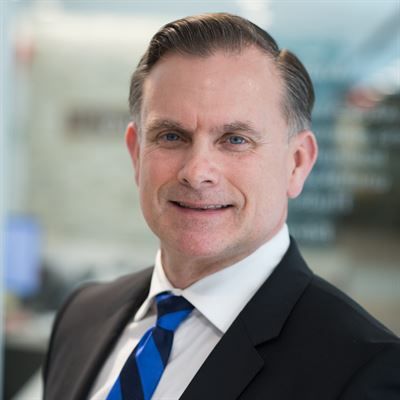
Gen. Robert Spalding
Retired Brigadier Gen. Robert Spalding sides with the senior military officials' hawkish outlook, forecasting Chinese President Xi Jinping to emulate Russian President Vladimir Putin on Taiwan.
“China will attack soon,” he said in an email interview with The Korea Times on Tuesday. “They are practicing every day, and Xi has said he will not leave the Taiwan question unsettled on his watch.”
He said there were people in the West who underestimated Putin's ambitions, prior to Russia's invasion of Ukraine in February 2022, adding that they ended up being wrong.
“People believed that Putin would not invade Ukraine, because it seems crazy from the position of someone who lives in a free country. But powerful dictators have a different way of looking at the world,” he said. “The biggest problem we have in the free world is the inability to see from the perspective of our enemies. And be assured that the Chinese Communist Party (CCP) is our enemy.”
He called on the leaders of free democracies to try to look into the mind of the Chinese leader to understand his and his country's course of action in the future.
Cross-strait relations have drawn keen attention from South Koreans as well, mainly due to its huge potential fallout on the divided country.
If China invades Taiwan, the entire region will be affected and countries like South Korea and Japan will find their security at risk.
Gen. Spalding, author of the 2021 book, “War Without Rules: China's Playbook for Global Domination,” observed that U.S. strategy toward China based on wishful thinking is an impediment prompting the U.S. to remain unprepared for China's political warfare.
“When I arrived at the Pentagon as the China adviser to the chairman of the Joint Chiefs of Staff in 2014, the instructions were clear: We were not going to do anything in public to antagonize China as their relationship is too significant financially,” he wrote in his book. “The narrative was that the two most powerful countries in the world had to cooperate to solve greater challenges in nuclear-armed North Korea and climate change. That stance was built on the absurd idea that China wants to fix either of these issues. (It doesn't).”
His observation partly explains the origin of the perception gap in China's motives behind its massive military buildup.
Frontline military brass sensed the threat from China is real and imminent, but senior officials at the Pentagon are advised not to address it publicly, hoping the matter would be settled peacefully. Hence, the perception gap.
The complexity and confusing nature of China's military strategy, summarized in the book, titled “Unrestricted Warfare,” poses another challenge to effective U.S. policy responses, according to Gen. Spalding.
Published in 1999, “Unrestricted Warfare,” co-authored by two colonels of the People's Liberation Army, Qiao Liang and Wang Xiangsui, has become China's military playbook to help China become the sole superpower in the future after defeating the U.S.
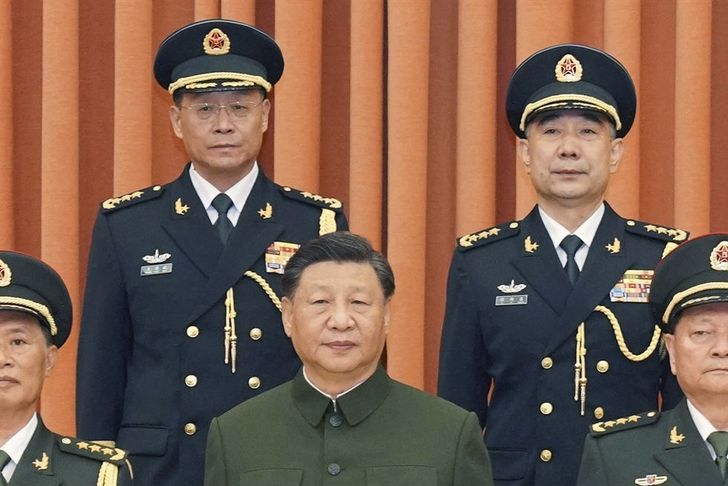
In this photo released by Xinhua News Agency, Chinese President Xi Jinping, also chairman of the Central Military Commission (CMC), center, poses for photos with the new commander of the rocket force, Wang Houbin, top left, and political commissar Xu Xisheng, top right, after promoting them to the rank of general in Beijing on July 31. AP-Yonhap
Gen. Spalding said “Unrestricted Warfare” is about the “everywhere war,” noting it has already begun.
With the term “everywhere war,” Gen. Spalding said China and its state-sponsored entities mobilize every possible, even illicit, means if they were to help China achieve its goals.
Such illicit means include cyberattacks, industrial espionage to steal technology, bribing and funding politicians to establish policies favorable to China and turning a blind eye to the illegal production of fentanyl, which has been shipped to the United States and led to the drug epidemic there, to name a few.
“The U.S. is completely unprepared, because 'Unrestricted Warfare' is about political warfare,” he said. “The U.S. is good at conventional warfare, but democracies are very vulnerable to Unrestricted Warfare, because it leverages the openness of free societies against the principles upon which they are founded. Unrestricted Warfare leverages the business and academic community to begin to decrease the traditional advantages enjoyed by democracies for creating economic opportunity.”
He said China does this by destroying the rules that make the system function in a fair and meritocratic manner. “Slowly the societies devolve into Marxism, and that is what we are seeing today,” he said.
Gen. Spalding was a former pilot of a B-2 Spirit stealth bomber, one of the key U.S. strategic assets.
“Being a B-2 pilot was an extreme experience,” he said. “From just the pure thrill of flying two aircraft (B-2 pilots fly both the B-2 and T-28 supersonic trainer), and the strategic nature with which the B-2 is used in combat. My most thrilling moments were not always in the cockpit. Sometimes it was being on the ground as a commander waiting for my crews to arrive home safely.”
B-2 Spirit is one of the bombers the U.S. Air Force is reportedly mulling to deploy regularly in and around the Korean Peninsula to strengthen deterrence against North Korea.
The stealth bomber is one of the most lethal U.S. strategic assets that, according to North Korea experts here, “leaves North Korean leader Kim Jong-un in shock and awe.”
Gen. Spalding concurs with their view, saying the B-2 is a powerful weapon system.
“Its power is that is so capable that enemies should fear its use. This fear is at the heart of deterrence,” he said. “These are the tools of the nuclear age and it is what stayed the hand of the U.S.S.R for decades. We must use this power wisely to prevent war in the future.”
During his over 26 years of service in the military and the U.S. government, Gen. Spalding served as the chief China strategist for the chairman of the Joint Chiefs, the Joint Staff at the Pentagon. He also served at the White House as the senior director for strategic planning at the National Security Council.
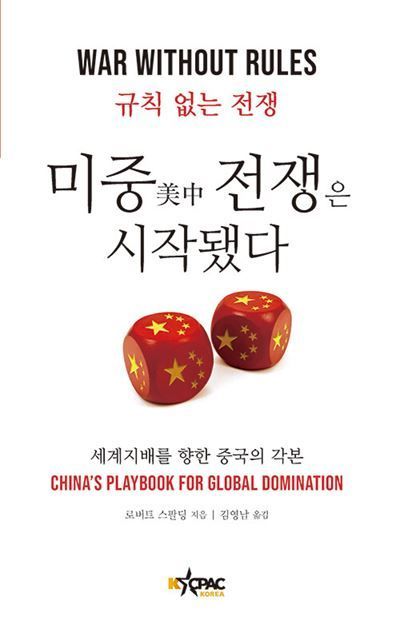
Gen. Robert Spalding's 2021 book, “War Without Rules: China's Playbook for Global Domination,” was translated into Korean and released for sale in July.
His 2021 book, “War Without Rules: China's Playbook for Global Domination,” was translated into Korean and released in local bookstores for sale in July.
It's a rare but informative book written by a retired U.S. Air Force general designed to teach China's military and communist party and their political warfare which people in Western democracies are not familiar with.
The publication is timely as it was released amid growing concerns that China's interference in foreign elections and misinformation campaign could disrupt South Korea, ahead of the National Assembly elections to be held in April next year.