Parents to be required to schedule meetings, phone calls with teachers

Cho Hee-yeon, superintendent of the Seoul Metropolitan Office of Education, speaks during a press conference at the education office in Seoul, Wednesday. Yonhap
By Jun Ji-hye
Parents will have to make a reservation before meeting with or phoning teachers, as part of measures introduced by the Seoul Metropolitan Office of Education (SMOE) to protect educators from facing excessive calls made by demanding parents, SMOE Superintendent Cho Hee-yeon announced Wednesday.
The progressive superintendent said waiting rooms equipped with surveillance cameras will be introduced at some schools in Seoul to control visits by parents more strictly.
In instances where teachers face legal disputes with parents, the education office will expand its support for lawsuit costs and simplify procedures to carry out the necessary support.
The announcement came amid increasing calls to better protect teachers' wellbeing, after an elementary school teacher in her 20s ended her life inside her classroom last month. The teacher's death has triggered a torrent of speculation online that she suffered from constant harassment from the parents of some of her students.
“We plan to introduce a reservation system for meetings or phone calls with teachers, in a bid to create a unified communication channel to deal with parents' complaints,” Cho said during a press conference. “This system will keep teachers from having to handle such complaints on their own.”
Cho said his office will introduce chatbots, which have been utilized at banks and public offices, to deal with frequently asked questions, as a way to lessen the burden on teachers stemming from parental complaints.
“Excessive and malicious complaints made by some parents have infringed on teachers' rights and threatened their survival,” Cho said, noting that this experimental system will be adopted at schools in Seoul next month.
In line with the plan, the education office will launch another pilot project, also next month, to create waiting rooms monitored by surveillance cameras at some schools for stricter access control. Parents who want to talk to teachers in person will be asked to wait in these rooms.
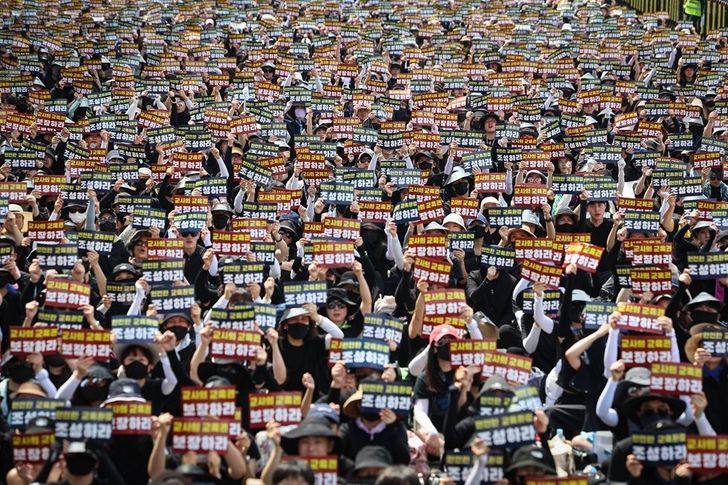
Teachers from across the country lift signs calling for better protection of teachers' rights during a rally in Seoul, Saturday, following the recent suicide of a young elementary school teacher inside her classroom. Yonhap
The education office will also enhance its support for teachers facing legal disputes, in response to criticism that many educators across the country have been suffering from indiscriminate accusations of child abuse filed by parents or students.
According to teachers' unions, most of the accusations against teachers have been filed as a result of their attempts to guide students, such as grabbing them by the arm to stop a fight or telling noisy students to be quiet.
Cho said his office will expand the scope of support for lawsuit costs and simplify procedures.
Such support is offered only after teachers' rights committees at schools complete their deliberations of each case. Under the change, teachers can be offered the support by simply presenting a document showing that the committee plans to deliberate on their case.
In a bid to reduce the number of cases being taken to court, the office will also enhance its grievance mediation services.
Cho, however, did not mention any plans to revise the student rights ordinance, which has been cited by many teachers and unions as one of the major factors causing frequent infringement of teachers' rights.
“I maintain the position that teachers' rights are not in conflict with students' rights,” he said. “My office is currently collecting opinions about measures to ramp up students' accountability in response to chronological changes.”
The progressive-led student rights ordinance, which was enacted in 2010 to view each student as an individual human being rather than the subject of control, bans corporal punishment and discrimination by teachers. Although the ordinance has been praised for its good intentions, it also faced criticism for only emphasizing students' rights, while neglecting teachers' rights.