Ex-president's key aides are masterminds of Yoon's policies

Former President Lee Myung-bak, third from left, waves to citizens as he walks along the Cheonggye stream in central Seoul, May 15. Newsis
Opposition denounces practice as refusal to embrace fresh faces
By Nam Hyun-woo
President Yoon Suk Yeol has filled key posts in his administration with those who served under former President Lee Myung-bak, triggering a strong backlash from the opposition party and some civic groups, which argue the move is no more than a return to the past.
While the opposition claims this practice highlights the president's refusal to embrace fresh faces and diverse perspectives, some attribute it to a lack of talent in the conservative spectrum in Korea, which was annihilated after the impeachment of Lee's successor, former President Park Geun-hye.
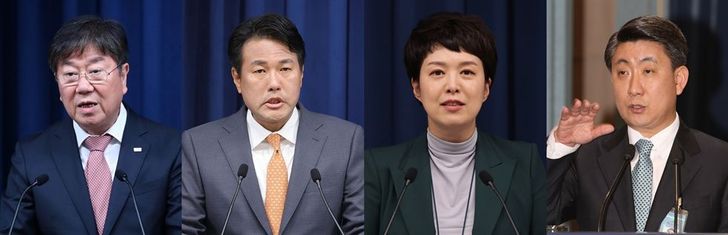
From left, Kim Dae-ki, Kim Tae-hyo, Kim Eun-hye and Lee Dong-kwan / Korea Times file
The latest figure who joined the Yoon administration is Lee Dong-kwan, the former president's senior secretary for public relations.
Yoon, Friday, nominated Lee, his special adviser for external relations, as the new chief of the Korea Communications Commission, which oversees and regulates broadcasting and communications services, according to his office. Lee's appointment is subject to parliamentary confirmation scheduled for next month.
Lee is one of the key aides to the former president, who led the country from 2008 to 2013. The special adviser served as the spokesperson for Lee from 2008 to 2009 before being promoted to senior secretary for public relations from 2009 to 2010. Afterward, he served as a special adviser for the president on the media in 2011.
“The current issue revolves around the global fight against fake news, with governments and civil organizations fully committed to addressing the challenge,” the nominee said. “As a priority, I will make efforts to restore a fair media ecosystem and create an information dissemination environment that fosters freedom and open communication.”
The nomination triggered blatant criticism from the opposition.
“Nominee Lee spearheaded media suppression during the Lee Myung-bak government, by mobilizing the National Intelligence Service (NIS) and the police, and openly interfering in personnel matters of broadcasters,” main opposition Democratic Party of Korea spokesperson Rep. Kang Sun-woo said, Saturday.
“That was the very case that President Yoon, who was then a prosecutor, was investigating allegations that the NIS intervened in domestic elections. It is nonsense that the nominee was a problematic figure at the time, but is now the right person for the job.”
Earlier this month, Yoon appointed former Culture Minister and actor Yu In-chon as presidential special adviser for cultural affairs and sports, a new position Yoon created for the former minister.
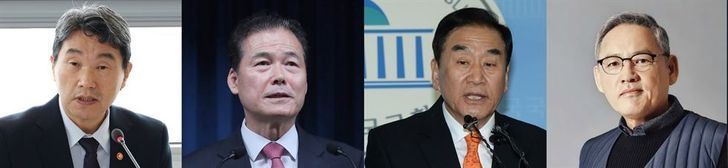
From left are Lee Joo-ho, Kim Yung-ho, Lee Jae-oh and Yu In-chon / Korea Times file
Yu served as the culture minister during the Lee administration from 2008 to 2011, and later became a special adviser to the former president.
These two individuals are the latest among the presidential secretaries, ministers, and other high-ranking government officials who served during the Lee administration and are now working for Yoon.
Within the presidential office, several key positions are now occupied by former aides or ranking government officials from the Lee administration. They include Yoon's Chief of Staff Kim Dae-ki, First Deputy Director of National Security Kim Tae-hyo, senior presidential secretary for public relations Kim Eun-hye, senior secretary for civil and social agenda Kang Seung-kyoo, and secretary for state affairs monitoring Han Oh-seop.
Expanding the scope to the entire political spectrum of Korea, Deputy Prime Minister and Minister of Education Lee Joo-ho and Unification Minister Kim Yung-ho have experience serving the Lee administration. Minister of Patriots and Veterans Affairs Park Min-shik is also known to have been a Lee loyalist when he was a lawmaker.
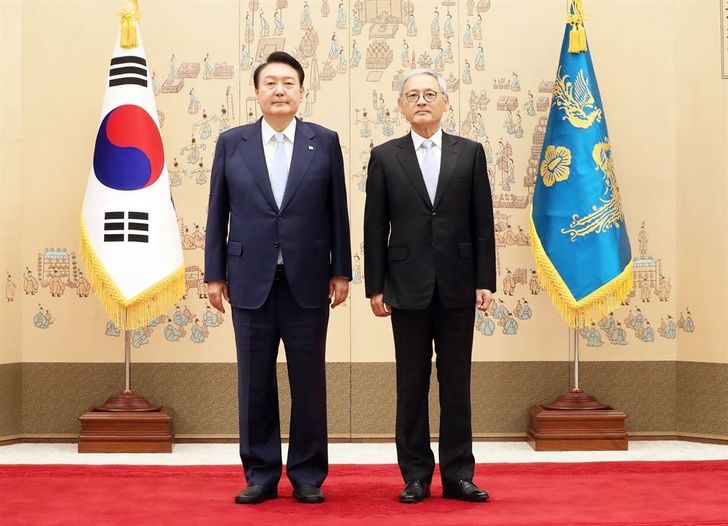
President Yoon Suk Yeol poses with his special adviser for cultural affairs and sports Yu In-chon during an appointment ceremony at the presidential office in Yongsan District, Seoul, July 7. Korea Times photo by Seo Jae-hoon
Within the ruling People Power Party, there are former Lee administration officials who constitute the party's mainstream. They are Reps. Kweon Seong-dong and Yoon Han-hong, known as Yoon's key allies, who were presidential secretaries under Lee.
The return of former aides to Lee had widely been anticipated even before Yoon took office, because his presidential transition committee and election camp were filled with those who served under the Lee administration.
Restricted talent pool
Experts noted that Yoon's reliance on Lee's former aides is a natural consequence of Korea's recent political history.
“After the impeachment of former President Park Geun-hye, the only remaining political faction among conservatives is those who were loyal to former President Lee, as most of them were politically retired in the wake of the impeachment,” said Shin Yul, a political science professor at Myongji University.
Park succeeded Lee in 2013, but could not complete her five-year term, because she was ousted due to a large-scale corruption scandal. Yoon was one of the lead prosecutors who investigated Park's scandal, and later became the prosecutor general of the liberal Moon Jae-in administration that followed.
After taking power, the Moon administration promoted the catchphrase of “draining old swamps” and launched investigations into some of those who served ranking positions during the Park administration. Although Yoon later turned his back on Moon and emerged as the flagbearer of the conservatives, the investigations labeled many of those who served under Park as “failed conservatives,” preventing Yoon from hiring Park's aides, pundits said.
“During the Moon administration's campaign against the legacy of Park, many individuals who had served under the former president were marginalized from the country's politics,” said Park Sang-byeong, a professor at Inha University's Graduate School of Policy Science.
“Although years have passed since then and some of those who were investigated were found to be innocent from a legal perspective, they are still perceived as politically retired due to the lingering negative public sentiment surrounding the Park presidency.”
The professor also noted the difference in the political backgrounds of former Presidents Lee and Park, which is the reason why former aides to Lee are now occupying prominent positions within conservative circles.
“While former President Lee forged his political career together with close aides when he was first elected as Seoul mayor, Park, who is the daughter of former President Park Chung-hee, established her career more independently, benefitting from her father's legacy,” Park said.
Shin at Myongji University also pointed out the distinction between those who served under Lee and those close to Park.
He stated that individuals who worked with Lee have earned a reputation as pragmatists, whereas those aligned with Park are considered conservative ideologists. This distinction makes it challenging for Yoon, whose political background is not based on ideology, to rely on talents from the Park administration.
“If Yoon were to position himself as the prodigy of the conservatives, he might opt for people from the Park era,” Shin said.
“However, considering Yoon's history with both conservative and liberal blocs, his remaining viable option is to lean towards pragmatism, leading him to seek out individuals from the Lee administration.”
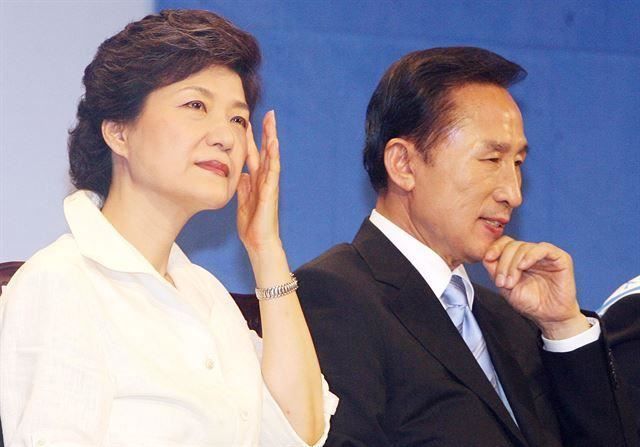
Then presidential hopefuls Park Geun-hye, left, and Lee Myung-bak wait for their turn to give speeches during the presidential primary of the Hannara Party, the predecessor of the People Power Party, at a stadium in Anyang, Gyeonggi Province, in this Aug. 13, 2007 photo. Korea Times file