Next year's hourly minimum wage raised 2.5% to 9,860 won

Jeong Yong-jae, left, a senior official at the Korean Confederation of Trade Unions, protests after the next year's hourly minimum wage was set at 9,860 won at the Minimum Wage Commission meeting at the Government Complex in Sejong, Wednesday. Yonhap
Labor, business circles both unhappy about new wage hike
By Jun Ji-hye
The hourly minimum wage for next year was set at 9,860 won ($7.8), a 2.5 percent increase from this year, the Minimum Wage Commission said, Wednesday, after the conclusion of marathon talks.
The new minimum wage translates into a monthly pay of nearly 2.07 million won, up from 2.02 million this year.
Both labor and business circles criticized the new minimum wage ― the former slammed it for failing to reflect inflation, while the latter claimed the hike will increase the burden of personnel expenses faced by businesses.
The Minimum Wage Commission reached the decision at its 15th meeting that started Tuesday afternoon and continued through early Wednesday morning.
The commission was originally composed of 27 members ― nine each representing the public's interest, businesses and labor, but currently there are 26 members after the labor representative was arrested in May while holding a demonstration.
The decision was made in a vote, as the labor and business sides were sharply divided until the end and failed to reach an agreement through negotiations.
The 9,860 won that was finally proposed by the business side earned 17 votes, while the labor side's 10,000 won recommendation received eight. There was one abstention. The results of the vote showed that most of those representing the public's interest sided with the business side.
What caught the most attention was whether the 2024 minimum wage would surpass 10,000 won for the first time, as the labor side had initially proposed 12,210 won, marking a 26.9 percent year-on-year increase, while the business side had initially suggested a freeze. The final decision fell short of the level desired by labor.
The commission took 110 days to set the new minimum wage, marking the longest period of negotiations since the current wage determination system was introduced in 2007. Previously, the longest period on record was 108 days of negotiations in 2016.
The labor members argued that the latest minimum wage hike failed to reflect inflation.
“The 2024 minimum wage was set at a level that fell short of the outlook for next year's economic growth and inflation rates. It is no better than a wage cut,” Ryu Ki-seop, a senior official at the Federation of Korean Trade Unions, told reporters. “Low-wage workers have faced more difficulties as the minimum wage has failed to reflect a sharp price rise for the last two years.”
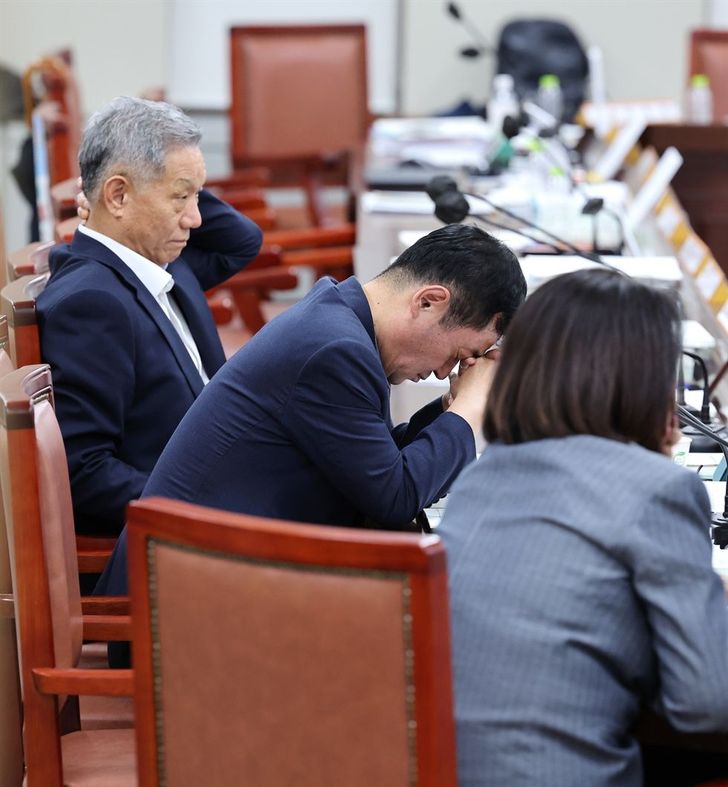
The business-side members of the Minimum Wage Commission agonize during a meeting to decide next year's minimum wage at the Government Complex in Sejong, Wednesday. The commission later set next year's hourly minimum wage at 9,860 won as proposed by the business side. Yonhap
Businesses also denounced the committee's decision, raising concerns that the wage hike will aggravate difficulties faced by enterprises and small business owners.
“Companies and many small business owners have had a hard time due to sluggish sales and inventory accumulation caused by weak domestic demand,” said Chu Kwang-ho, head of the Federation of Korean Industries' economic and industrial division. “The new minimum wage hike is expected to increase the burden of personnel expenses and aggravate these difficulties.”
An association of small business owners, which has strongly demanded a wage freeze, also protested against the new minimum wage hike.
“The Minimum Wage Commission has increased the minimum wage by 52.4 percent for the last seven years, resulting in a reduction in employment,” the association said in a statement. “The latest hike will further destroy jobs.”
Under the law, the commission is required to submit the new minimum wage decision to the labor ministry, which is then required to announce it publicly no later than Aug. 5.
Both labor and business sides can raise objections until this announcement.
The ministry can ask the commission to reevaluate the minimum wage if it determines that the objections are appropriate. But a reevaluation has never occurred since the minimum wage system was introduced.
If finalized, the new minimum wage will take effect on Jan. 1, 2024.