Main opposition party attacks IAEA's credibility over Fukushima report

International Atomic Energy Agency Director General Rafael Grossi, right, listens to Rep. Wi Seong-gon of the Democratic Party of Korea, during his meeting with main opposition party lawmakers at the National Assembly in Seoul, Sunday. Yonhap
DPK calls report 'tailored for Japan'; PPP slams DPK for fighting against science
By Jung Min-ho
After two years of safety inspections on Japan's plan to release treated wastewater from Fukushima Daiichi Nuclear Power Plant, the final report by the International Atomic Energy Agency (IAEA) was supposed to settle the argument.
However, the main opposition Democratic Party of Korea (DPK) rejected its conclusions on Sunday, expressing regret over the IAEA's report, claiming it was “tailored for Japan” and attacking the credibility of the international organization.
Speaking directly to IAEA Director General Rafael Grossi at the National Assembly in Seoul, Rep. Woo Won-shik accused him of conducting research with a “predetermined conclusion.”
“I think there was a lack of neutrality and objectivity from the beginning,” he said during the party members' meeting with Grossi who arrived in Korea last Friday. “It is very regretful that the IAEA made the conclusion without looking into how the water release will affect the neighboring countries in the region.”
Rep. Wi Seong-gon, head of the party's committee against Japan's water release plan, asked Grossi to demand Tokyo delay it.
“We demand Japan put off the discharge plan and consider alternatives, in cooperation with the international community,” he said. “We also ask for the IAEA's responsible handling as an international organization of Koreans' concerns and the issue they rightly raised.”
The heated meeting comes after the IAEA announced, in last week's comprehensive report on Japan's plan to release the treated water into the Pacific Ocean, that it is “consistent with international safety standards.” Grossi also said the conclusions reached were a consensus among all scientists who took part in the Fukushima inspections.
Yet Grossi said the lawmakers' worries were reasonable and assured that the IAEA will continue to monitor the issue. But he reiterated the IAEA's stated position of there being no risk to safety.
“The issue at hand today has attracted a lot of interest, and this is absolutely logical because the actions and the way in which Japan will be addressing this have important implications,” Grossi said.
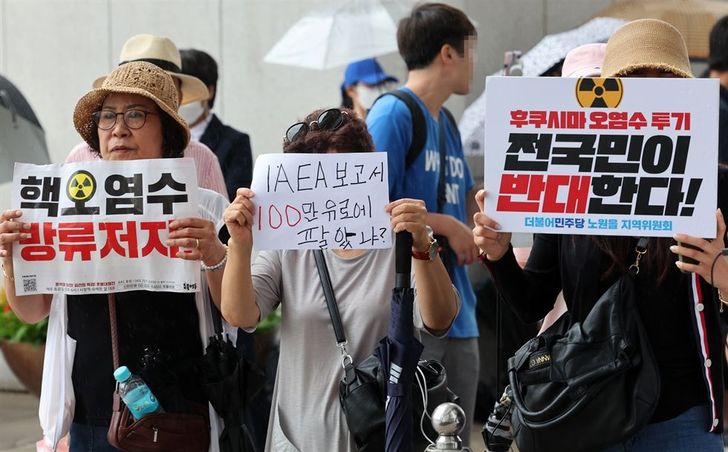
Activists hold a rally at the National Assembly in Seoul, Sunday, in protest of Japan's plan to release wastewater from Fukushima Daiichi Nuclear Power Plant. The sign in the middle says, "Did you sell the IAEA report for 1 million euros?" Yonhap
His trip to Seoul was fraught with tension. The DPK and its supporters vowed to fight the IAEA for “siding with Japan.” When he arrived on Friday, he was met with hundreds of angry protesters at Gimpo International Airport, with some waving signs bearing messages like “Grossi, go home.”
Calling the DPK-led protest an “international shame,” the governing People Power Party (PPP) urged it to stop stoking fears with lies.
“People jeeringly say only the DPK and North Korea distrust the IAEA's findings,” Kim Min-soo, spokesman for the PPP, said in a statement. “We have just been embarrassed by its Fukushima lies and instigation.”
On Saturday, the IAEA chief met Yoo Guk-hee, head of Korea's Nuclear Safety and Security Commission, and Foreign Minister Park Jin to discuss the issue, after the Yoon Suk Yeol administration officially endorsed the safety of the Japanese plan.
A massive earthquake and tsunami in 2011 damaged the power plant's cooling systems. Tokyo Electric Power Company (TEPCO), the operator of the facility, has since been storing the water used to cool it down, producing about 100 tons of contaminated water per day. It has been removing almost all of the contamination from the water using its Advanced Liquid Process System (ALPS), which can treat up to 2,000 tons of water per day.
After the IAEA gave the green light, TEPCO is expected to begin pumping out the treated water soon. It will take decades to discharge the more than 1 million tons of water.