Seoul says Fukushima wastewater release plan meets int'l standards

Government Policy Coordination Minister Bang Moon-kyu, left, announces the government's analysis on Japan's plan to release contaminated water from its damaged Fukushima Daiichi Nuclear Power Plant during a press conference at the Government Complex in downtown Seoul, Friday. Yonhap
IAEA chief to arrive in Seoul Friday evening
By Nam Hyun-woo
The Korean government said Friday Japan's plan to release contaminated water from the damaged Fukushima Daiichi Nuclear Power Plant meets international standards, including those of the International Atomic Energy Agency (IAEA), if Tokyo sticks to its plan.
The government announced this as it revealed its own 22-month analysis on the water discharge plan. It also added that it respects the IAEA's analysis on the Fukushima wastewater, in which the agency evaluated that the overall water processing system meets safety standards and the water would have a negligible radiological impact on both humans and the environment.
“As the government analyzed Japan's wastewater release plan, the total concentration of radioactive materials meets the marine discharge standards,” Government Policy Coordination Minister Bang Moon-kyu said in a press conference.
“For tritium, the analysis detected even lower levels than the Japanese standards, meeting international standards, including the IAEA's.”
Bang continued that the analysis was based on the premise that the water is discharged as planned, and final consideration would be possible only after Japan unveils its final release plan and Korea confirms its feasibility.
In its report, the Korean government anticipated that the wastewater will flow into South Korean waters four to five years after the release, given the sea current is flowing in the opposite direction toward the Pacific Ocean.
Bang also said that the government respects the IAEA's report on the release plan, which was revealed on Tuesday. “It has been the government's longstanding stance to recognize the IAEA as a prestigious internationally agreed-upon agency, and we respect its findings,” Bang said.
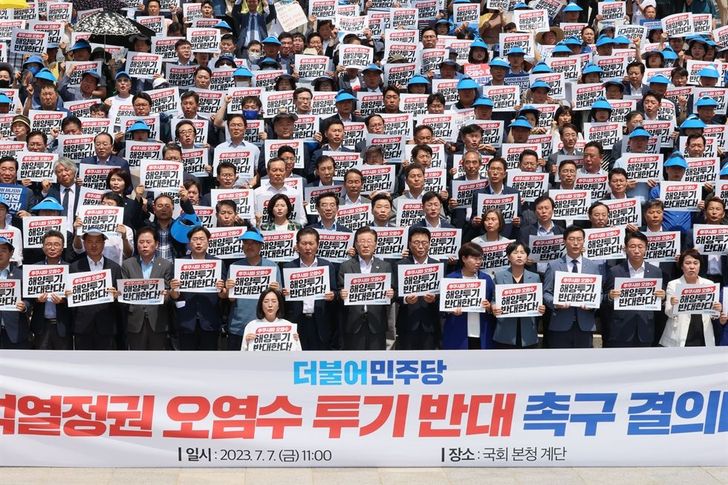
Lawmakers of the main opposition Democratic Party of Korea stage a rally in front of the National Assembly on Yeouido, Seoul, Friday, calling for the government to oppose Japan's plan to release wastewater from the Fukushima Daiichi Nuclear Power Plant. Yonhap
Bang, however, said that Friday's analysis results are only about the validity of the current release plan proposed by Japan, adding that the government will look into Tokyo's final discharge plan and carry out additional review if there are any changes.
The main opposition Democratic Party of Korea (DPK) held a rally in front of the National Assembly on Yeouido, Friday, and condemned the government for prioritizing relations with Japan over threats to public health.
“The IAEA stipulated in its report that it takes no responsibility for any outcomes, and completely ignored the damage that neighboring countries may face,” DPK Chairman Lee Jae-myung said. “The government is obsessed with concealing the possible crisis stemming from the contaminated water release and worried only about possible setbacks to improving Korea-Japan relations.”
The DPK demanded President Yoon Suk Yeol reject the IAEA analysis and demand Japan delay its release plan until scientific, objective and neutral verification can be made.
Minor opposition Justice Party members held a joint press conference with Rep. Yuko Otsubaki of Japan's progressive opposition Social Democratic Party at the National Assembly to protest Japan's wastewater discharge plan.
IAEA Director Rafael Grossi, who is now in Japan, will arrive in Korea late Friday for a three-day visit, with a plan to meet Korea's Foreign Minister Park Jin and Nuclear Safety and Security Commission head Yoo Guk-hee.
Grossi stressed in a press conference in Japan, Friday, that the IAEA is scientific and neutral, and he wants to meet the DPK politicians to speak about the release plan.