Allies to seek stronger trilateral cooperation in envisaged summit
By Kang Seung-woo
Kurt Campbell, the White House Indo-Pacific coordinator, said, Thursday, South Korea, Japan and the United States will explore ways to boost trilateral cooperation ― probably on North Korea's nuclear program and China's assertiveness ― in an envisaged three-way summit.
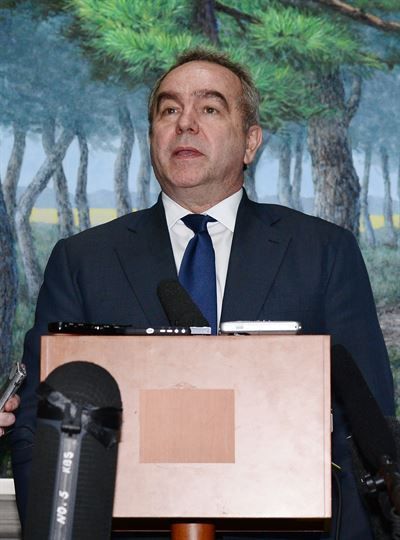
Kurt Campbell
"President Biden extended an invitation to both Prime Minister Kishida and President Yoon to come to Washington later this summer for a three-way summit between the leaders," he said in a video speech for a forum hosted by Yonhap News Agency and the unification ministry.
"(In the envisioned summit), we will celebrate the remarkable progress that's been made in the bilateral relationship between Japan and South Korea, and see what steps we can take to make sure we lock that progress in and to see what's possible to 'trilateralize' areas of cooperation going forward.”
Biden proposed such a summit when he met with Yoon and Kishida on the sidelines of the Group of Seven summit in Hiroshima, Japan last month, to bolster deterrence against the North and strengthen the free and open international order.
Cho Hyun-dong, South Korea's ambassador to the U.S., told reporters in Washington, D.C., Wednesday (local time), that the three sides were in talks over holding the summit in the U.S. capital, while it is expected to take place in August, according to media reports.
The proposed trilateral summit would mark the first such gathering arranged solely for their shared agenda, not on the sidelines of a multilateral forum.
Amid reconciliation between Korea and Japan, the two U.S. regional allies, trilateral cooperation has gained steam.
Among others is a plan on sharing North Korean missile warning data before the end of 2023 as Pyongyang has heightened tensions with its missile program, including its unsuccessful attempt to put a spy satellite into orbit, May 31.
In that respect, the defense chiefs of the three countries agreed, earlier this month, to activate a data-sharing mechanism to exchange real-time missile warning data before the end of the year in order to improve each country's ability to detect and assess missiles launched by North Korea.