Hunger strike or 'mukbang': lawmakers' contrasting responses to Fukushima wastewater release

Lawmakers of the main opposition Democratic Party of Korea ― Rep. Yoon Jae-gap, left, and Rep. Woo Won-shik, center ― stage an indefinite hunger strike at the National Assembly, Monday, in protest of Japan's plan to discharge radioactive wastewater into the sea. At right is DPK Chairman Rep. Lee Jae-myung. Yonhap
IAEA expected to issue final report on Fukushima wastewater in early July
By Lee Hyo-jin
Rival parties are showing contrasting responses to Japan's imminent discharge of radioactive wastewater into the Pacific Ocean. Opposition lawmakers have launched a hunger strike, while ruling party lawmakers are visiting local markets to eat seafood so as to reassure the public that the contaminated water will not affect Korea's seafood products.
However, such political displays that are of no help in seeking practical responses to the issue are causing anger as they only incite conflict, without meaningfully addressing the critical issue at hand.
Rep. Woo Won-shik of the main opposition Democratic Party of Korea (DPK) started an indefinite hunger strike, Monday, in protest of Tokyo's plan to discharge tons of radioactive wastewater from the Fukushima Daiichi nuclear plant into the Pacific Ocean. By doing so, he joined his fellow lawmaker Rep. Yoon Jae-gap who has been fasting for a week since June 20 for the same reason.
During a press conference held at the National Assembly, Woo said his protest targets not only the Japanese government but also the Yoon Suk Yeol administration.
“I will stage an indefinite hunger strike until Japan cancels the discharge plan and President Yoon reconsiders his wrong decision,” Woo said, criticizing Yoon for not taking proper measures against the neighboring country.
On the same day, Lee Jeong-mi, leader of the minor opposition Justice Party, also began a hunger strike in front of the Japanese Embassy in Seoul. She accused Yoon of acting like a parrot of the Japanese government by turning a blind eye to the issue.
The ruling People Power Party (PPP) condemned the DPK for “staging a show” which only aggravates public concern.
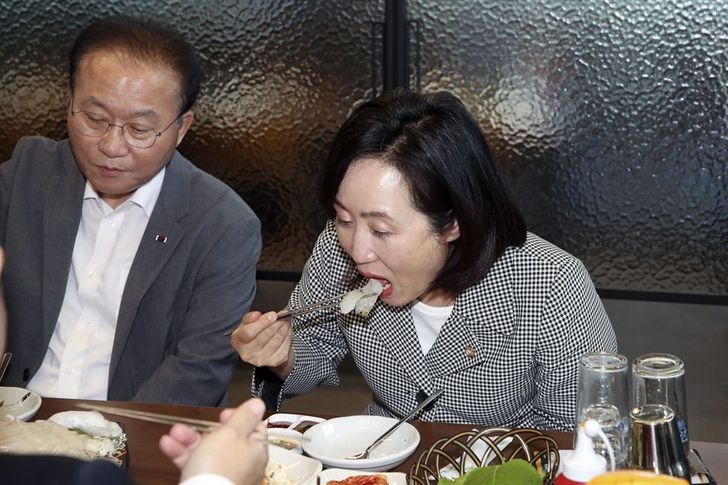
Rep. Jun Joo-hyae of the ruling People Power Party (PPP) eats raw fish at Garak Market in Seoul, Friday. Courtesy of People Power Party
“Their fasting seems like an extreme way to dilute the truth (about the wastewater release),” said PPP floor leader Rep. Yun Jae-ok during a party meeting, Tuesday. He also said that staging a hunger strike against the Korean government seems pointless, given that the decision to discharge the wastewater will be made purely by the Japanese government.
To alleviate public concerns about the possibility of the contaminated water damaging local seafood products, PPP members have been eating seafood from local markets to reassure consumers and show their support for owners of seafood businesses, who worry that their sales will drop following the release of the wastewater.
However, these lawmakers' methods ― resorting to hunger strikes or engaging in 'mukbang' (Korean slang for an eating show) ― do not seem to be gaining support from the public, who are demanding practicable measures on the issue.
The Tokyo Electric Power Company (TEPCO) is currently making final preparations for the water discharge once the International Atomic Energy Agency (IAEA) gives the green light, wrapping up its ongoing safety inspection.
According to Japanese local media reports, IAEA chief Rafael Grossi is expected to travel to Tokyo on July 4 to discuss the final report with Japanese Prime Minister Fumio Kishida, after which Kishida will decide on the exact date for the wastewater release.
According to a survey conducted jointly by Hankook Ilbo and Yomiuri Shimbun among 1,000 Korean adults and 1,017 Japanese adults last month, 84 percent of Korean respondents were opposed to the water discharge plan. Among the Japanese respondents, 30 percent opposed the plan.