Discovery of dead babies exposes loopholes in state management of newborns

gettyimagesbank
Arrest warrant sought for mother accused of killing 2 newborn babies
By Jun Ji-hye
The discovery of two infants who were apparently murdered by their mother and stored in a refrigerator has once again exposed serious loopholes in the country's system of managing newborn babies that relies only on parents to register childbirths.
This has left 2,236 out of some 2.6 million babies who were born from 2015 until last year without any record of registration, while it remains unclear whether they are alive or dead, according to the Board of Audit and Inspection (BAI), Thursday.
The state auditor singled out 23 unregistered babies among the 2,236 and instructed local governments to check if they are alive. This led to the confirmations of at least three babies that have died, and among them, the two dead newborns were discovered at a home in Suwon, Gyeonggi Province, apparently murdered by their mother.
In a bid to prevent newborns from being left unregistered and becoming “ghost babies,” the government has pushed for a new system obligating medical institutions to notify local governments of childbirths. But this has made slow progress due to opposition from the medical community citing an increased administrative burden.
The Gyeonggi Nambu Provincial Police Agency sought an arrest warrant on Thursday for the mother accused of killing her two newborn babies and storing their bodies in a refrigerator at home.
The woman in her 30s allegedly strangled the two babies to death. After giving birth to them at hospitals, she allegedly killed one baby at home in November 2018 and the other near the hospital in November 2019, just one day after they were born.
According to police, she confessed to killing the infants due to her poor financial condition as she was already raising three children. Her husband told police he believed her when she told him she had an abortion.
Police in Hwaseong are investigating a separate case involving child abandonment.
During police questioning, the mother of a baby said she had given the infant to a person she got to know on an internet chatroom less than a month after giving birth.
Police launched investigations into these two cases after the BAI's audit of the Ministry of Health and Welfare that began in March.
The inspection focused on babies whose births were not registered despite records of being delivered at hospitals, as the government faces increasing calls to root out child abuse cases.
The latest cases had remained hidden for years due mainly to the current system that requires only parents to register a baby's birth. Medical institutions are not obligated to do that.
This has often led to cases of child abuse as the government faced difficulties in taking preemptive action to protect children who remain invisible because they are not registered.
In March, a mother was arrested in relation to the death of a 76-day-old baby from a serious case of malnutrition. The mother did not register the birth of her baby, either.
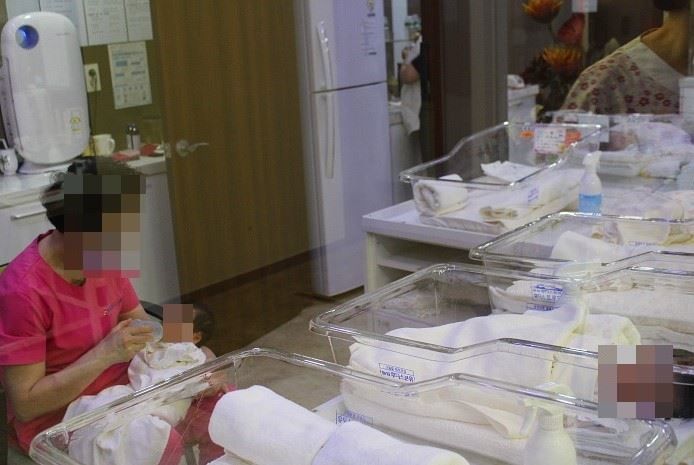
A newborn care unit at a postpartum care center / Korea Times file
As part of efforts to improve the situation, the welfare ministry has been pushing to introduce a new system obligating medical institutions to notify local governments of childbirths.
The medical community opposed this, citing the burden of additional paperwork. They also raised concerns that the new system could force some pregnant women to give birth at unregistered medical facilities.
“The government is attempting to shift the responsibly of protecting children to private medical institutions,” a group of obstetricians said in a statement on April 17.
An official at the welfare ministry said a bill to revise the Family Relation Registration Act, aimed at introducing the new system, is currently pending at the National Assembly.
“We are mulling ways to create a convenient way for medical institutions to participate in the new system to persuade the medical community,” the official said.
Meanwhile, First Vice Health Minister Lee Ki-il said later on Thursday that the government will investigate the whereabouts of all unregistered babies revealed during the BAI's inspection.
“The ministry will cooperate with the Korean National Police Agency, the Korea Disease Control and Prevention Agency and local governments to carry out investigations into all unregistered cases across the country,” Lee said during a media briefing.
“At first, we will attempt to contact the parents of unregistered babies through local governments. If this fails to confirm whether the babies are safe, we will ask police for cooperation.”