Korea to send inspection team to Fukushima Sunday

Park Ku-yeon, left, the first deputy chief of the Office for Government Policy Coordination, speaks during a news conference at the Government Complex Seoul, Friday. At right is Yoo Guk-hee, chairperson of the Nuclear Safety and Security Commission who will lead a delegation to inspect the damaged Fukushima Daiichi Nuclear Power Plant. Korea Times photo by Shim Hyun-chul
Head of Nuclear Safety and Security Commission to lead Seoul team
By Jun Ji-hye
Korea will dispatch a 21-member delegation to Japan this Sunday to assess the neighboring country's plan to discharge treated radioactive water from the crippled Fukushima nuclear power plant, the government announced, Friday.
The delegation, led by Yoo Guk-hee, who chairs the Nuclear Safety and Security Commission, will stay in Japan until May 26 to conduct on-site inspections at the plant and hold discussions with Japanese officials.
Park Ku-yeon, the first deputy chief of the Office for Government Policy Coordination, announced the plans as the two countries reached a consensus on the details of the inspection after working-level talks.
In April 2021, the Japanese government announced a plan to start releasing into the Pacific Ocean starting in 2023 water containing tritium, an isotope of hydrogen, from the wrecked Fukushima Daiichi Nuclear Power Plant, which was devastated by a tsunami triggered by an earthquake in March 2011.
The Fukushima plant, on the east coast of Japan, holds an estimated 1.25 million tons of contaminated water in more than 1,000 tanks.
The dispatch of the delegation was agreed upon during a summit between President Yoon Suk Yeol and Japanese Prime Minister Fumio Kishida on May 7, as part of measures to ease concerns of many Koreans over possible health and environmental hazards from the release of water from the wrecked plant.
The delegation is comprised of 21 members ― 19 experts from the Korea Institute of Nuclear Safety, one expert from the Korea Institute of Ocean Science and Technology and Yoo.
“The official schedule of the delegation will begin Monday when a meeting with Japan's relevant institutions is scheduled,” Park said during a press conference at the Government Complex Seoul. “On-site inspection activities will be conducted on Tuesday and Wednesday to check how contaminated water has been managed.”
Another meeting and Q&A session with Japanese institutions will be held on Thursday based on the results of the on-site inspection, Park noted.
The Japanese institutions include the Ministry of Economy, Trade and Industry, the Nuclear Regulation Authority and the Tokyo Electric Power Company (TEPCO), the operator of the crippled power plant.
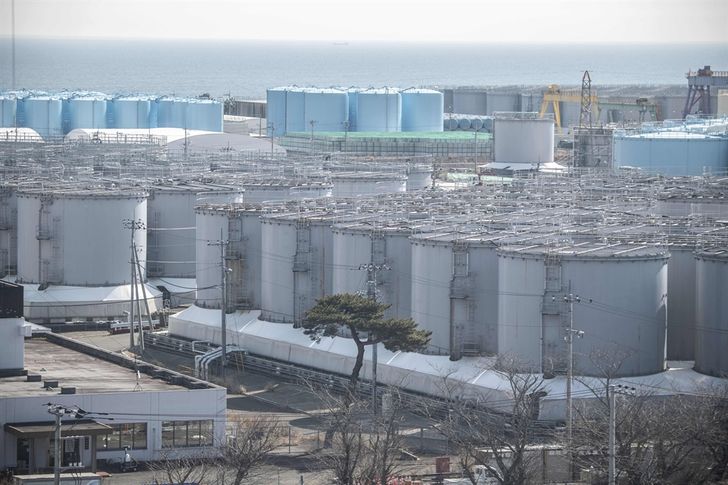
Storage tanks for contaminated water at the damaged Fukushima Daiichi Nuclear Power Plant are seen in this March 11, 2022 photo. Yonhap
The Seoul delegation will check the operation of TEPCO's Advanced Liquid Processing Systems (ALPS), the pumping and filtration units designed to remove radioactive substances from the contaminated water, as well as the analysis results of the water after it is treated through ALPS.
The delegation will also secure the necessary information to conduct its own scientific evaluation of the contaminated water.
“The government will draw up follow-up measures to protect the health and safety of the people based on the results of the inspection,” Park said.
He noted the government will continue to closely consult with Japan about the issue so the contaminated water can be discharged in accordance with international laws and standards.
He added the government will enhance radioactivity checks on adjacent seas and fishery products and crack down on records falsifying the origin of fishery products.