Tension grows in medical circles as President Yoon may veto Nursing Law

Representatives of the Korean Nurses Association hold signs calling for President Yoon Suk Yeol to sign the Nursing Act into law during their hunger strike in front of the association's building in Seoul, Sunday. Yonhap
98% of nurses agree to take collective action in case of veto
By Jun Ji-hye
Medical circles face a critical point this week as President Yoon Suk Yeol could veto the opposition-led Nursing Act in a Cabinet meeting expected on Tuesday.
On Sunday, the ruling People Power Party (PPP) and the government decided to ask the president to veto the act, after a high-level policy consultation meeting attended by PPP Chairman Rep. Kim Gi-hyeon, PPP floor leader Rep. Yun Jae-ok, Prime Minister Han Duck-soo and Health Minister Cho Kyoo-hong as well as several presidential aides including chief of staff Kim Dae-ki.
The decision was made amid strong protests from doctors and nursing assistants over the law, which is designed to help clarify the scope of nurses' duties and improve their working conditions.
“The passage of the bill at the National Assembly without a social consensus has caused serious conflict and confusion,” Prime Minister Han said during the meeting.
Chief of staff Kim also said, “It was regrettable that the bill failed to reflect the opinions of the various parties involved.”
The main opposition Democratic Party of Korea (DPK), which controls more than half of the 300-seat Assembly, unilaterally approved the bill to legislate the law in the Assembly's plenary session on April 27, despite fierce opposition from the PPP as well as the Korea Medical Association (KMA).
The KMA is a doctors' group that is leading a coalition of medical workers' organizations, including the Korean Licensed Practical Nurses Association and the Korean Association of Medical Technologists, in protest against the law.
The Assembly-approved bill was sent on May 4 to the government for Yoon to give his final approval. Upon receiving it, Yoon must either sign it into law or reject it within 15 business days. The deadline is this Friday.
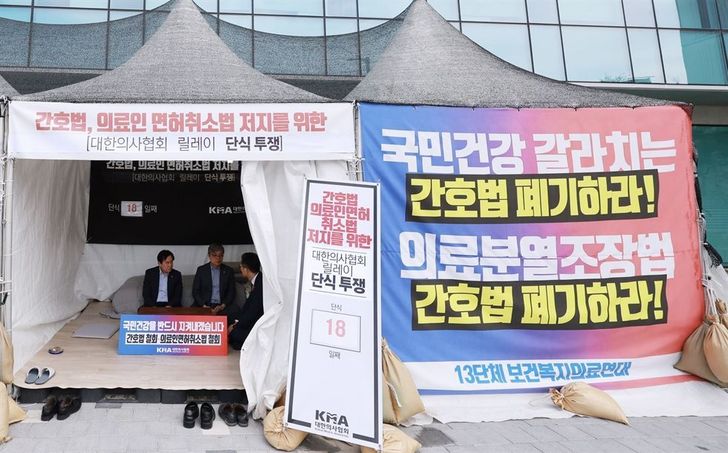
Lee Pil-soo, right, president of the Korea Medical Association (KMA), talks to heads of other doctors' organizations who join a relay hunger strike in front of the KMA building in Seoul, Sunday. Yonhap
The health ministry said it will work to arbitrate disputes in the medical community till the end so as to prevent large-scale strikes.
However, confusion seems to be inevitable. Each group has threatened to take collective action if the president does not decide in favor of their respective side.
The nurses' community sees the law as essential in redefining their jobs, claiming that ambiguities in their roles and duties as stipulated in the Medical Services Act have increased their workload.
The Korean Nurses Association said 98.4 percent of its members agreed with the need to take collective actions if President Yoon exercises his veto power against the law.
The association added that the International Council of Nurses sent a letter expressing its support for the law on behalf of all nurses' associations throughout the world.
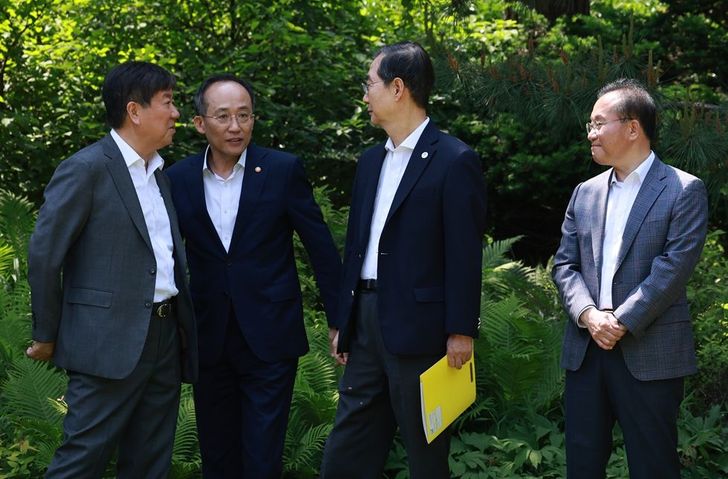
From left, presidential chief of staff Kim Dae-ki, Finance Minister Choo Kyung-ho, Prime Minister Han Duck-soo and People Power Party floor leader Rep. Yun Jae-ok hold talks ahead of a meeting between the ruling party and the government at the prime minister's official residence in Seoul, Sunday. Yonhap
On the other hand, doctors call into question the details of the law that let nurses perform their duties in “local communities,” claiming this would give them too much authority and debilitate the hierarchical cooperative system between doctors and nurses.
Other medical workers, especially nursing assistants, claimed they could suffer discrimination.
The coalition led by the KMA held partial strikes on May 3 and last Thursday. It has threatened to go on a larger strike on May 17 if the president does not veto the law.