Reporter's notebook Taming unions should not be end goal of Yoon's labor market reform

Leaders of “Refresh Workers' Council" join hands during the council's establishment ceremony in Yongsan District, Seoul, Tuesday. Yonhap
By Nam Hyun-woo
President Yoon Suk Yeol appears to be highlighting the widening generational divide in Korea's labor unions as a strategy to secure a stronger argument for his initiative to reform the country's labor-management relations.
However, calls are growing for the president to avoid exploiting the divide as a tool to tame labor unions, and instead approach it as a chance to blend diversity into Korea's labor culture.
“Labor unions' attempts to protect their vested interests are tantamount to stealing the future from the younger generation,” Yoon said during a Cabinet meeting, Tuesday.
Yoon has been criticizing Korea's “militant” labor unions and promoting his plan to overhaul the country's inflexible labor practices. He made these comments against a backdrop of a widening generation gap among unionists in recent years.
In March 2021, LG Electronics' young office workers formed their own labor union in protest of the company's largest labor union's focus on issues related to manufacturing workers only. The new union sought to represent the voices of office workers and distanced themselves from political matters. It quickly gained over 3,000 members.
This inspired a slew of young employees from other big-name companies, including Hyundai Motor, to organize their own labor unions and raise critical opinions about the political campaigns of existing unions.
This resulted in the establishment of a council of such unions on Tuesday. Named the Refresh Workers' Council. It is comprised of minor labor unions from eight companies, including LG Electronics, LG Energy Solution, Seoul Metro, Kumho Tire and Korea Gas Corp. The council now has 6,000 members. Next month, that number will increase to 8,000 when two more labor unions will join.
As the council aims to “focus on the fundamental issues of labor unions, not political slogans that conventional unions have been advocating,” criticism has mounted from existing unions.
Seoul Metro's largest union, which is under the Korean Confederation of Trade Unions (KCTU), said in a statement that “the claim that labor unions should keep their distance from politics stems from a complete misunderstanding of the history and foundation of labor unions.”
Against this backdrop, President Yoon's comments highlighting the generational divide are being interpreted as a tactic to use the younger generations' negative sentiment toward existing unions as a way to weaken the current scheme of two large umbrella unions ― the KCTU and the Federation of Korean Trade Unions ― guiding its sub-organizations to engage militant labor movements.
In a Jan. 18-25 survey by the Dong-A Ilbo, a local newspaper, and the Federation of Korean Industries, the country's largest business lobby, 84.7 percent of 600 respondents aged between 20 and 39 said they believe improvements are required for the staging of disputes by labor unions.
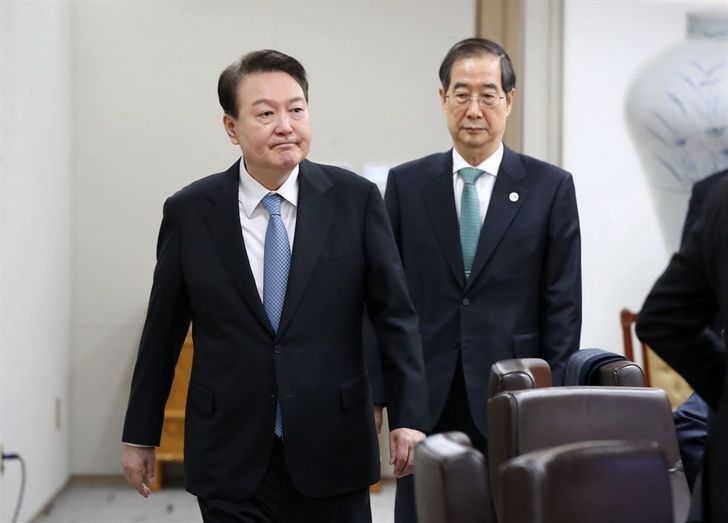
President Yoon Suk Yeol, left, and Prime Minister Han Duck-soo attend a Cabinet meeting at the presidential office in Yongsan District, Seoul, Tuesday. Joint Press Corps
However, concerns are growing that Yoon's highlighting of the generational divide may end up being a tool for weakening unions ― rather than encouraging diverse opinions ― if Yoon only focuses on suppressing unions.
A month after LG Electronics established a young office workers' union, a group of young office workers at Hyundai Motor Group ― known for its militant labor union ― also organized their own union, criticizing the company's labor negotiations as being concentrated on matters related to manufacturing workers.
However, the office workers' union lost its presence after its former head, an employee of Hyundai KEFICO, quit his job last year. He had failed to win the independent status needed to negotiate with the company. While doing so, the union suffered internal conflicts over whether to join the KCTU.
LG Electronics' office worker union is slowly improving its presence by holding a meeting with Minister of Employment and Labor Lee Jung-sik, but it is yet to hold the legal status needed to negotiate with the company.
As long as those new unions' movements just remain as critical voices to the old unions, it will end up being a feud between unions, far from cultivating a desired labor culture. Furthermore, the president may have to remember that he is criticizing and pressuring labor unions in order to reform the country's labor culture, not to tame unions under his control.