Arrest warrant sought for main opposition party chief

Ruling Democratic Party of Korea Chairman Lee Jae-myung, center, leaves a facility for senior citizens in Gwanak District, Seoul, Thursday, as prosecutors seek an arrest warrant for him. Joint Press Corps
By Nam Hyun-woo
Prosecutors on Thursday sought an arrest warrant for main opposition Democratic Party of Korea (DPK) Chairman Lee Jae-myung on charges of corruption and bribery during his tenure as the mayor of Seongnam, Gyeonggi Province from 2010 to 2018.
This is the first time in Korea that an arrest warrant has been sought for the leader of the main opposition party.
The Seoul Central District Prosecutors' Office filed the arrest warrant with the Seoul Central District Court, accusing Lee of breaching his duties, violating laws related to conflicts of interest, receiving bribes and concealing profits generated from crimes. The accusations are related to a land development scandal in Seongnam's Daejang-dong and Wirye areas and a separate bribery allegation involving the city's football club.
Specifically, prosecutors accused Lee of breach of duty by causing 489.5 billion won ($381.6 million) in financial damage to a development unit of the city government by removing an agreement on profit sharing in the Daejang-dong project, allowing the private developers to pocket huge profits.
The prosecution has also accused Lee of receiving 13.3 billion won in corporate donations from four companies to Seongnam FC football club, in exchange for administrative favors when he was the owner of the club.
“These are typical and chronic crimes stemming from collusion between the city mayor, influential regional figures and large companies,” an official at the prosecution said. “These are corrupt crimes the nature and methods of which are cunning. Given the massive amounts of illegal profits generated from the crimes, we expect heavy punishment.”
The prosecution added that it sought the arrest warrant due to suspicions that Lee could destroy evidence.
“This will remain in history as an unprecedented event,” Lee said during a DPK meeting at the National Assembly. “Today is the day that Yoon's dictatorial administration proclaimed the privatization of prosecutors and the day that the rule of law has collapsed due to the desire to eliminate political enemies.”
While denying the illegalities, Lee said, “The dictatorial regime will not be able to avoid the judgment of the people and history” and pledged to “brave the unconstitutional coercion with dignity.”
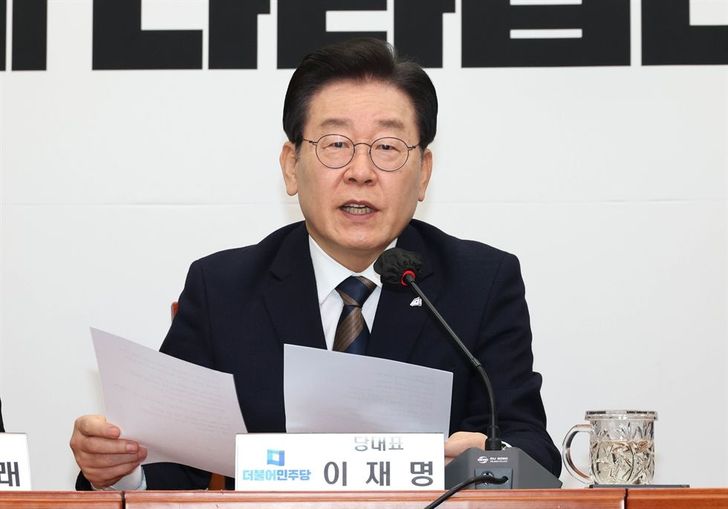
Democratic Party of Korea Chairman Lee Jae-myung reads a statement during a party meeting at the National Assembly, Thursday, as prosecutors seek an arrest warrant for him. Yonhap
Since Lee is an incumbent lawmaker who enjoys immunity from arrest, the court will soon send a document to the National Assembly seeking its consent for Lee's arrest via the prosecution and the Ministry of Justice. The Assembly will report this to its first plenary session after receiving the document, which is expected to be on Feb. 24, and will put it to a vote within 72 hours. That means the vote is anticipated to take place during the Feb. 28 plenary session.
Chances are slim for the Assembly to authorize Lee's arrest, because the DPK, which has long criticized the prosecution's investigations into its chairman as political persecution, holds 169 out of 299 registered seats at the Assembly. The arrest requires more than half of the lawmakers to take part in the session and approval by more than half of those attending.
“This is an unprecedented act of violence aimed at incapacitating the main opposition party and eliminating President Yoon Suk Yeol's political rival, rather than to find the truth behind the land development scandal,” DPK spokesperson Rep. An Ho-young said. “The war is on against Yoon's prosecutors.”
DPK floor leader Park Hong-keun also said the prosecution's move is “truly deplorable” and that it is merely “a puppet of the administration which is obsessed with eliminating the opposition party's leader.”
The DPK has yet to decide whether to set up a party guideline asking its lawmakers to reject Lee's arrest, but it anticipates that most of its lawmakers will do so.
So far, the ruling People Power Party (PPP), Justice Party and Transition Korea have expressed their intention to approve Lee's arrest. Given they each have 115, six, and one lawmakers respectively, 28 approval votes from the DPK or independent lawmakers will comprise a majority to pass Lee's arrest.