ANALYSIS Biden's 'Buy America' policy pressuring Samsung, SK in China

Seoul needs to ask Washington to extend exemption from US restrictions on transfer of advanced chip-making tools to China
By Kim Yoo-chul
The era of free-trade in the United States, still one of the most crucial commercial markets for South Korean exporters, seems to have ended because “industrial policy” has become the new rage.
Amid the continued trade dispute between the U.S. and China, President Joe Biden is now embracing a new economic theory to return the country to being a global manufacturing leader. In stressing “build more, and build it all here,” during his second State of the Union address, last week, the U.S. president specifically mentioned the passage of the CHIPS and Science Act (CHIPS Act) and the Inflation Reduction Act (IRA) as examples of his administration's drive to expand manufacturing in the U.S.
The two laws have brought in massive amount of dollars in funding for cash-intensive manufacturing projects on U.S. soil, in addition to tax breaks for made-in U.S. electric vehicles, batteries and chips. As the “Buy America” plan is more about Biden's concerted efforts for greater resilience in critical supply chains and to prevent them from any future disruptions ― as seen during the peak of the COVID-19 pandemic ― it's not a far-fetched scenario for Washington to request its key, like-minded East Asian allies including South Korea, Japan and Taiwan to delay or reduce investments in advanced technologies in China.
“Obviously, it's simply not a good thing to raise barriers for domestic companies here that have become global technology leaders, just because of the ripple effects from the conflict between the world's top two economies,” said Hwang Seong-hyeon, a senior analyst at Eugene Investment in Seoul.
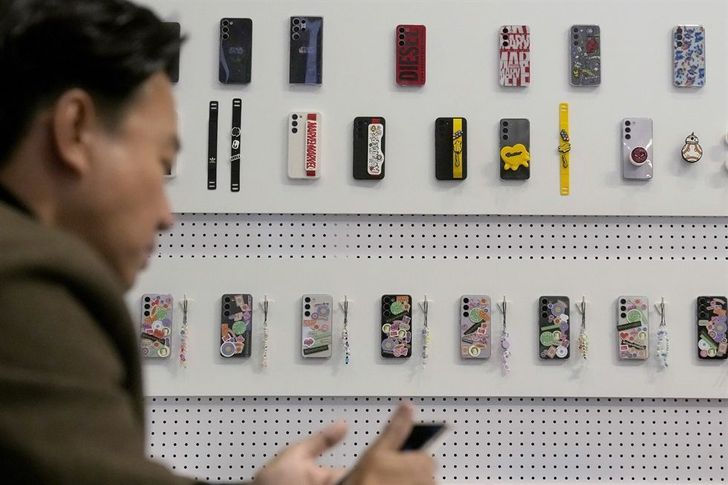
Phone cases, watch bands and accessories for Samsung Galaxy phones are displayed in San Francisco, Jan. 31. AP-Yonhap
Since the onset of the Washington-Beijing competition, the South Korean government has been pressured to write a statement on its position regarding its main ally and its largest economic partner.
As South Korea is home to the world's two largest chipmakers ― Samsung Electronics and SK hynix ― Biden's greater emphasis on growing U.S. semiconductor manufacturing as a way to bolster the American middle class is making it difficult for Seoul to maintain its “strategic equilibrium” regarding Washington and Beijing. China was South Korea's top trading partner in terms of trade volume last year.
Specifically, the U.S. thinks that Chinese companies may soon be able to manufacture more sophisticated semiconductors. Such an assessment raises national security concerns, from Washington's standpoint, because there is a high chance that Beijing will develop weaponized lasers, air-defense systems and missiles with in-house technology, if the U.S. doesn't impose restrictions on the export of semiconductor-making tools to China.
“As the early part of President Biden's speech focused on chips, it's sensible to say that Buy America rules will put semiconductors at the forefront. I would say both Samsung and SK will be asked to invest more in the U.S. But we have to keep in mind that despite the ongoing political and economic tensions between them decoupling isn't happening yet in any meaningful way in terms of the volume of U.S.-China trade,” an aide to former President Moon who handled South Korea's key trade policies said.
“The Biden administration will remain very careful when it comes to crafting the actual specifics of the Buy America plan, therefore, it's not necessary for Samsung and SK, for example, to respond to Buy America rules immediately.”
Samsung operates a large-scale memory chip plant in the Chinese city of Xi'an. This facility accounts for 42 percent of Samsung's NAND memory semiconductor production and 15 percent of global supply, according to estimates by Fitch Ratings. SK also has a plant in China's Wu'xi that accounts for 13 percent of global DRAM production, and it recently acquired all of Intel's NAND chip facilities in Dalian.
Politics not economics
Speaking to The Korea Times, executives and government officials said that as U.S. efforts to crackdown on China's technology industry have been determined by political factors, it's highly likely Washington will accelerate its moves to limit Beijing's access to critical semiconductor-manufacturing equipment.
“South Korea's trade ministry is working closely with the U.S. Commerce Department to address possible outstanding risks and issues domestic chip manufacturers may face as the U.S. has increasingly been widening the scope for implementation of new rules to stop U.S. investment in advanced technologies in China,” a government official said, requesting anonymity as he wasn't authorized to officially speak to the media.
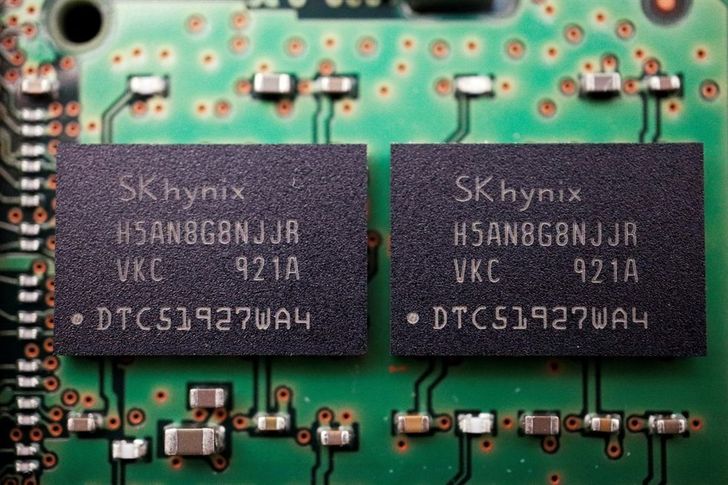
Memory chips manufactured by SK hynix are seen on a computer circuit board in this Feb. 25, 2022 file photo. Reuters-Yonhap
The CHIPS Act bars manufacturers from building advanced semiconductor factories in China for the next decade. Out of the Act's budget of $280 billion, about $53 billion has been designated to strengthen U.S.-based semiconductor manufacturing. Samsung and SK are considered as top recipients of the Act.
Representatives of Samsung said its Xi'an factory is operating normally, however, they didn't deny the possibility of the company being involved in discussions regarding supplying advanced chip-making tools or building new manufacturing facilities at the factory due to the looming geopolitical concerns.
“President Biden's Buy America plan will have a negative impact on Samsung and SK's semiconductor businesses in China. Because Japan and the Netherlands have agreed to cooperate with the U.S.' export controls for advanced chip-making tools such as extreme ultraviolet lithography (EUV) machines, both Samsung and SK will have no option but to cut production capacity at their plants in Xi'an and Wu'xi,” a senior executive at a domestic supplier of Samsung said.
The Netherlands is home to ASML, the world's only EUV supplier. Tokyo Electron is the world's largest supplier of semiconductor processing and integrated circuit equipment in terms of global market share as of 2021, according to research firms.
The executive added that both Samsung and SK will face difficulties in upgrading their manufacturing lines with more advanced semiconductor tools until the third quarter of 2023. The volume of chip-making tools exported by South Korea to China was nearly halved in 2022, year-on-year, according to data from the Korea International Trade Association.
“SK has reduced the monthly amount of water used at its Wu'xi plant this year by over 8 percent, compared to the last year,” an executive at a local supplier of the company said.
Despite the U.S.' targeting China's technology industries ― and the political furor over its decision to shoot down a Chinese “spy balloon” ― security and intelligence experts say the chances of Washington “overreaching” in its ongoing anti-Beijing campaign are low because indefinite restrictions on advanced chip technologies will inevitably hurt the competitiveness of U.S. businesses in China. All leading tech companies from Tesla to Apple and Qualcomm have sizable operations in China.
As a short-term strategy to help the best interests of South Korean semiconductor manufacturers, experts say company executives and government officials should ask Washington for an additional extension to an exemption from the restrictions on the exports of advanced chips and chip-making tools to China.
Last October, SK said the U.S. Commerce Department granted it a one-year exemption from the restrictions, allowing it to transfer tools and other necessary supplies for the manufacture of its advanced chips. Samsung and Taiwan's TSMC were thought to have received the same grace period, though Samsung officials in Seoul declined to confirm this.