Yoon's proposal for electoral system reform stirs debate

Lawmakers pass a law revision at a plenary session of the National Assembly on Yeouido, Seoul, in this Dec. 28 file photo. Yonhap
By Nam Hyun-woo
Heated debates arose at the National Assembly after President Yoon Suk-yeol floated the idea of altering Korea's electoral system to introduce multiple representatives for electoral districts.
Parties are struggling to find alignment as each lawmaker has their own interests depending on their constituencies and political stature, lowering the chances of seeing drastic changes in the upcoming 2024 general election.
“We need to consider strengthening the representative nature (of elections) by using an electoral district system with multiple representatives per constituency,” Yoon said in an interview published by Chosun Ilbo newspaper on Monday.
“Since the current single-member district election results in an all-or-nothing outcome, elections get overheated, aggravating partisan divides and conflicts between people.”
He suggested constituencies elect two to four representatives each depending on their attributes.
National Assembly Speaker Kim Jin-pyo provided momentum for Yoon's idea, saying he is planning to “fix the rules for next year's general elections no later than mid-March” and propose multiple plans to a special committee on political reforms.
Currently, Korea uses a single-member district system, in which a constituency elects a single representative. Since it is a winner-takes-all system, it embodies the risk of failing to represent those who didn't vote for the winner. Also, it has been argued that the system only strengthens the presence of the two major parties.
For example, during the general elections in 2020, the main opposition Democratic Party of Korea (DPK) garnered 49.9 percent of the total votes, but gained seats in 163 out of 253 constituencies, or 64.4 percent. The United Future Party, the predecessor of the ruling People Power Party (PPP), gained 41.5 percent of the total votes, but won only in 84 constituencies.
Hypothetically, a system allowing multiple candidates to be elected for a single constituency would allow the voices of those who voted for the No. 2 or 3 candidates to be represented. Also, candidates from minor parties have better odds of getting elected.
This, however, also has some shortcomings, because the No. 1 candidate who wins 90 percent of votes will have the same influence as the No. 2 candidate who won only 10 percent. Also, some argue that this will only promote the two-party system further, because major parties will likely forward multiple candidates to a single constituency.
During last year's June 1 local elections, Korea tested a multiple-representative system in electing municipal council members in 30 out of 1,030 constituencies. Out of 109 winners, however, 105 were from either the PPP or the DPK, and only four were from minor opposition parties.
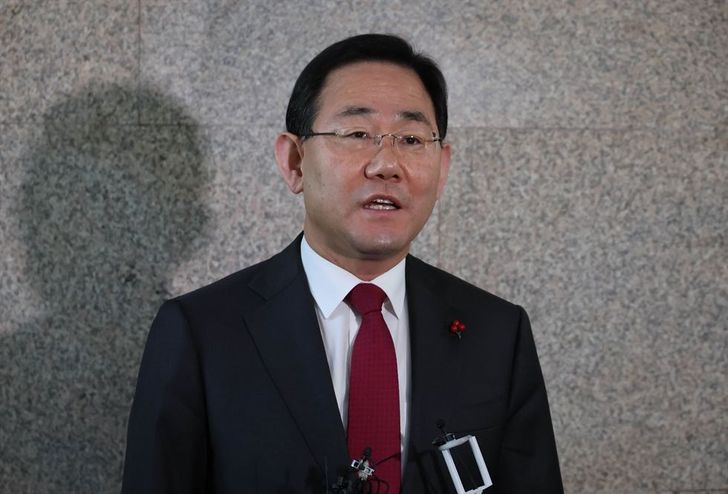
Ruling People Power Party floor leader Rep. Joo Ho-young reponds to reporters' questions at the National Assembly on Yeouido, Seoul, Wednesday. Yonhap
The two major parties are struggling to reach a consensus, as their respective members are divided over the various pros and cons of the system.
According to PPP officials, multiple PPP lawmakers are opposing the multi-representative constituency system, claiming it is more advantageous for the DPK.
“Though lawmakers are not openly opposing President Yoon's proposal, there are concerns that it will only help the DPK, because the DPK's stronghold of Gwangju and the Jeolla provinces will likely elect liberal lawmakers only,” one of the official said. “In comparison, the DPK's support rate in our home turf of Busan, Daegu and the Gyeongsang provinces is reaching some 40 percent.”
On the other hand, PPP Rep. Ha Tae-keung said in an interview with broadcaster MBC that “the feasible solution to overcome regional cronyism is a multiple-representative district system.”
The situation is similar in the DPK. DPK Rep. Cho Eung-cheon said in an interview with broadcaster BBS, “Multiple-representative districts must be introduced in Korea because they enable a multi-party system.”
On the other hand, DPK Rep. Kim Sung-whan said in a press conference, “Districts with more than one representative are more convenient for major parties to strengthen their monopoly.”
“Various opinions are raised depending on the situation of constituencies,” Ruling PPP floor leader Rep. Joo Ho-young said Wednesday. “It will be very difficult to collect opinions.”
DPK Chairman Lee Jae-myung also said Wednesday, “It is difficult to express my opinion, because we are collecting party members' thoughts.”
Against this backdrop, chances are slim that lawmakers will finish collecting their opinions on having more than one representative for constituencies for the 2024 general elections, because they have to revise the election law by April 10, a year before the election.