S. Korea, US to normalize joint military drills

Defense Minister Lee Jong-sup explains the details of the ministry's policy report to President Yoon Suk-yeol at the presidential office in Yongsan District, Seoul, Friday.
President asks defense ministry to increase soldier's salary to 2 million won
By Kwon Mee-yoo
The Ministry of National Defense has vowed to strengthen its ability to fend off North Korea's nuclear and missile threats, announcing its plan to normalize combined drills between South Korea and the United States later this year.
During the ministry's policy briefing to President Yoon Suk-yeol, Defense Minister Lee Jong-sup said South Korea will resume large-scale field training with the U.S., which have been canceled, delayed or downscaled since the North Korea―United States Singapore Summit in 2018.
"Normalization of the exercises and training will strengthen the combined defense posture of South Korea and the U.S.," the ministry said in a statement.
The summer allied training, slated for Aug. 22 through Sept. 1, will be called “Ulchi Freedom Shield” (UFS), replacing the Ulchi Freedom Guardian training, which has been discontinued since 2018 by the previous Moon Jae-in administration as a measure following former U.S. President Donald Trump's promise to Pyongyang to suspend joint South Korea-U.S. military exercises.
Both combined exercises in the first and second half of the year will accompany field maneuvers in addition to the computer simulation-based command post training that has been taking place in recent years.
South Korea also plans to establish a Counter Missile Working Group (CMWG) with the U.S.
The ministry also said it would strive to reinforce South Korea's "three-axis" defense system against the North's ever-advancing nuclear and missile threats. The system consists of the Kill Chain pre-emptive strike platform; the Korea Air and Missile Defense system and Korea Massive Punishment and Retaliation (KMPR), an operation plan targeting the North Korean leadership in case of a major conflict.
Along with these efforts, a Low Altitude Missile Defense (LAMD) system against the North's long range artillery threatening the Seoul Metropolitan area is in development. The system refers to an air defense network to intercept long-range rockets and artillery similar to Israel's "Iron Dome" system.
President Yoon has pledged to have the LAMD implemented by 2026, three years earlier than the Defense Acquisition Program Administration's original plan of 2029, and the ministry is likely to speed up.
The ministry said it would expand detection capabilities and counter-fire capabilities by deploying the LAMD early.
President Yoon also urged the ministry to make efforts to honor his campaign pledge to increase the monthly welfare stipend for conscripted soldiers up to 2 million won as well as improve the lives of soldiers in other ways.
He also emphasized education on cyber security and the implementation of artificial intelligence (AI) into the military system.
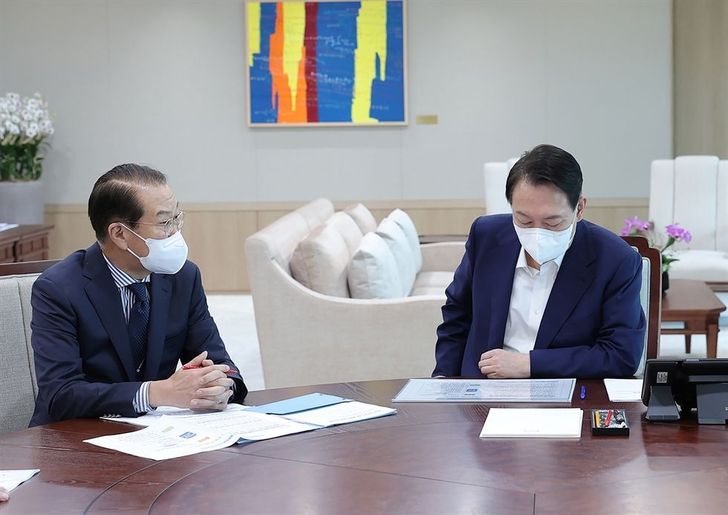
Unification Minister Kwon Young-se, left, gives a policy briefing to President Yoon Suk-yeol at the presidential office, Friday. Yonhap
Meanwhile, the Ministry of Unification vowed to bring up detailed ideas to make President Yoon's “audacious plans” for North Korea good enough for the North to accept denuclearization during its policy briefing.
Yoon also asked the ministry to establish the North Korean Human Rights Foundation.