President's motives behind 'star Cabinet ministers' remark

President Yoon Suk-yeol answers reporters' questions as he enters his office in Yongsan District, Seoul, Wednesday. Joint Press Corps
Yoon hopes eloquent Cabinet ministers can convince public with his policy visions: experts
By Nam Hyun-woo
President Yoon Suk-yeol has been stressing the importance of “star ministers” who are not shy of the media spotlight, in what appears to be an effort to give Cabinet members greater discretion and defy negative public sentiment on his administration.
According to the presidential office, Yoon said during a Cabinet meeting on Tuesday that ministers should not feel pressure about media exposure, and he would not mind even if they outshine him.
“I want ministers to be the stars of this administration,” Yoon was quoted as saying. He cited the case of late Samsung Group Chairman Lee Kun-hee, who relied on star CEOs to run his tech empire, according to the office.
On his way to work, Wednesday, Yoon reaffirmed his position about the role of a star player for a team. “Since I worked for the prosecution, I have been saying that it is important to have star prosecutors rather than making the prosecutor general famous,” he said.
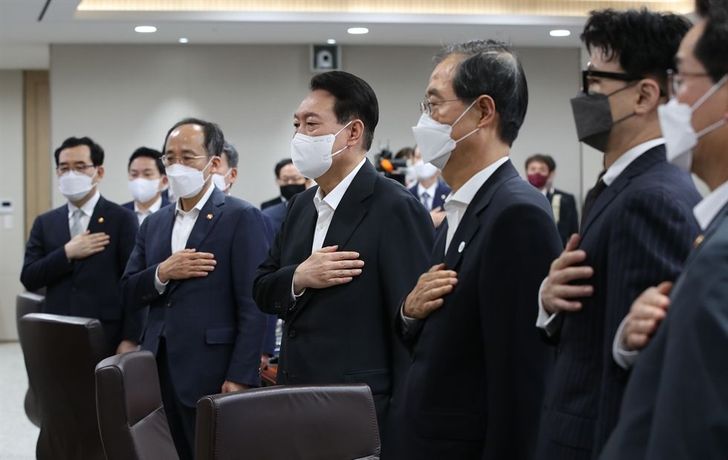
President Yoon Suk-yeol and ministers salute during a Cabinet meeting at the presidential office in Yongsan District, Seoul, Tuesday. Joint Press Corps
The remarks are interpreted as Yoon's demand that ministers should be more active in addressing public opinion about the government, and spare the president himself from receiving all the attention on every government matter.
“With the president taking questions about all issues every morning, all eyes are on Yoon,” said Cho Jin-man, a professor of international politics at Duksung Women's University.
“If the president upstages the ministries and ministers on all issues, the consequences will be unpleasant. The remarks appeared to be aimed at encouraging ministers to have greater discretion in addressing state affairs, as well as lessening pressures weighing on the president.”
As Cho said, the pressure is growing on the Yoon administration due to poor approval ratings stemming from undying controversies over the employment of presidential aides who have personal relations with Yoon, intensifying conflicts with the previous administration and worsening economic conditions.
Multiple surveys show that Yoon's approval rate has dropped below 35 percent, but his attempts to promote the government's economic measures are not gaining greater attention. Against this backdrop, the remarks are seen as Yoon's strategy to take a step back from state affairs while giving more leeway to ministers.
However, experts said the rhetoric was too rough to deliver his intention, because the remarks are giving the impression that Yoon is blaming his faltering support rate on poor promotion of government policies.
“The problem is the remarks can be interpreted as the president blaming policy promotion as the cause of all issues,” said Eom Gyeong-yeong, director of the private political think tank Zeitgeist Institute. “Not only Yoon but also many of his predecessors have been trapped in this illusion and failed to scrutinize whether their approach to state affairs is right or wrong.”
Cho also said the rhetoric of “star ministers” was equivocal, because it remains unclear whether Yoon is allowing ministers to have greater discretion or just encouraging their media appearances.
“If there are no clear signs stating ministers' enhanced authority, the remark may end up encouraging ministers' TV appearances and thus dispersing the president's responsibility,” Cho said. “You can become a star when your performance is outstanding. Promotion is not everything.”