Gov't unveils deregulation of high-tech education, electric cars, healthcare

President Yoon Suk-yeo, speaks with Prime Minister Han Duck-soo at the presidential office in Seoul, June 13. Yonhap
The government unveiled a set of deregulation measures for high-tech education, subsidies for electric cars and healthcare Monday in line with President Yoon Suk-yeol's pledge to help the private sector lead the country's economic growth.
The measures will ease 33 restrictions on university education in high-tech sectors, state subsidies on electric cars, computer software for medical equipment and others, the Office for Government Policy Coordination said in a statement.
Under the measures, the government will allow universities to increase their quota for graduate students in four high-tech sectors, including artificial intelligence and big data, if they meet a requirement for the number of professors.
Currently, universities can increase their quota for graduate students only if they meet four requirements, including the number of professors, school sites and basic assets for profits.
Also, the central government will allow local governments to provide state subsidies to companies if they seek to buy electric cars in an area where there is no dealership selling such vehicles.
So far, companies have received state subsidies for electric cars if they buy such vehicles from a dealership in their area.
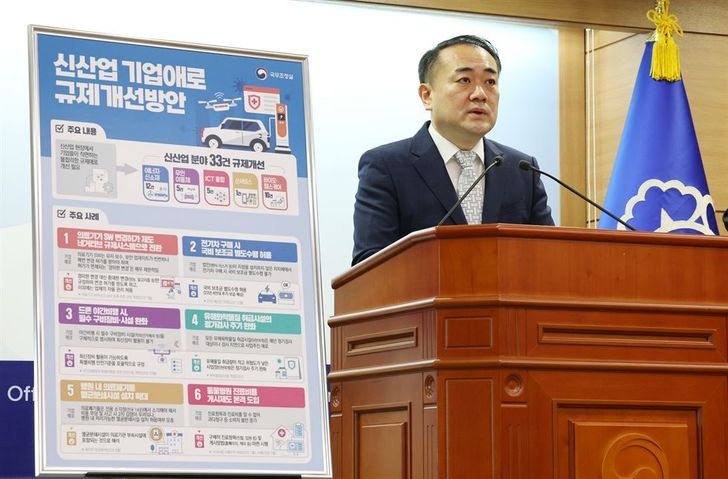
An official of the Office for Government Policy Coordination speaks during a briefing at the government complex in Sejong, June 13. Yonhap
The government will also abolish a so-called negative list system, under which everything not forbidden is allowed, for computer software used in medical equipment, according to the statement.
Later this week, the government plans to roll out the blue print for economic policies, with a focus on revitalizing the private sector and seeking deregulation.
Yoon has pledged to pursue small government in a bid to help the private sector take the initiative in creating jobs and spurring economic growth. (Yonhap)