Freedom of assembly: Not in my president's backyard

Former President Moon Jae-in gestures while conversing with two unidentified men at his house in Yangsan, South Gyeongsang Province, May 11. Yonhap
Opposition lawmakers shift stance, seek to ban protests near Moon's house
By Jung Min-ho
When protesters screamed near the house of former President Lee Myung-bak for months about five years ago, calling on authorities to arrest him immediately, most lawmakers from the Democratic Party of Korea (DPK) remained silent or even encouraged such rallies.
Their aggressive voices and mockery ― with some calling Lee a rat ― began to subside only when it looked certain that he would be arrested on charges of bribery and abuse of power less than a year after President Moon Jae-in took office with a promise to “restore justice.”
About a month after Moon's term ended last month, DPK lawmakers are now seeking to ban such rallies citing “privacy concerns” when the former leader himself became a target of critics claiming to be the victims of his policies, including the families of people who died or suffered from severe side effects of COVID-19 vaccines.
A bill proposed jointly by several DPK lawmakers will, if passed, prohibit protests within 100 meters of former presidents' houses. At present, the law would apply to Moon and ex-President Park Geun-hye, who was recently pardoned after spending five years in prison for abuse of power among other offenses. Lee is still in prison.
The legislative move comes shortly after Moon filed a complaint with the police last week against four alleged leaders of protests near his home in Yangsan, South Gyeongsang Province. In a May 15 statement, he complained about their “noises, cursing and anti-intellectualism” that “breaks the peace” in his town.
Moreover, DPK lawmakers called on Han Sang-chul, the town's police chief, to “sternly respond” to the protesters. Apparently pressured by the DPK, Han, who has the authority to prohibit rallies under certain circumstances, told the protesters that their plan to stage a demonstration on June 1 would not be permitted.
“When we asked DPK lawmakers to make a special law for people who have suffered severe vaccine side effects, they never responded … Now, they are trying to make a law to protect one person, Moon,” Kim Doo-kyung, a representative of the families of “vaccine side effect victims” told The Korea Times Tuesday. “His people have described the protesters as being a violent mob. The truth is that there are far more police and security guards who are protecting him from dozens of protesters.”
Kim said the group will not stop holding its weekly rally near Moon's home and, if Han continues to abuse his power to block them, they will bring the case to a court of law.
“We trusted Moon when he said he would take responsibility for the vaccines' possible side effects. As a result, we lost our family members … Moon's daughter, Da-hye, said she would protect her father from protesters. I hope she realizes that we no longer have family members to protect,” he said.
The protesters who frequently appear in Yangsan include a diverse group people, and some indeed cause disturbance in the neighborhood by, for example, shouting expletives through a loudspeaker. But so far, no one has been arrested or officially investigated for violence.
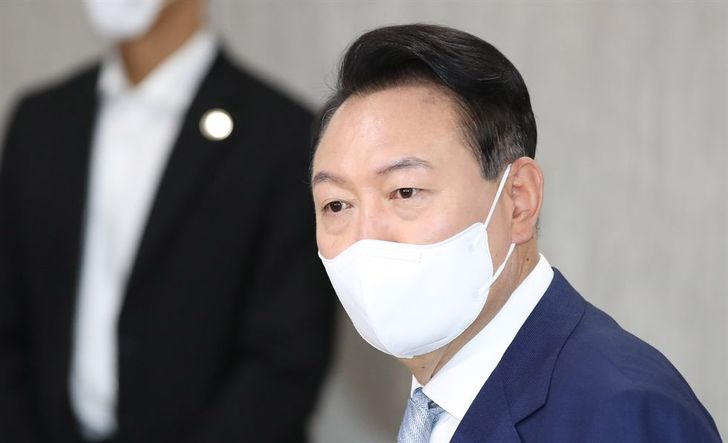
President Yoon Suk-yeol speaks to reporters as he enters his office in Seoul, Tuesday. Yonhap
Yoon shrugs off demand for special protection
Following demands by some lawmakers for measures to protect Moon, President Yoon Suk-yeol made it clear that he has no intention of taking such steps.
Asked about his view on the protests near Moon's house, Yoon said such demonstrations have been ― and will be ― allowed even near the presidential office as long as protesters do not violate the assembly and demonstration law.
An official at the presidential office told reporters later that the president was referring to the principle that everyone is equal under the law
“Freedom of assembly is one of the basic rights in a democratic society,” the official said. “The right cannot be suppressed and people can hold rallies as long as they do so within the law.”
Those comments signify a possible challenge to DPK lawmakers who are drafting a bill to ban rallies near the homes of former presidents. Even if the DPK passes the bill at the National Assembly where it holds a majority, it can be vetoed by the president.
Rep. Cho O-sup, a DPK spokesman, accused the presidential office of turning a blind eye to the suffering of Moon and his neighbors, calling Yoon “extremely narrow-minded.”
“Yoon's perception is very problematic. It is tantamount to giving a bad signal to the police who should stop curse-filled protests,” Cho said. “The protests near (Moon's) Yangsan house are a terrorist act that is destructive and violent … We urge Yoon to take necessary measures to sternly respond to them. If not, we warn that he will be held responsible for the protests.”