Rival parties make last-ditch appeals for support on eve of local elections

A voter casts a ballot at a polling station in Terminal 1 of Incheon International Airport, May 27, the first day of two days of early voting in the June 1 local elections and National Assembly by-elections. (Yonhap)
Rival political parties made last-ditch efforts Tuesday to woo undecided voters on the eve of nationwide local elections amid expectations the results will boost or weaken the mandate of the new government of President Yoon Suk-yeol.
Up for grabs in Wednesday's elections are posts for 17 metropolitan mayors and provincial governors, 226 lower-level council heads, as well as 779 seats in provincial and metropolitan councils, and 2,602 in lower-level local councils.
Also at stake will be seven National Assembly seats in by-elections.
Surveys have shown the ruling People Power Party (PPP) is expected to win at least nine out of the 17 key races for big city mayors and provincial governors, including Seoul and Incheon, while the main opposition Democratic Party of Korea (DPK) is expected to win at least four races, including three on its home turf ― the Jeolla provinces.
The other four races are considered neck and neck, including the contest for Gyeonggi Province governor.
On the final day of the campaign period, the PPP appealed for support in regions ranging from the southern resort island of Jeju to Gyeonggi, while the DPK spent the final day focusing on campaigning in Seoul and the country's central Chungcheong Province.
The elections come less than a month after Yoon took office.
The PPP hopes it can extend the momentum of the presidential election victory.
"If the presidential election was the first half of the government change, the local elections are the second half of the government change," PPP floor leader Kweon Seong-dong said at a party meeting. "We should remember that we won the presidential election by just 0.7 of a percentage point. We cannot be complacent."
The DPK has been appealing for support, saying it needs enough power to keep the new government in check.
"Heeding the people's order, which has called for self-reflection and reform, we have found our way to reform," DPK co-interim chief Park Ji-hyun said. "We cannot give up local governments to those armed with lies, incompetence and blunt remarks."
While hoping for a complete sweep on its traditional home ground, Gyeongsang Province in the country's southeastern area, the PPP is also looking to win in key battleground provinces, such as the Chungcheong provinces and Gyeonggi Province.
It also hopes to win at least four of the seven National Assembly seats in the by-elections.
The DPK, which scored a resounding victory four years ago by grabbing 14 of the 17 gubernatorial and mayor posts in the 2018 local elections, is believed to be leading only on its home turf and Jeju.
However, the liberal party claims it can turn the tables in regions such as Chungcheong, Gyeonggi and Gangwon provinces.
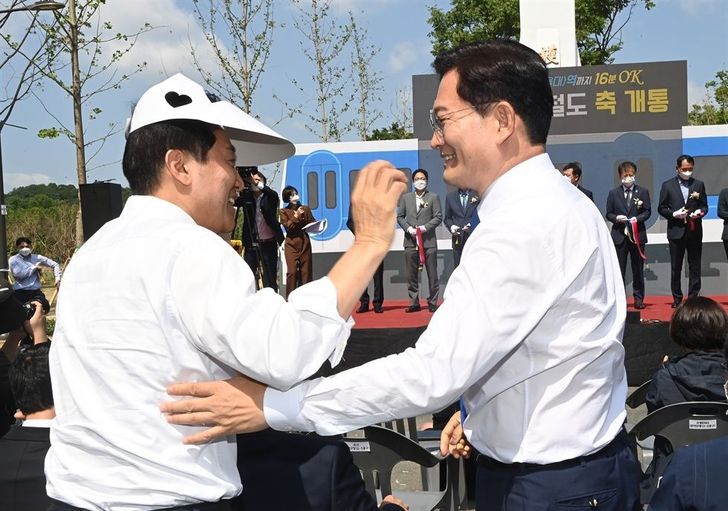
Oh Se-hoon, left, the ruling People Power Party candidate for Seoul Mayor, speaks with Song Young-gil, the main opposition Democratic Party of Korea candidate at Boramae Park in Seoul, May 27.
Of the many battlegrounds, both parties view the capital area as the most important, as half of the country's population resides there.
In particular, the Seoul mayor and Gyeonggi governor elections have been traditionally regarded as key races, since the winners often become political heavyweights and take a shot at the country's presidency later.
The Seoul mayoral election has been mainly a two-horse race between current Mayor Oh Se-hoon and former DPK Chair Song Young-gil. Recent polls showed Oh, who is running for a fourth term on the PPP ticket, leading Song by a wide margin.
The race for Gyeonggi governor has been largely between former lawmaker Kim Eun-hye of the PPP and former Finance Minister Kim Dong-yeon of the DPK. Recent polls showed the two were running neck and neck.
When it comes to the parliamentary by-elections, all eyes are on former presidential candidates Lee Jae-myung and Ahn Cheol-soo.
Ahn, who withdrew from the presidential race to endorse Yoon, is chasing the seat representing the Bundang-A district of Seongnam, just south of Seoul, as the PPP candidate.
Lee, who lost to Yoon in the March 9 presidential election only by a razor-thin 0.73 percentage-point gap, is hoping to win the seat in the Gyeyang-B district in Incheon, 40 kilometers west of Seoul, as the DPK candidate.
In the run-up to Wednesday's local elections, a proposal to relocate Seoul's Gimpo International Airport has emerged as a hot button issue recently.
The issue came to the fore after the DPK's Song and Lee jointly proposed a plan to “move” Gimpo airport into Incheon International Airport and develop the western part of the capital area for housing and businesses.
The PPP has been denouncing the proposal, saying it is unfeasible and will negatively impact the tourist influx to the southern resort island of Jeju, considering that Gimpo airport is the main gateway to Jeju.
Both sides are also gauging the impact of the extra budget that was passed Sunday to support pandemic-hit small businesses.
In the case of the DPK, the party is hoping it can overcome a recent internal feud, which was sparked by the DPK co-interim chief Park's call for a sweeping reform of the party, and a sexual misconduct case involving one of its lawmakers. (Yonhap)