Candidates cause stir with vow to 'relocate' Gimpo airport

Lee Jae-myung, second from right, running in Incheon's Gyeyang District B by-election on the main opposition Democratic Party of Korea's ticket, announces his campaign pledge to spur development in the region west of Seoul, Friday. Second from left is DPK Seoul mayoral candidate Song Young-gil, who teamed up with Lee on the pledge. Yonhap
By Kwon Mee-yoo
Gimpo International Airport, the only commercial airport in Seoul, is becoming a heated issue in the June 1 local elections as Lee Jae-myung, the main opposition liberal Democratic Party of Korea (DPK) candidate running in a by-election for Incheon's Gyeyang District B, has pledged to “relocate” the airport in order to lift development restrictions for the region west of Seoul.
Originally built as a military airport in the 1930s during the Japanese colonial period, Gimpo International Airport served as Korea's main air gateway until Incheon International Airport opened in 2001.
Currently, the airport is mainly used for domestic flights and some short- and medium-distance international flights due to its proximity to Seoul. International flights have been suspended for over two years because of the COVID-19 pandemic, but will resume next month.
Lee, who ran in the March 9 presidential election and lost by a narrow margin, pledged to close Gimpo International Airport and move its operations to other airports, as it currently affects the height restrictions on buildings in the Incheon area and other regions bordering the airport.
Lee insisted that Incheon International Airport can absorb the flights taking off and landing at Gimpo and that Gyeyang District should be developed along with the western part of Seoul as well as neighboring Gimpo City of Gyeonggi Province, which are underdeveloped compared to other parts of the Seoul metropolitan area.
Lee's plan also includes express trains for the capital region connecting Seoul and Incheon International Airport, which is about 50 kilometers away from the capital, faster.
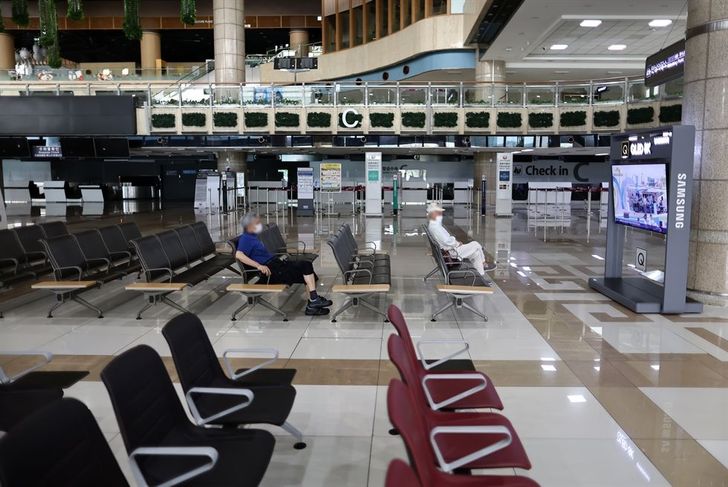
Gimpo International Airport's international terminal is nearly empty, Sunday, as the airport plans to resume international flights in June after two years of suspension due to the COVID-19 pandemic. Yonhap
About 70 percent of Gimpo's domestic flights are between Seoul and Jeju Island, Korea's favorite domestic holiday destination, which complicates the issue far beyond the Seoul metropolitan area.
Song Young-gil, the former DPK chairman and Seoul mayoral candidate, teamed up with Lee to promote the plan for Gimpo International Airport, suggesting making a new connection to Jeju Island by the KTX bullet train by digging an undersea tunnel.
"This is the time to imagine the future of Seoul from a long-term perspective. Pledges for relocating Olympic-daero and Gangbyeonbuk-ro expressways underground, to link the mainland and Jeju Island via KTX and to develop the western areas near Gimpo International Airport for future strategic industries are part of the big plan," Song wrote on Facebook, Saturday.
Song also said regional airports could cover the needs of Gimpo International Airport ― such as Cheongju International Airport, for those living in the southern Seoul metropolitan area and Wonju International Airport for those east of the Seoul metropolitan area.
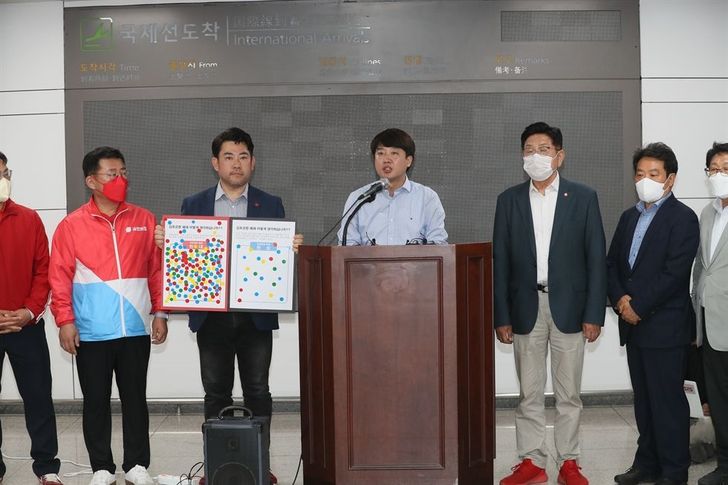
The ruling People Power Party (PPP) leader Lee Jun-seok, center, speaks during a press conference condemning the Democratic Party of Korea's Incheon lawmaker candidate Lee Jae-myung's pledge to close Gimpo International Airport at Jeju International Airport, Friday. Yonhap
The ruling People Power Party (PPP) immediately blasted Lee and Song as “reckless and ignorant.”
Seoul Mayor Oh Se-hoon, who is running for reelection on the PPP ticket, accused Lee and Song of making grand pledges purely to win votes.
PPP leader Lee Jun-seok flew down to Jeju Island to criticize Lee Jae-myung and Song's pledges. He claimed that closing down Gimpo Airport would kill domestic tourism on Jeju Island and blamed the DPK candidates for playing with the livelihoods of Jeju islanders by making extravagant pledges for Seoul and Incheon citizens.
Oh Young-hun, the Jeju provincial governor candidate from the DPK, tried to distance himself from Lee and Song's pledges while criticizing the PPP for dividing the public.
"The future and autonomy of Jeju is not in the hands of President Yoon Suk-yeol nor PPP chief Lee Jun-seok's short post aggravating national division," Oh said during a press conference, Saturday.