PM nominee grilled over alleged conflict of interest

Prime Minister nominee Han Duck-soo gestures during his confirmation hearing at the National Assembly in Yeouido, Seoul, Monday. Joint Press Corps
Opposition party defends Han claiming he possesses experience, expertise
By Nam Hyun-woo
Rival parties clashed over Prime Minister nominee Han Duck-soo's qualifications during a confirmation hearing on Monday. The ruling Democratic Party of Korea (DPK) took issue with Han's wealth which increased in size over the past 10 years after he last served in a government position, while the main opposition People Power Party (PPP) defended him, claiming he is more qualified than any other prime minister of the current Moon Jae-in administration.
During the first leg of a two-day National Assembly confirmation hearing on Han, Monday, DPK Rep. Kim Eui-kyeom slammed the nominee's stints at Kim & Chang, saying Han alternated between jobs at one of the biggest law firms in Korea and the government like going through “a revolving door.”
“There have been no precedents and there won't be,” Kim said. “While working at the law firm, Han received 2 billion won ($1.58 million) in salary, but made almost no donations.”
Han served as senior presidential secretary for economic affairs in 2001 and moved to Kim & Chang as an advisor the next year, collecting 150 million won in salary for working eight months. He returned to the government to serve as the policy coordination minister, finance minister, prime minister and ambassador to the U.S. From 2017 to 2021. He then went back to Kim & Chang to work as an advisor and received a salary of 1.8 billion won.
DPK Rep. Nam In-soon also said Han's overall wealth increased by 4.3 billion won after he left public positions, including the salary from Kim & Chang, but there are no clear documents or data proving Han's work at the law firm.
“If you received more than 2 billion won in salary, you should be able to state what your work was,” Nam said. “He made seven overseas trips while working for Kim & Chang, and he first said he cannot reveal the details citing confidentiality, and then he suddenly changed his statement by saying that six of them were just personal visits.”
Han explained that his work at the law firm was “explaining Korea's economic condition and drawing foreign investment” and that they are “not different from my work as a diplomat.”
“The work I did for Kim & Chang does not contradict my duties as a public official,” Han said. “There has never been an instance where my work (at Kim & Chang) was related to a particular case, and I never asked public officials for favors. … The work of explaining Korea's economic condition and outlook is a very difficult job.”
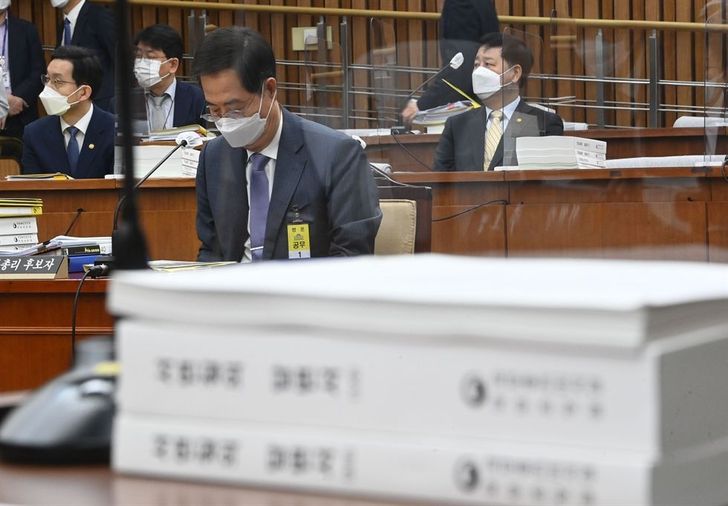
Prime Minister nominee Han Duck-soo looks down during his confirmation hearing at the National Assembly in Yeouido, Seoul, Monday. Joint Press Corps
Throughout the hearing, the DPK and the minor liberal Justice Party accused Han of neglecting requests for documents related to their suspicions, including his wife's controversial sale of her paintings.
“Though Han did not offer a clear explanation, it was reported that his wife, an amateur artist, has sold about 10 paintings and earned 100 million won,” DPK Rep. Shin Dong-kun said. “Although we asked him five times to provide documents related to this, Han refused to elaborate who purchased the paintings and how much they paid, citing privacy.”
Shin claimed that Han's wife, Choi A-young, sold her painting to Hyosung Group for 16 million won in 2012, and the price was overvalued compared to the prices of artworks created by artists who have more illustrious careers.
“This is preposterous,” Shin said. “I will call this the Han Duck-soo premium. If there is no problem related to the sale, Han should reveal who purchased the paintings.”
Han refuted that his wife is “almost a professional artist” and that she did not hold any exhibitions while he served as a public official, in order to avoid controversy.
DPK Rep. Kim Hoi-Jae criticized Han for earning 620 million won from 1989 to 1999 by renting a home in Jongno District to foreign firms, saying the rent was overvalued and that Han is refusing to reveal details of the income.
“If Han agrees, we can confirm whether it was appropriate or not by simply clicking the National Tax Service's (NTS) website, but Han is refusing to cooperate,” Kim said.
Han refuted by saying that the NTS' principle is to provide a nominee's tax data only for the past five years.
Meanwhile, PPP lawmakers defended Han, saying he is a qualified nominee.
“The current Moon Jae-in administration has set seven standards in nominating public officials, and Han meets every standard including military service, tax records and others,” PPP Rep. Kim Mi-ae said.
“He accumulated expertise and experience in the economy, diplomacy and trade for the past 40 years, and has a high understanding of state affairs. Given this, it is difficult to assume that he served at Kim & Chang only for his personal gain.”
PPP Rep. Jun Joo-hyae also said former prime ministers of the Moon administration won Assembly approval despite admitting to their shortcoming to the standards. Jun said Han is a worthy candidate compared to them.
Before the hearing began, Han said he believes the most urgent task is to stabilize the livelihood of the public and pledged to use every possible policy tool to accomplish this.
Unlike Cabinet ministers, a prime minister nominee must get approval from the National Assembly to take the helm. Half of all lawmakers must be present at the confirmation hearing and half of the attendees must vote for the candidate.