Judges question chief justice over cronyism allegations
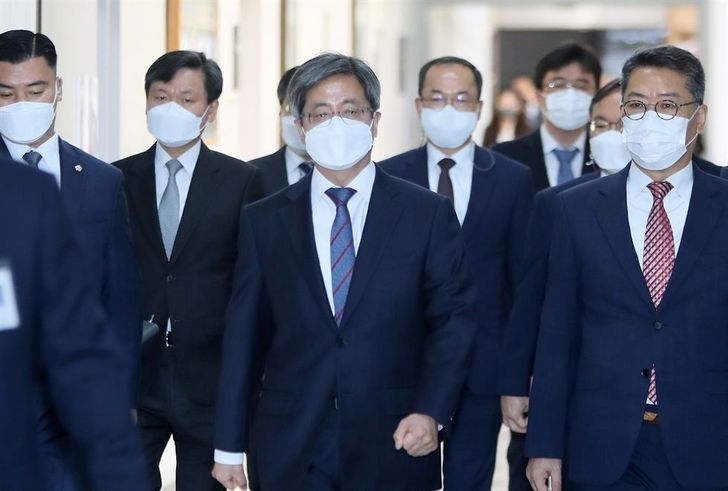
Supreme Court Chief Justice Kim Myeong-su, center in blue tie, walks in to attend a regular meeting of the National Council of Representative Judges at the Judicial Research and Training Center in Goyang, Gyeonggi Province, Monday. Yonhap
By Lee Hae-rin
Supreme Court Chief Justice Kim Myeong-su is facing cronyism allegations, for favoring his close associates in personnel affairs of the judiciary.
A group of delegate judicial officers across the country, the name of which would translate into English as the National Council of Representative Judges, submitted an official letter to the National Court Administration of the Supreme Court requesting an explanation for Kim's alleged bias in hiring. The top court responded by saying it does not see any problems.
The court administration told the judges in a written reply that “Kim's personnel matters follow former practices and pose no particular problem.”
However, the administration's response failed to convince judges and could lead to additional questioning and debates at the council's regular meeting, held at the Judicial Research and Training Center in Goyang, Gyeonggi Province, Monday.
Previously, the council had submitted a questionnaire about the cronyism allegations against Kim to the court administration.
According to the judges, several of Kim's close associates, especially those who are from the same research association as Kim, have received special benefits, including serving one year more than the common practice of two years as chief justice and being appointed to courts in Seoul after serving in regional courts outside the capital.
Also, the judges demanded Kim's explanation for nominating Jeong Hyo-chae as the chief justice of Incheon District Court without a recommendation, which is against the judiciary official management policy Kim introduced last year.
Kim's personnel practices have led to criticisms among judges for leading to political bias in the legislative branch.
The National Council of Representative Judges was established in 2017 in response to a corruption scandal involving then-Chief Justice Yang Seung-tae. Delegates are elected by judges across the country.
Chief Justice Kim was the council's first president and it is the first time for the council to raise a complaint against him.
Meanwhile, the current administration has faced criticisms for biased hiring in the judicial and administrative branches, favoring officials from a progressive research group and lawyers' association.
For example, three key figures of the judicial administrative branches, including Supreme Court Chief Justice Kim Myeong-su, National Election Committee Chairperson Noh Jeong-hee and Constitutional Court President Yoo Nam-seok, are all from the research group, while the members of this group and association account for 2 percent to 10 percent of over 3,000 judges in the country.
A total 117 out of 123 representative judges will attend today's conference online or in person.
Chief Justice Kim attended the meeting this morning and said in his greeting speech, “I ask of you to be the driving force to establish judges' independence by staying vigilant to many deterrent factors against it and seeking means of improvement.”
Kim did not answer the judges' questions on the cronyism allegations, and an official from the court administration in charge of the questioning is likely to respond instead.