Two schools of thought inside transition team about gender equality ministry

Ahn Cheol-soo, right, chairman of the Presidential Transition Committee, speaks during a meeting with reporters at the Korea Banking Institute building in Seoul, Friday. Yonhap
643 women's groups issue statement urging transition committee to save ministry
By Kang Hyun-kyung
There seem to be two schools of thought inside President-elect Yoon Suk-yeol's Presidential Transition Committee regarding the Ministry of Gender Equality and Family.
On the one hand, Yoon is a hardliner who thinks the ministry has already fulfilled its commitment over the past two decades, since its creation in the early 2000s, and that there is no need to prolong its life with public funds in his administration.
On the other, there is a group of moderates who are calling for the slowdown of Yoon's drive to abolish the ministry, warning that pushing ahead with the controversial plan against the will of many others, including many women's and civic groups, will only backfire and hold back the new government's policy initiatives.
Ahn Cheol-soo, the chairman of the transition team, seems to be one of the moderates calling for an approach that “sufficiently reflects the opinions of women's groups.”
He told reporters on Friday that the team will prepare several different possible policy directions for the gender equality and family ministry, and that afterwards, President-elect Yoon can choose among them.
When asked if the ministry will be abolished as Yoon pledged during the presidential election period, Ahn said there are several different ways to implement Yoon's campaign pledges.
“The president-elect will choose the option that he thinks is the best,” he said at the Korea Banking Institute building in Tongeui-dong, Seoul.
Ahn said that members of the transition team are willing to sit down with women's groups and try to incorporate their opinions about the ministry in the policy recommendations for Yoon.
Transition committee spokesperson Shin Yong-hyun clarified what Ahn said about several different policy options, noting the ministry will disappear into history.
“That being said, there will no longer be a state agency called the Ministry of Gender Equality and Family in the new government. So the question will be which ministries will take over gender equality affairs: will they be realigned into several different ministries or will there be another ministry or agency to be created to replace the gender equality ministry or incorporate its functions along with other related ones,” she said during a regular press briefing. “Members of the transition team will discuss this, find solutions and come up with several different options in recommending policies to the President-elect.”
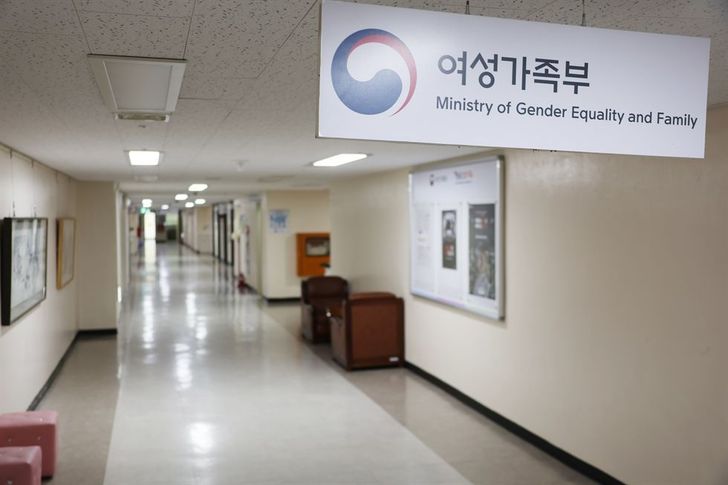
An inside view of the Ministry of Gender Equality and Family / Yonhap
The uncertain fate of the gender equality ministry was discussed again as transition team received policy briefings from the ministry on Friday.
Activists from 643 women's groups, including Korea Women's Association United, released a joint statement urging the presidential transition team to withdraw Yoon's campaign pledge to abolish the ministry.
In the statement, they said that gender equality in Korea has a long way to go, citing the how the country ranks 102nd out of 156 countries in gender equality (2021), and where the gender wage gap is 31.5%, the worst in the OECD (2020).
“Still many women are exposed to sexual violence and the employment of women is lower than that of men in the workplace,” it read. The statement said that the nation needs the gender equality and family ministry because there are structural obstacles impeding the realization of gender equality ― such as gender discrimination in various parts of society ― which the ministry needs to remove.
Ahn has been more flexible about the fate of the gender equality ministry than Yoon.
During a press conference on March 14 at the National Assembly, he made similar remarks about Yoon's pledges and the transition team's role. About the gender equality and family ministry, he said that there are some campaign pledges that may need to be scrapped.
As seen in previous administrations, he explained, some campaign pledges were in the end not adopted as actual policies. “For example, about 50 percent of campaign pledges were adopted into actual policies during the Lee Myung-bak and Park Geun-hye governments. The rate for the Roh Moo-hyun government was some 60 percent,” he said.
Ahn noted that the role of the transition committee is to screen the feasibility of campaign pledges, noting that Moon Jae-in had to start his presidency right after winning the election, without a transition committee, so most of his campaign pledges became the main state policies, leading to many side effects.
President-elect Yoon, however, has been clear about his position on the gender equality and family ministry.
When asked if he would abolish it as he announced, he told reporters on Thursday, “Sure. You know that's my campaign pledge.”
Yoon said he's not the type of person who promises something to get elected. “Do you think that I am the person who lies to voters during the election?” he shot back at reporters, showing that there has been no change in his position on the issue.